英语 版本
文学
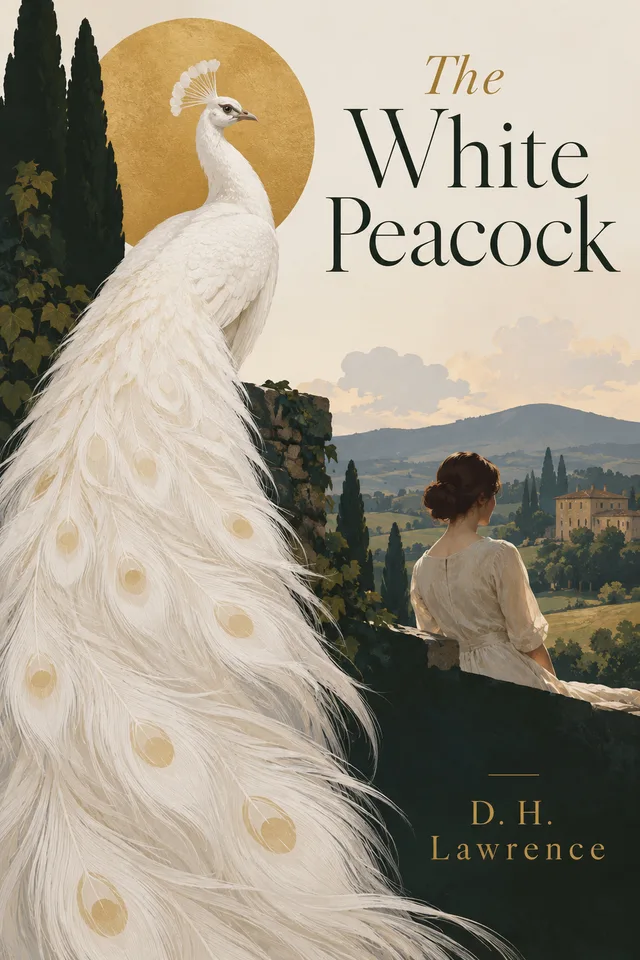
The White Peacock
英语 BooksWhale 版本 · D. H. Lawrence
A rural English drama of desire, class, marriage, and the emotional tensions beneath a changing social order.
- 预览
- 文本节选
- 格式
- 在线阅读, EPUB, PDF
- 访问
- Library 获取
图书简介
The White Peacock
Set in the English countryside, The White Peacock traces friendships and romantic attachments across class boundaries. D. H. Lawrence brings close attention to landscape and rural life into a story of competing desires and troubled marriages. Nature, work, money and jealousy shape the characters’ choices, revealing how social expectations can redirect their hopes and leave lasting emotional consequences.
BooksWhale 版本
此版本如何整理
此版本基于公版文本,并由 BooksWhale 整理为适合数字阅读的版本。
公版依据
为什么此版本可以分享
D. H. Lawrence died in 1930, and The White Peacock was first published in English in 1911.
阅读预览
文本节选
预览选自整理后的阅读文本。
预览章节Full text阅读预览
The White Peacock
D. H. Lawrence
预览章节PART I — CHAPTER I THE PEOPLE OF NETHERMERE预览
I stood watching the shadowy fish slide through the gloom of the mill-pond. They were grey, descendants of the silvery things that had darted away from the monks, in the young days when the valley was lusty. The whole place was gathered in the musing of old age. The thick-piled trees on the far shore were too dark and sober to dally with the sun; the weeds stood crowded and motionless. Not even a little wind flickered the willows of the islets. The water lay softly, intensely still. Only the thin stream falling through the mill-race murmured to itself of the tumult of life which had once quickened the valley.
I was almost startled into the water from my perch on the alder roots by a voice saying:
“Well, what is there to look at?” My friend was a young farmer, stoutly built, brown eyed, with a naturally fair skin burned dark and freckled in patches. He laughed, seeing me start, and looked down at me with lazy curiosity.
“I was thinking the place seemed old, brooding over its past.”
He looked at me with a lazy indulgent smile, and lay down on his back on the bank, saying: “It’s all right for a doss—here.”
“Your life is nothing else but a doss. I shall laugh when somebody jerks you awake,” I replied.
He smiled comfortably and put his hands over his eyes because of the light.
“Why shall you laugh?” he drawled.
“Because you’ll be amusing,” said I.
We were silent for a long time, when he rolled over and began to poke with his finger in the bank.
“I thought,” he said in his leisurely fashion, “there was some cause for all this buzzing.”
I looked, and saw that he had poked out an old, papery nest of those pretty field bees which seem to have dipped their tails into bright amber dust. Some agitated insects ran round the cluster of eggs, most of which were empty now, the crowns gone; a few young bees staggered about in uncertain flight before they could gather power to wing away in a strong course. He watched the little ones that ran in and out among the shadows of the grass, hither and thither in consternation.
“Come here—come here!” he said, imprisoning one poor little bee under a grass stalk, while with another stalk he loosened the folded blue wings.
“Don’t tease the little beggar,” I said.
“It doesn’t hurt him—I wanted to see if it was because he couldn’t spread his wings that he couldn’t fly. There he goes—no, he doesn’t. Let’s try another.”
“Leave them alone,” said I. “Let them run in the sun. They’re only just out of the shells. Don’t torment them into flight.”
He persisted, however, and broke the wing of the next.
“Oh, dear—pity!” said he, and he crushed the little thing between his fingers. Then he examined the eggs, and pulled out some silk from round the dead larva, and investigated it all in a desultory manner, asking of me all I knew about the insects. When he had finished he flung the clustered eggs into the water and rose, pulling out his watch from the depth of his breeches’ pocket.
“I thought it was about dinner-time,” said he, smiling at me. “I always know when it’s about twelve. Are you coming in?”
“I’m coming down at any rate,” said I as we passed along the pond bank, and over the plank-bridge that crossed the brow of the falling sluice. The bankside where the grey orchard twisted its trees, was a steep declivity, long and sharp, dropping down to the garden.
The stones of the large house were burdened with ivy and honey-suckle, and the great lilac-bush that had once guarded the porch now almost blocked the doorway. We passed out of the front garden into the farm-yard, and walked along the brick path to the back door.
预览章节CHAPTER II DANGLING THE APPLE预览
The long-drawn booming of the wind in the wood and the sobbing and moaning in the maples and oaks near the house, had made Lettie restless. She did not want to go anywhere, she did not want to do anything, so she insisted on my just going out with her as far as the edge of the water. We crossed the tangle of fern and bracken, bramble and wild raspberry canes that spread in the open space before the house, and we went down the grassy slope to the edge of Nethermere. The wind whipped up noisy little wavelets, and the cluck and clatter of these among the pebbles, the swish of the rushes and the freshening of the breeze against our faces, roused us.
The tall meadow-sweet was in bud along the tiny beach and we walked knee-deep among it, watching the foamy race of the ripples and the whitening of the willows on the far shore. At the place where Nethermere narrows to the upper end, and receives the brook from Strelley, the wood sweeps down and stands with its feet washed round with waters. We broke our way along the shore, crushing the sharp-scented wild mint, whose odour checks the breath, and examining here and there among the marshy places ragged nests of water-fowl, now deserted. Some slim young lap-wings started at our approach, and sped lightly from us, their necks outstretched in straining fear of that which could not hurt them. One, two, fled cheeping into cover of the wood; almost instantly they coursed back again to where we stood, to dart off from us at an angle, in an ecstasy of bewilderment and terror.
“What has frightened the crazy little things?” asked Lettie.
“I don’t know. They’ve cheek enough sometimes; then they go whining, skelping off from a fancy as if they had a snake under their wings.”
Lettie however paid small attention to my eloquence. She pushed aside an elder bush, which graciously showered down upon her myriad crumbs from its flowers like slices of bread, and bathed her in a medicinal scent. I followed her, taking my dose, and was startled to hear her sudden, “Oh, Cyril!”
On the bank before us lay a black cat, both hindpaws torn and bloody in a trap. It had no doubt been bounding forward after its prey when it was caught. It was gaunt and wild; no wonder it frightened the poor lap-wings into cheeping hysteria. It glared at us fiercely, growling low.
“How cruel—oh, how cruel!” cried Lettie, shuddering.
I wrapped my cap and Lettie’s scarf over my hands and bent to open the trap. The cat struck with her teeth, tearing the cloth convulsively. When it was free, it sprang away with one bound, and fell panting, watching us.
I wrapped the creature in my jacket, and picked her up, murmuring:
“Poor Mrs. Nickie Ben—we always prophesied it of you.”
“What will you do with it?” asked Lettie.
“It is one of the Strelley Mill cats,” said I, “and so I’ll take her home.”
The poor animal moved and murmured and I carried her, but we brought her home. They stared, on seeing me enter the kitchen coatless, carrying a strange bundle, while Lettie followed me.
“I have brought poor Mrs. Nickie Ben,” said I, unfolding my burden.
“Oh, what a shame!” cried Emily, putting out her hand to touch the cat, but drawing quickly back, like the pee-wits.
“This is how they all go,” said the mother.
“I wish keepers had to sit two or three days with their bare ankles in a trap,” said Mollie in vindictive tones.
We laid the poor brute on the rug, and gave it warm milk. It drank very little, being too feeble, Mollie, full of anger, fetched Mr. Nickie Ben, another fine black cat, to survey his crippled mate. Mr. Nickie Ben looked, shrugged his sleek shoulders, and walked away with high steps. There was a general feminine outcry on masculine callousness.
目录
本版本内容
- 01Full text
- 02PART I — CHAPTER I THE PEOPLE OF NETHERMERE
- 03CHAPTER II DANGLING THE APPLE
- 04CHAPTER III A VENDOR OF VISIONS
- 05CHAPTER IV THE FATHER
- 06CHAPTER V THE SCENT OF BLOOD
- 07CHAPTER VI THE EDUCATION OF GEORGE
- 08CHAPTER VII LETTIE PULLS DOWN THE SMALL GOLD GRAPES
- 09CHAPTER VIII THE RIOT OF CHRISTMAS
- 10CHAPTER IX LETTIE COMES OF AGE
- 11PART II — CHAPTER I STRANGE BLOSSOMS AND STRANGE NEW BUDDING
- 12CHAPTER II A SHADOW IN SPRING
- 13CHAPTER III THE IRONY OF INSPIRED MOMENTS
- 14CHAPTER IV KISS WHEN SHE’S RIPE FOR TEARS
- 15CHAPTER V AN ARROW FROM THE IMPATIENT GOD
- 16CHAPTER VI THE COURTING
- 17CHAPTER VII THE FASCINATION OF THE FORBIDDEN APPLE
- 18CHAPTER VIII A POEM OF FRIENDSHIP
- 19CHAPTER IX PASTORALS AND PEONIES
- 20PART III — CHAPTER I A NEW START IN LIFE
- 21CHAPTER II PUFFS OF WIND IN THE SAIL
- 22CHAPTER III THE FIRST PAGES OF SEVERAL ROMANCES
- 23CHAPTER IV DOMESTIC LIFE AT THE RAM
- 24CHAPTER V THE DOMINANT MOTIF OF SUFFERING
- 25CHAPTER VI PISGAH
- 26CHAPTER VII THE SCARP SLOPE
- 27CHAPTER VIII A PROSPECT AMONG THE MARSHES OF LETHE