English Edition
Literature
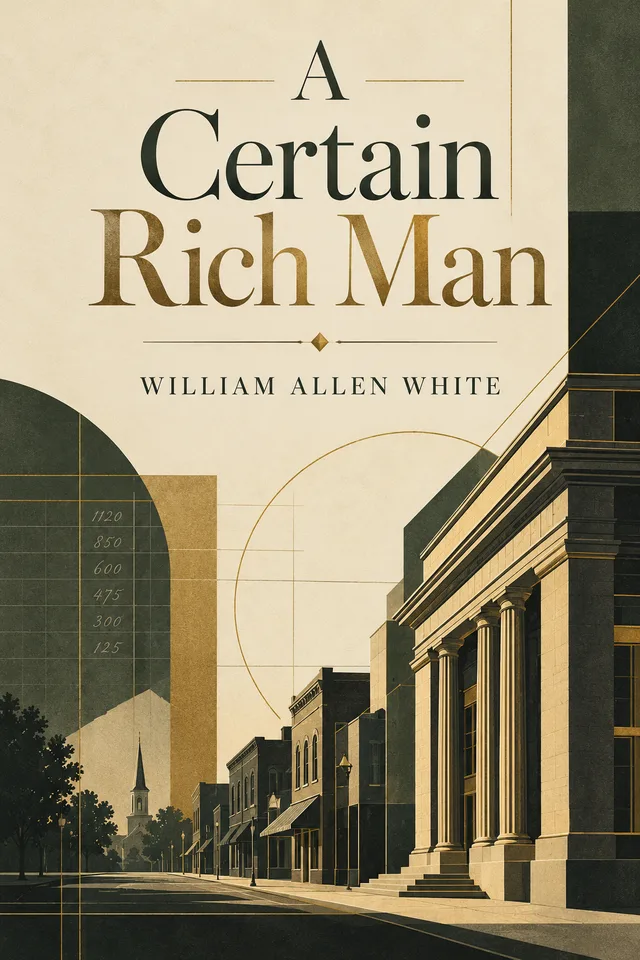
A Certain Rich Man
English BooksWhale Edition by William Allen White
A Kansas financier’s rise exposes the costs of ambition, inequality, and the pursuit of wealth in small-town America.
- Preview
- A sample from the prepared text
- Formats
- Online reader, EPUB, PDF
- Access
- Library claim
Book introduction
A Certain Rich Man
John Barclay grows from a frontier boy into a powerful financier, linking the fortunes of Sycamore Ridge to the expansion of American business. William Allen White follows the friendships, political bargains, labor conflicts, and family losses surrounding his ascent. The novel measures material success against the claims of sympathy and responsibility, giving its portrait of Kansas life a broad social and moral reach.
BooksWhale edition
How this edition was prepared
This edition is based on a public domain text and has been prepared for digital reading by BooksWhale.
Public domain basis
Why this edition can be shared
Original English work by William Allen White, who died in 1944. The source is the public-domain transcription from Project Gutenberg; modern editorial apparatus and illustrations are excluded.
Read preview
A sample from the prepared text
Preview selected from the prepared reader text.
Preview chapterBOOK IRead preview
BOOK I
Preview chapterCHAPTER IPreview
The woods were as the Indians had left them, but the boys who were playing there did not realize, until many years afterwards, that they had moved in as the Indians moved out. Perhaps, if these boys had known that they were the first white boys to use the Indians' playgrounds, the realization might have added zest to the make-believe of their games; but probably boys between seven and fourteen, when they play at all, play with their fancies strained, and very likely these little boys, keeping their stick-horse livery-stable in a wild-grape arbour in the thicket, needed no verisimilitude. The long straight hickory switches—which served as horses—were arranged with their butts on a rotting log, whereon some grass was spread for their feed. Their string bridles hung loosely over the log. The horsemen swinging in the vines above, or in the elm tree near by, were preparing a raid on the stables of other boys, either in the native lumber town a rifle-shot away or in distant parts of the woods. When the youngsters climbed down, they straddled their hickory steeds and galloped friskily away to the creek and drank; this was part of the rites, for tradition in the town of their elders said that whoever drank of Sycamore Creek water immediately turned horse thief. Having drunk their fill at the ford, they waded it and left the stumpy road, plunging into the underbrush, snorting and puffing and giggling and fussing and complaining—the big ones at the little ones and the little ones at the big ones—after the manner of mankind.
When they had gone perhaps a half-mile from the ford, one of the little boys, feeling the rag on his sore heel slipping and letting the rough woods grass scratch his raw flesh, stopped to tie up the rag. He was far in the rear of the pack when he stopped, and the boys, not heeding his blat, rushed on and left him at the edge of a thicket near a deep-rutted road. His cry became a whimper and his whimper a sniffle as he worked with the rag; but the little fingers were clumsy, and a heel is a hard place to cover, and the sun was hot on his back; so he took the rag in one hand and his bridle in the other, and limped on his stick horse into the thick shade of a lone oak tree that stood beside the wide dusty road. His sore did not bother him, and he sat with his back against the tree for a while, flipping the rag and making figures in the dust with the pronged tail of his horse. Then his hands were still, and as he ran from tune to tune with improvised interludes, he droned a song of his prowess. Sometimes he sang words and sometimes he sang thoughts. He sank farther and farther down and looked up into the tree and ceased his song, chirping instead a stuttering falsetto trill, not unlike a cricket's, holding his breath as long as he could to draw it out to its finest strand; and thus with his head on his arm and his arm on the tree root, he fell asleep.
The noon sun was on his legs when he awoke, and a strange dog was sniffing at him. As he started up, he heard the clatter of a horse's feet in the road, and saw an Indian woman trotting toward him on a pony. In an instant he was a-wing with terror, scooting toward the thick of the woods. He screamed as he ran, for his head was full of Indian stories, and he knew that the only use Indians had for little boys was to steal them and adopt them into the tribe. He heard the brush crackling behind him, and he knew that the woman had turned off the road to follow him. A hundred yards is a long way for a terror-stricken little boy to run through tangled underbrush, and when he had come to the high bank of the stream, he slipped down among the tree roots and tried to hide. His little heart beat so fast that he could not keep from panting, and the sound of breaking brush came nearer and then stopped, and in a moment he looked up and saw the squaw leaning over the bank, holding to the tree above him. She smiled kindly at him and said:—
Preview chapterCHAPTER IIPreview
And so on the night of the battle of Sycamore Ridge, John Barclay closed the door of his childhood and became a boy. He did not remember how Ward's wounds were dressed, nor how the town made a hero of the man; but he did remember Watts McHurdie and Martin Culpepper and the Hendricks boys tramping through the cave that night with torches, and he was the hero of that occasion because he was the smallest boy there and they put him up through the crack in the head of the cave, and he saw the stars under the elm tree far above the town, where he and his mother had spent a Sunday afternoon three years before. He called to the men below and told them where he was, and slipped down through, the hole again with an elm sprout in his hand to prove that he had been under the elm tree at the spring. But he remembered nothing of the night—how the men picketed the town; how he sat up with them along with the other boys; how the women, under his mother's direction and Miss Lucy's, cared for the wounded man, who lapsed into delirium as the night wore on, and gibbered of liberty and freedom as another man would go over his accounts in his dreams.
His mother and Miss Lucy took turns nursing Ward night after night during the hot dry summer. As the sick man grew better, many men came to the house, and great plans were afloat. Philemon Ward, sitting up in bed waiting for his leg to heal, talked much of the cave as a refuge for fugitive slaves. There was some kind of a military organization; all the men in town were enlisted, and Ward was their captain, drums were rattling and men were drilling; the dust clouds rose as they marched across the drouth-blighted fields. One night they marched up to the Barclay home, and Ward with a crutch under his arm, and with Mrs. Barclay and Miss Lucy beside him, stood in the door and made a speech to the men. And then there were songs. Watts McHurdie threw back his head and sang "Scots wha ha' wi' Wallace bled," following it with some words of his own denouncing slavery and calling down curses upon the slaveholders; so withal it was a martial occasion, and the boy's heart swelled with patriotic pride. But for a vague feeling that Miss Lucy was neglecting him for her patient, John would have begun making a hero of Philemon R. Ward. As it was, the boy merely tolerated the man and silently suspected him of intentions and designs.
But when school opened, Philemon Ward left Sycamore Ridge and John Barclay made an important discovery. It was that Ellen Culpepper had eyes. In Sycamore Ridge with its three hundred souls, only fifteen of them were children, and five of them were ten years old, and John had played with those five nearly all his life. But at ten sometimes the scales drop from one's eyes, and a ribbon or a bead or a pair of new red striped yarn stockings or any other of the embellishments which nature teaches little girls to wear casts a sheen over all the world for a boy. The magic bundle that charmed John Barclay was a scarlet dress, "made over," that came in an "aid box" from the Culpeppers in Virginia. And when the other children in Miss Lucy's school made fun of John and his amour, the boy fought his way through it all—where fighting was the better part of valour—and made horsehair chains for Ellen and cut lockets for her out of coffee beans, and with a red-hot poker made a ring for her from a rubber button as a return for the smile he got at the sly twist he gave her hair as he passed her desk on his way to the spelling class. As for Miss Lucy, who saw herself displaced, she wrote to Philemon Ward, and told him of her jilting, and railed at the fickleness and frailty of the sex.
Table of contents
Inside this edition
- 01BOOK I
- 02CHAPTER I
- 03CHAPTER II
- 04CHAPTER III
- 05CHAPTER IV
- 06CHAPTER V
- 07CHAPTER VI
- 08CHAPTER VII
- 09CHAPTER VIII
- 10CHAPTER IX
- 11CHAPTER X
- 12CHAPTER XI
- 13CHAPTER XII
- 14CHAPTER XIII
- 15CHAPTER XIV
- 16CHAPTER XV
- 17CHAPTER XVI
- 18BOOK II
- 19CHAPTER XVII
- 20CHAPTER XVIII
- 21CHAPTER XIX
- 22CHAPTER XX
- 23CHAPTER XXI
- 24CHAPTER XXII
- 25CHAPTER XXIII
- 26CHAPTER XXIV
- 27CHAPTER XXV
- 28CHAPTER XXVI
- 29CHAPTER XXVII
- 30CHAPTER XXVIII
- 31CHAPTER XXIX
- 32CHAPTER XXX
Language availability
Other languages
Additional language editions are not published yet. This section will link to other BooksWhale editions when they become available.
Request another language