English Edition
History
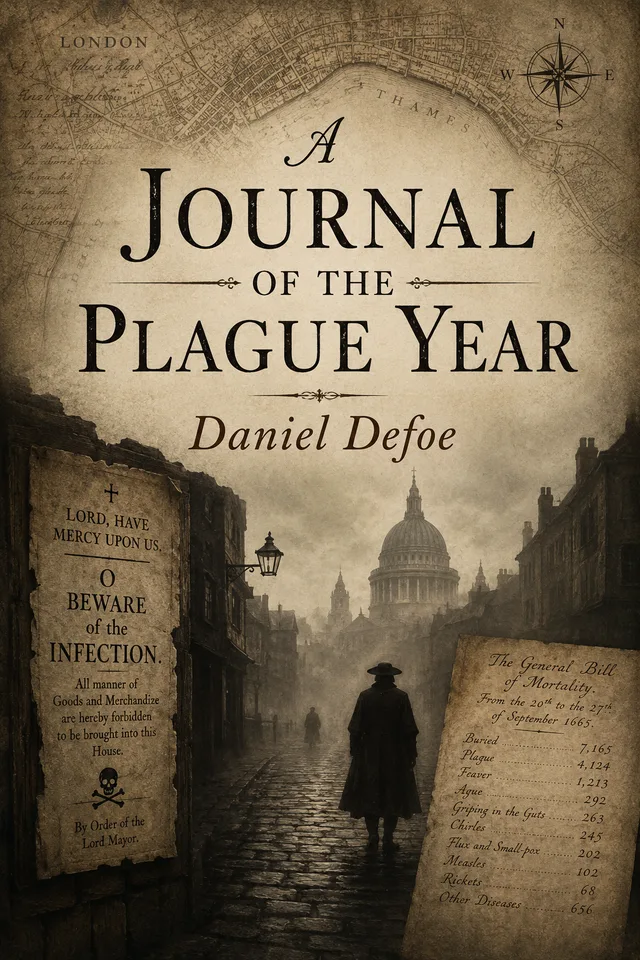
A Journal of the Plague Year
English BooksWhale Edition by Daniel Defoe
Defoe reconstructs London’s 1665 plague through observation, rumor, mortality bills, fear, charity, and civic disorder.
- Preview
- A sample from the prepared text
- Formats
- Online reader, EPUB, PDF
- Access
- Library claim
Book introduction
A Journal of the Plague Year
A Journal of the Plague Year blends documentary detail and narrative invention to portray London during the Great Plague of 1665. Through a careful witness figure, Defoe records quarantine, trade collapse, religious anxiety, public health measures, street life, and the human cost of epidemic fear.
BooksWhale edition
How this edition was prepared
This edition is based on a public domain text and has been prepared for digital reading by BooksWhale.
Public domain basis
Why this edition can be shared
Daniel Defoe died in 1731, and A Journal of the Plague Year was first published in 1722. These dates support the public-domain basis for the English source text used in this edition.
Read preview
A sample from the prepared text
Preview selected from the prepared reader text.
Preview chapterFull textRead preview
A Journal of the Plague Year
Daniel Defoe
A Journal of the Plague Year
by Daniel Defoe
being Observations or Memorials of the most remarkable occurrences, as well public as_ private, which happened in London during the last great visitation in 1665. Written by a CITIZEN who continued all the while in London_. Never made publick before
It was about the beginning of September, 1664, that I, among the rest of my neighbours, heard in ordinary discourse that the plague was returned again in Holland; for it had been very violent there, and particularly at Amsterdam and Rotterdam, in the year 1663, whither, they say, it was brought, some said from Italy, others from the Levant, among some goods which were brought home by their Turkey fleet; others said it was brought from Candia; others from Cyprus. It mattered not from whence it came; but all agreed it was come into Holland again.
We had no such thing as printed newspapers in those days to spread rumours and reports of things, and to improve them by the invention of men, as I have lived to see practised since. But such things as these were gathered from the letters of merchants and others who corresponded abroad, and from them was handed about by word of mouth only; so that things did not spread instantly over the whole nation, as they do now. But it seems that the Government had a true account of it, and several councils were held about ways to prevent its coming over; but all was kept very private. Hence it was that this rumour died off again, and people began to forget it as a thing we were very little concerned in, and that we hoped was not true; till the latter end of November or the beginning of December 1664 when two men, said to be Frenchmen, died of the plague in Long Acre, or rather at the upper end of Drury Lane. The family they were in endeavoured to conceal it as much as possible, but as it had gotten some vent in the discourse of the neighbourhood, the Secretaries of State got knowledge of it; and concerning
themselves to inquire about it, in order to be certain of the truth, two physicians and a surgeon were ordered to go to the house and make inspection. This they did; and finding evident tokens of the sickness upon both the bodies that were dead, they gave their opinions publicly that they died of the plague. Whereupon it was given in to the parish clerk, and he also returned them to the Hall; and it was printed in the weekly bill of mortality in the usual manner, thus—
Plague, 2. Parishes infected, 1.
The people showed a great concern at this, and began to be alarmed all over the town, and the more, because in the last week in December 1664 another man died in the same house, and of the same distemper. And then we were easy again for about six weeks, when none having died with any marks of infection, it was said the distemper was gone; but after that, I think it was about the 12th of February, another died in another house, but in the same parish and in the same manner.
This turned the people’s eyes pretty much towards that end of the town, and the weekly bills showing an increase of burials in St Giles’s parish more than usual, it began to be suspected that the plague was among the people at that end of the town, and that many had died of it, though they had taken care to keep it as much from the knowledge of the public as possible. This possessed the heads of the people very much, and few cared to go through Drury Lane, or the other streets suspected, unless they had extraordinary business that obliged them to it
Preview chapterABRACADABRAPreview
ABRACADABR Others had the Jesuits’ ABRACADAB mark in a cross:
Preview chapterABRACADA I HPreview
ABRACADA I H
Table of contents
Inside this edition
- 01Full text
- 02ABRACADABRA
- 03ABRACADA I H
- 04ABRACAD S.
- 05ABRACA
- 06ORDERS FOR CLEANSING AND KEEPING OF THE STREETS SWEPT.
- 07ORDERS CONCERNING LOOSE PERSONS AND IDLE ASSEMBLIES.
- 08SIR GEORGE WATERMAN
- 09SIR CHARLES
- 10FINIS
Language availability
Other languages
Additional language editions are not published yet. This section will link to other BooksWhale editions when they become available.
Request another language