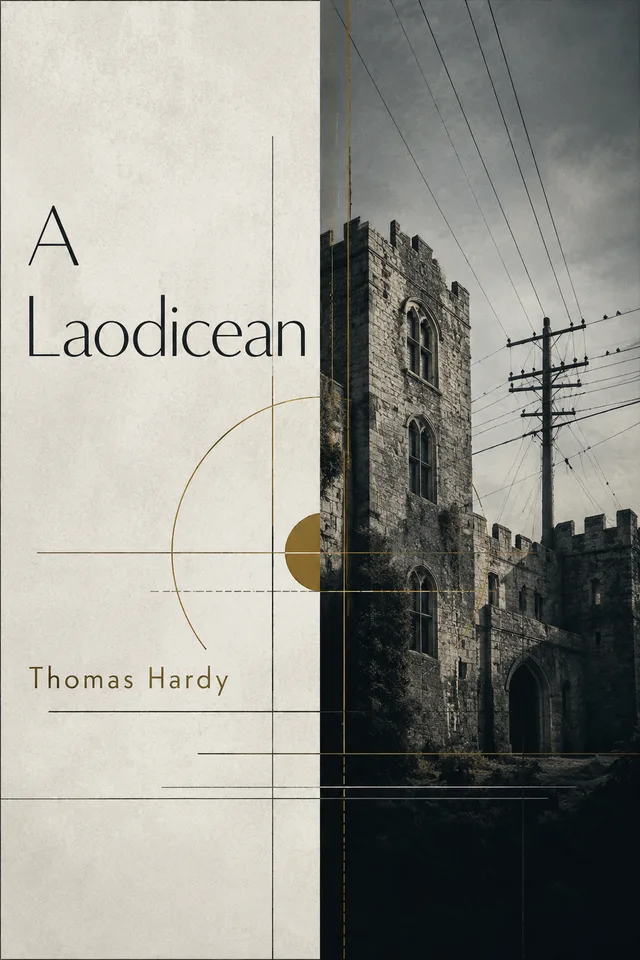
English Edition
Literature
A Laodicean
English BooksWhale Edition by Thomas Hardy
A Hardy novel of inheritance, architecture, modern technology, divided faith, romance, and uncertainty.
- Preview
- A sample from the prepared text
- Formats
- Online reader, EPUB, PDF
- Access
- Library claim
Book introduction
A Laodicean
A Laodicean follows Paula Power, George Somerset, and a contested estate where medieval architecture meets telegraphy, photography, and modern doubt. This English edition brings readers a distinctive Hardy novel about identity, progress, love, and class.
BooksWhale edition
How this edition was prepared
This edition is based on a public domain text and has been prepared for digital reading by BooksWhale.
Public domain basis
Why this edition can be shared
Thomas Hardy died in 1928, and A Laodicean was first published in 1881. These dates support the public-domain basis for this English original edition.
Read preview
A sample from the prepared text
Preview selected from the prepared reader text.
Preview chapterFull textRead preview
A Laodicean
Thomas Hardy
By Thomas Hardy
Preview chapterPREFACE.Preview
The changing of the old order in country manors and mansions may be slow or sudden, may have many issues romantic or otherwise, its romantic issues being not necessarily restricted to a change back to the original order; though this admissible instance appears to have been the only romance formerly recognized by novelists as possible in the case. Whether the following production be a picture of other possibilities or not, its incidents may be taken to be fairly well supported by evidence every day forthcoming in most counties.
The writing of the tale was rendered memorable to two persons, at least, by a tedious illness of five months that laid hold of the author soon after the story was begun in a well-known magazine; during which period the narrative had to be strenuously continued by dictation to a predetermined cheerful ending.
As some of these novels of Wessex life address themselves more especially to readers into whose souls the iron has entered, and whose years have less pleasure in them now than heretofore, so “A Laodicean” may perhaps help to while away an idle afternoon of the comfortable ones whose lines have fallen to them in pleasant places; above all, of that large and happy section of the reading public which has not yet reached ripeness of years; those to whom marriage is the pilgrim’s Eternal City, and not a milestone on the way. T.H.
January 1896.
Preview chapterI.Preview
The sun blazed down and down, till it was within half-an-hour of its setting; but the sketcher still lingered at his occupation of measuring and copying the chevroned doorway--a bold and quaint example of a transitional style of architecture, which formed the tower entrance to an English village church. The graveyard being quite open on its western side, the tweed-clad figure of the young draughtsman, and the tall mass of antique masonry which rose above him to a battlemented parapet, were fired to a great brightness by the solar rays, that crossed the neighbouring mead like a warp of gold threads, in whose mazes groups of equally lustrous gnats danced and wailed incessantly.
He was so absorbed in his pursuit that he did not mark the brilliant chromatic effect of which he composed the central feature, till it was brought home to his intelligence by the warmth of the moulded stonework under his touch when measuring; which led him at length to turn his head and gaze on its cause.
There are few in whom the sight of a sunset does not beget as much meditative melancholy as contemplative pleasure, the human decline and death that it illustrates being too obvious to escape the notice of the simplest observer. The sketcher, as if he had been brought to this reflection many hundreds of times before by the same spectacle, showed that he did not wish to pursue it just now, by turning away his face after a few moments, to resume his architectural studies.
He took his measurements carefully, and as if he reverenced the old workers whose trick he was endeavouring to acquire six hundred years after the original performance had ceased and the performers passed into the unseen. By means of a strip of lead called a leaden tape, which he pressed around and into the fillets and hollows with his finger and thumb, he transferred the exact contour of each moulding to his drawing, that lay on a sketching-stool a few feet distant; where were also a sketching-block, a small T-square, a bow-pencil, and other mathematical instruments. When he had marked down the line thus fixed, he returned to the doorway to copy another as before.
It being the month of August, when the pale face of the townsman and the stranger is to be seen among the brown skins of remotest uplanders, not only in England, but throughout the temperate zone, few of the homeward-bound labourers paused to notice him further than by a momentary turn of the head. They had beheld such gentlemen before, not exactly measuring the church so accurately as this one seemed to be doing, but painting it from a distance, or at least walking round the mouldy pile. At the same time the present visitor, even exteriorly, was not altogether commonplace. His features were good, his eyes of the dark deep sort called eloquent by the sex that ought to know, and with that ray of light in them which announces a heart susceptible to beauty of all kinds,--in woman, in art, and in inanimate nature. Though he would have been broadly characterized as a young man, his face bore contradictory testimonies to his precise age. This was conceivably owing to a too dominant speculative activity in him, which, while it had preserved the emotional side of his constitution, and with it the significant flexuousness of mouth and chin, had played upon his forehead and temples till, at weary moments, they exhibited some traces of being over-exercised. A youthfulness about the mobile features, a mature forehead--though not exactly what the world has been familiar with in past ages--is now growing common; and with the advance of juvenile introspection it probably must grow commoner still. Briefly, he had more of the beauty--if beauty it ought to be called--of the future human type than of the past; but not so much as to make him other than a nice young man.
Table of contents
Inside this edition
- 01Full text
- 02PREFACE.
- 03I.
- 04part of the churchyard was in obscurity, and damp with rising dew.
- 05II.
- 06AT THE SOLE EXPENSE OF
- 07JOHN POWER, ESQ., M.P.
- 08III.
- 09IV.
- 10V.
- 11part of the castle he may wish to see. On my return I shall be glad to
- 12VI.
- 13VII.
- 14VIII.
- 15IX.
- 16X.
- 17XI.
- 18XII.
- 19XIII.
- 20XIV.
- 21XV.
- 22I.
- 23II.
- 24III.
- 25IV.
- 26V.
- 27VI.
- 28VII.
- 29I.
- 30II.
- 31III.
- 32IV.
- 33V.
- 34scene except the banker and herself. The former called back the clerk,
- 35VI.
- 36STANCY CASTLE.
- 37A PLAY
- 38IN AID OF THE FUNDS OF THE
- 39COUNTY HOSPITAL,
- 40ROYAL HORSE ARTILLERY,
- 41MARKTON BARRACKS,
- 42ASSISTED BY SEVERAL
- 43LADIES OF THE NEIGHBOURHOOD.
- 44VII.
- 45VIII.
- 46IX.
- 47act, as if he were indulging in a monologue which did not quite reach
- 48X.
- 49XI.
- 50I.
- 51‘HOTEL ---, NICE,
- 52POWER.’
- 53II.
- 54III.
- 55IV.
- 56V.
- 57I.
- 58II.
- 59III.
- 60IV.
- 61V.
- 62act to the end.
- 63VI.
- 64VII.
- 65VIII.
- 66IX.
- 67X.
- 68XI.
- 69XII.
- 70XIII.
- 71XIV.
- 72I.
- 73II.
- 74III.
- 75IV.
- 76V.
Language availability
Other languages
Additional language editions are not published yet. This section will link to other BooksWhale editions when they become available.
Request another language