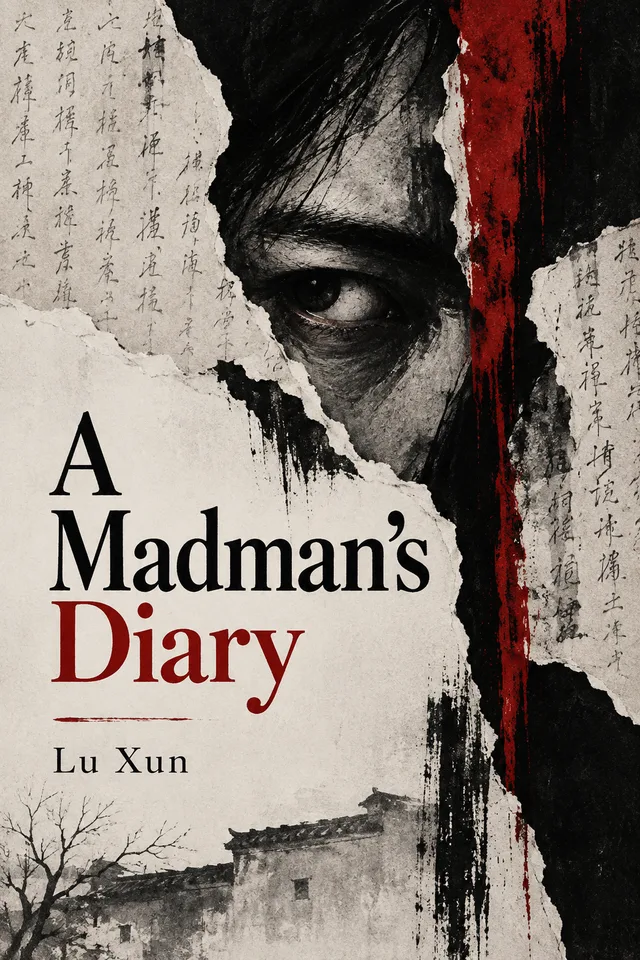
English Edition
Literature
A Madman’s Diary
English BooksWhale Edition by Lu Xun
Original title: 狂人日记
Lu Xun’s landmark modern Chinese story of paranoia, social violence, tradition, and awakening.
- Preview
- A sample from the prepared text
- Formats
- Online reader, EPUB, PDF
- Access
- Library claim
Book introduction
A Madman’s Diary
A Madman’s Diary presents a narrator who begins to see cannibalism hidden inside everyday words, customs, and family relations. Lu Xun turns psychological terror into a fierce critique of oppressive tradition, making the story a foundational work of modern Chinese fiction.
BooksWhale edition
How this edition was prepared
This edition is an AI-assisted, human-reviewed translation prepared by BooksWhale. It has been reviewed for readability, formatting, and consistency.
Public domain basis
Why this edition can be shared
Lu Xun died in 1936, and the source text 狂人日记 was first published in 1918. These dates support the public-domain basis of the source work for this reviewed English translation.
Read preview
A sample from the prepared text
Preview selected from the prepared reader text.
Preview chapterFull textRead preview
A Madman’s Diary
Lu Xun
The Diary of a Madman
Selected Novels of Lu Xun
Foreword
Few writers have captured the turbulence of modern China with the precision, irony, and moral urgency of Lu Xun. More than a century after many of his best-known stories were first published, his fiction continues to speak with remarkable force because the problems he confronted were never merely political or historical. They were also problems of fear, conformity, cruelty, self-deception, loneliness, and the difficult awakening of the individual mind.
The Diary of a Madman, first published in 1918, stands at the center of Lu Xun’s literary achievement. Written in the form of fragmented diary entries, the story follows a man who gradually becomes convinced that the people around him belong to a society of cannibals. His terror may appear to be madness, yet beneath the distorted perceptions lies an accusation directed at an entire moral order. The image of “eating people” becomes a powerful metaphor for a society in which custom, hierarchy, and inherited values can destroy human dignity while presenting themselves as natural and respectable.
This combination of psychological intensity and social criticism appears throughout Lu Xun’s fiction. His characters are often ordinary people caught between an old world that has lost its authority and a new world that has not yet fully arrived. Some are humiliated by poverty or social prejudice; others cling desperately to illusions that protect them from painful truths. Lu Xun rarely idealizes his characters, but neither does he treat them with simple contempt. His satire can be severe, yet behind it lies a deep concern for those trapped by circumstances, habit, ignorance, and the judgment of others.
The stories collected in this volume reveal the extraordinary range of his narrative art. He could move from dark comedy to tragedy, from realism to allegory, and from quiet observation to fierce denunciation. His prose is often economical, but its apparent simplicity conceals complex layers of meaning. A gesture, a repeated phrase, an awkward silence, or a small social ritual may expose an entire structure of power and belief.
Lu Xun wrote during a period of profound transformation. The collapse of the Qing dynasty, the emergence of the Republic, the New Culture Movement, and intense debates over language, tradition, science, and national identity formed the background to his work. Yet readers do not need detailed knowledge of these events to recognize the human realities in his stories. The desire to belong, the fear of ridicule, the comfort of inherited beliefs, and the cost of questioning accepted truths remain immediately familiar.
To read Lu Xun today is therefore not simply to encounter a major figure in modern Chinese literature. It is to encounter a writer who continually asks what happens when a society refuses to examine itself, and what courage is required for an individual to see clearly.
These stories offer no easy consolation. What they offer instead is sharper vision—and, within that vision, the possibility of awakening.
A Madman’s Diary
Two brothers, whose names I shall now conceal, were both good friends of mine when we were in middle school. We had been separated for many years, and gradually lost touch. A few days ago I happened to hear that one of them had been seriously ill. As I was returning to my native place, I made a detour to visit them, but met only one brother, who told me that the sick man was his younger brother.
“You have taken the trouble to come such a long way to see him, but he recovered long ago and has gone to another place to await an official appointment.”
Laughing heartily, he produced two volumes of a diary, saying that from them one could see the nature of his brother’s illness at the time, and that there would be no harm in presenting them to an old friend. I took them home and read them through once. I discovered that his illness had apparently been something like “persecution mania.” The language was highly confused and incoherent, and much of it was absurd. No dates were given, but differences in the ink and handwriting showed that it had not all been written at one time. There were, however, passages with some degree of continuity, and I have now copied out one section for the study of medical men. I have not altered a single word, even where the text contains errors. The personal names, however, though all belonging to villagers unknown to the world and irrelevant to the main matter, have all been changed. As for the title, it was added by the author himself after his recovery, and I have left it unchanged.
Preview chapterIPreview
Tonight the moonlight is beautiful.
I have not seen it for more than thirty years. Seeing it tonight, I feel extraordinarily refreshed. Only now do I realize that for more than thirty years I have been in a daze. Yet I must be extremely careful. Otherwise, why did the Zhao family’s dog look at me twice?
My fear is justified.
Preview chapterIIPreview
There is no moonlight at all tonight. I know this is a bad sign. When I carefully went out this morning, Old Zhao Gui gave me a strange look: he seemed afraid of me, and yet he seemed to want to harm me. There were also seven or eight people whispering together about me, afraid that I might see them. Everyone I passed on the road was the same. The fiercest-looking one opened his mouth and smiled at me. A chill ran through me from head to heel, and I knew their arrangements were already complete.
But I was not afraid. I kept on walking my own way. Ahead of me a group of children were also talking about me. Their eyes were just like Old Zhao Gui’s, and their faces were all livid. I wondered what grudge I could possibly have against children, that they should behave like this too. I could not stop myself from shouting, “Tell me!”
They immediately ran away.
I thought: What grudge do I have against Old Zhao Gui? What grudge do I have against the people on the road? There was only that incident twenty years ago, when I kicked the old account book belonging to Mr. Ancient History, and Mr. Ancient History was very displeased. Although Old Zhao Gui does not know him, he must have heard about it and taken up his grievance. He has arranged with the people on the road to make enemies of me.
But what about the children? They had not even been born then. Why are they staring at me today with those strange eyes, seeming afraid of me and yet seeming to want to harm me?
This truly frightens me, bewilders me, and makes me sad.
I understand now.
Their parents taught them to do it!
Table of contents
Inside this edition
- 01Full text
- 02I
- 03II
- 04III
- 05IV
- 06V
- 07VI
- 08VII
- 09VIII
- 10IX
- 11X
- 12XI
- 13XII
- 14XIII
- 15“FIRST PRIZE: TENS OF THOUSANDS OF DOLLARS.”
- 16I
- 17II
- 18BOOM!!!
- 19III
- 20“THE INTESTINES OF THE NÜWA CLAN.”
- 21I
- 22II
- 23III
Language availability
Other languages
Chinese
Chinese Edition
狂人日记
Lu Xun · Literature
鲁迅借“狂人”的恐惧与觉醒,揭开礼教吃人的现代文学开端。
German
German Edition
Das Tagebuch eines Verrückten
Lu Xun · Literature
Lu Xuns schonungslose Erzählung über Verfolgungsangst, Tradition und die Gewalt sozialer Ordnung.
Spanish
Spanish Edition
Diario de un loco
Lu Xun · Literature
Un relato moderno donde la paranoia revela una crítica feroz de la tradición y la violencia social.