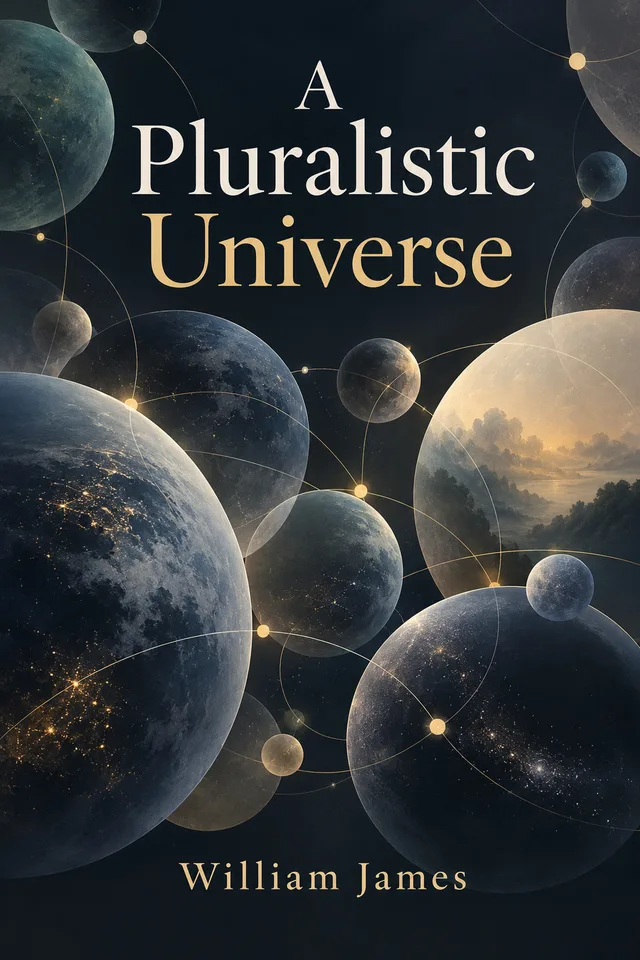
English Edition
Philosophy
A Pluralistic Universe
English BooksWhale Edition by William James
James contrasts monism and pluralism through lectures on experience, consciousness, Hegel, Fechner, and Bergson.
- Preview
- A sample from the prepared text
- Formats
- Online reader, EPUB, PDF
- Access
- Library claim
Book introduction
A Pluralistic Universe
William James examines whether reality forms a single absolute system or an unfinished plurality of connected experiences. These eight Hibbert Lectures discuss Hegel, Fechner, Bergson, consciousness, and religious experience. Three further essays develop the relations between things, the experience of activity, and the meaning of changing reality. The edition presents James's English text.
BooksWhale edition
How this edition was prepared
This edition is based on a public domain text and has been prepared for digital reading by BooksWhale.
Public domain basis
Why this edition can be shared
William James died in 1910. This edition uses the original English text preserved by Project Gutenberg; publisher advertising and separate annotations are omitted.
Read preview
A sample from the prepared text
Preview selected from the prepared reader text.
Preview chapterLECTURE I — THE TYPES OF PHILOSOPHIC THINKINGRead preview
As these lectures are meant to be public, and so few, I have assumed all very special problems to be excluded, and some topic of general interest required. Fortunately, our age seems to be growing philosophical again—still in the ashes live the wonted fires. Oxford, long the seed-bed, for the english world, of the idealism inspired by Kant and Hegel, has recently become the nursery of a very different way of thinking. Even non-philosophers have begun to take an interest in a controversy over what is known as pluralism or humanism. It looks a little as if the ancient english empirism, so long put out of fashion here by nobler sounding germanic formulas, might be repluming itself and getting ready for a stronger flight than ever. It looks as if foundations were being sounded and examined afresh.
Individuality outruns all classification, yet we insist on classifying every one we meet under some general head. As these heads usually suggest prejudicial associations to some hearer or other, the life of philosophy largely consists of resentments at the classing, and complaints of being misunderstood. But there are signs of clearing up, and, on the whole, less acrimony in discussion, for which both Oxford and Harvard are partly to be thanked. As I look back into the sixties, Mill, Bain, and Hamilton were the only official philosophers in Britain. Spencer, Martineau, and Hodgson were just beginning. In France, the pupils of Cousin were delving into history only, and Renouvier alone had an original system. In Germany, the hegelian impetus had spent itself, and, apart from historical scholarship, nothing but the materialistic controversy remained, with such men as Büchner and Ulrici as its champions. Lotze and Fechner were the sole original thinkers, and Fechner was not a professional philosopher at all.
The general impression made was of crude issues and oppositions, of small subtlety and of a widely spread ignorance. Amateurishness was rampant. Samuel Bailey's 'letters on the philosophy of the human mind,' published in 1855, are one of the ablest expressions of english associationism, and a book of real power. Yet hear how he writes of Kant: 'No one, after reading the extracts, etc., can be surprised to hear of a declaration by men of eminent abilities, that, after years of study, they had not succeeded in gathering one clear idea from the speculations of Kant. I should have been almost surprised if they had. In or about 1818, Lord Grenville, when visiting the Lakes of England, observed to Professor Wilson that, after five years' study of Kant's philosophy, he had not gathered from it one clear idea. Wilberforce, about the same time, made the same confession to another friend of my own. "I am endeavoring," exclaims Sir James Mackintosh, in the irritation, evidently, of baffled efforts, "to understand this accursed german philosophy."
What Oxford thinker would dare to print such naïf and provincial-sounding citations of authority to-day?
The torch of learning passes from land to land as the spirit bloweth the flame. The deepening of philosophic consciousness came to us english folk from Germany, as it will probably pass back ere long. Ferrier, J.H. Stirling, and, most of all, T.H. Green are to be thanked. If asked to tell in broad strokes what the main doctrinal change has been, I should call it a change from the crudity of the older english thinking, its ultra-simplicity of mind, both when it was religious and when it was anti-religious, toward a rationalism derived in the first instance from Germany, but relieved from german technicality and shrillness, and content to suggest, and to remain vague, and to be, in, the english fashion, devout.
By the time T.H. Green began at Oxford, the generation seemed to feel as if it had fed on the chopped straw of psychology and of associationism long enough, and as if a little vastness, even though it went with vagueness, as of some moist wind from far away, reminding us of our pre-natal sublimity, would be welcome.
Preview chapterLECTURE II — MONISTIC IDEALISMPreview
Let me recall to you the programme which I indicated to you at our last meeting. After agreeing not to consider materialism in any shape, but to place ourselves straightway upon a more spiritualistic platform, I pointed out three kinds of spiritual philosophy between which we are asked to choose. The first way was that of the older dualistic theism, with ourselves represented as a secondary order of substances created by God. We found that this allowed of a degree of intimacy with the creative principle inferior to that implied in the pantheistic belief that we are substantially one with it, and that the divine is therefore the most intimate of all our possessions, heart of our heart, in fact. But we saw that this pantheistic belief could be held in two forms, a monistic form which I called philosophy of the absolute, and a pluralistic form which I called radical empiricism, the former conceiving that the divine exists authentically only when the world is experienced all at once in its absolute totality, whereas radical empiricism allows that the absolute sum-total of things may never be actually experienced or realized in that shape at all, and that a disseminated, distributed, or incompletely unified appearance is the only form that reality may yet have achieved.
I may contrast the monistic and pluralistic forms in question as the 'all-form' and the 'each-form.' At the end of the last hour I animadverted on the fact that the all-form is so radically different from the each-form, which is our human form of experiencing the world, that the philosophy of the absolute, so far as insight and understanding go, leaves us almost as much outside of the divine being as dualistic theism does. I believe that radical empiricism, on the contrary, holding to the each-form, and making of God only one of the eaches, affords the higher degree of intimacy. The general thesis of these lectures I said would be a defence of the pluralistic against the monistic view. Think of the universe as existing solely in the each-form, and you will have on the whole a more reasonable and satisfactory idea of it than if you insist on the all-form being necessary. The rest of my lectures will do little more than make this thesis more concrete, and I hope more persuasive.
It is curious how little countenance radical pluralism has ever had from philosophers. Whether materialistically or spiritualistically minded, philosophers have always aimed at cleaning up the litter with which the world apparently is filled. They have substituted economical and orderly conceptions for the first sensible tangle; and whether these were morally elevated or only intellectually neat they were at any rate always aesthetically pure and definite, and aimed at ascribing to the world something clean and intellectual in the way of inner structure. As compared with all these rationalizing pictures, the pluralistic empiricism which I profess offers but a sorry appearance. It is a turbid, muddled, gothic sort of an affair, without a sweeping outline and with little pictorial nobility. Those of you who are accustomed to the classical constructions of reality may be excused if your first reaction upon it be absolute contempt—a shrug of the shoulders as if such ideas were unworthy of explicit refutation. But one must have lived some time with a system to appreciate its merits. Perhaps a little more familiarity may mitigate your first surprise at such a programme as I offer.
First, one word more than what I said last time about the relative foreignness of the divine principle in the philosophy of the absolute. Those of you who have read the last two chapters of Mr. Bradley's wonderful book, 'Appearance and reality,' will remember what an elaborately foreign aspect his absolute is finally made to assume. It is neither intelligence nor will, neither a self nor a collection of selves, neither truthful, good, nor beautiful, as we understand these terms. It is, in short, a metaphysical monster, all that we are permitted to say of it being that whatever it is, it is at any rate worth more (worth more to itself, that is) than if any eulogistic adjectives of ours applied to it. It is us, and all other appearances, but none of us as such, for in it we are all 'transmuted,' and its own as-suchness is of another denomination altogether.
Preview chapterLECTURE III — HEGEL AND HIS METHODPreview
Directly or indirectly, that strange and powerful genius Hegel has done more to strengthen idealistic pantheism in thoughtful circles than all other influences put together. I must talk a little about him before drawing my final conclusions about the cogency of the arguments for the absolute. In no philosophy is the fact that a philosopher's vision and the technique he uses in proof of it are two different things more palpably evident than in Hegel. The vision in his case was that of a world in which reason holds all things in solution and accounts for all the irrationality that superficially appears by taking it up as a 'moment' into itself. This vision was so intense in Hegel, and the tone of authority with which he spoke from out of the midst of it was so weighty, that the impression he made has never been effaced. Once dilated to the scale of the master's eye, the disciples' sight could not contract to any lesser prospect. The technique which Hegel used to prove his vision was the so-called dialectic method, but here his fortune has been quite contrary. Hardly a recent disciple has felt his particular applications of the method to be satisfactory. Many have let them drop entirely, treating them rather as a sort of provisional stop-gap, symbolic of what might some day prove possible of execution, but having no literal cogency or value now. Yet these very same disciples hold to the vision itself as a revelation that can never pass away. The case is curious and worthy of our study.
It is still more curious in that these same disciples, altho they are usually willing to abandon any particular instance of the dialectic method to its critics, are unshakably sure that in some shape the dialectic method is the key to truth. What, then, is the dialectic method? It is itself a part of the hegelian vision or intuition, and a part that finds the strongest echo in empiricism and common sense. Great injustice is done to Hegel by treating him as primarily a reasoner. He is in reality a naïvely observant man, only beset with a perverse preference for the use of technical and logical jargon. He plants himself in the empirical flux of things and gets the impression of what happens. His mind is in very truth impressionistic; and his thought, when once you put yourself at the animating centre of it, is the easiest thing in the world to catch the pulse of and to follow.
Any author is easy if you can catch the centre of his vision. From the centre in Hegel come those towering sentences of his that are comparable only to Luther's, as where, speaking of the ontological proof of God's existence from the concept of him as the ens perfectissimum to which no attribute can be lacking, he says: 'It would be strange if the Notion, the very heart of the mind, or, in a word, the concrete totality we call God, were not rich enough to embrace so poor a category as Being, the very poorest and most abstract of all—for nothing can be more insignificant than Being.' But if Hegel's central thought is easy to catch, his abominable habits of speech make his application of it to details exceedingly difficult to follow. His passion for the slipshod in the way of sentences, his unprincipled playing fast and loose with terms; his dreadful vocabulary, calling what completes a thing its 'negation,' for example; his systematic refusal to let you know whether he is talking logic or physics or psychology, his whole deliberately adopted policy of ambiguity and vagueness, in short: all these things make his present-day readers wish to tear their hair—or his—out in desperation. Like Byron's corsair, he has left a name 'to other times, linked with one virtue and a thousand crimes.'
The virtue was the vision, which was really in two parts. The first part was that reason is all-inclusive, the second was that things are 'dialectic.' Let me say a word about this second part of Hegel's vision.
Table of contents
Inside this edition
- 01LECTURE I — THE TYPES OF PHILOSOPHIC THINKING
- 02LECTURE II — MONISTIC IDEALISM
- 03LECTURE III — HEGEL AND HIS METHOD
- 04LECTURE IV — CONCERNING FECHNER
- 05LECTURE V — THE COMPOUNDING OF CONSCIOUSNESS
- 06LECTURE VI — BERGSON AND HIS CRITIQUE OF INTELLECTUALISM
- 07LECTURE VII — THE CONTINUITY OF EXPERIENCE
- 08LECTURE VIII — CONCLUSIONS
- 09APPENDIX A — THE THING AND ITS RELATIONS
- 10I
- 11II
- 12III
- 13IV
- 14V
- 15VI
- 16APPENDIX B — THE EXPERIENCE OF ACTIVITY
- 17APPENDIX C — ON THE NOTION OF REALITY AS CHANGING
Language availability
Other languages
Additional language editions are not published yet. This section will link to other BooksWhale editions when they become available.
Request another language