English Edition
Education
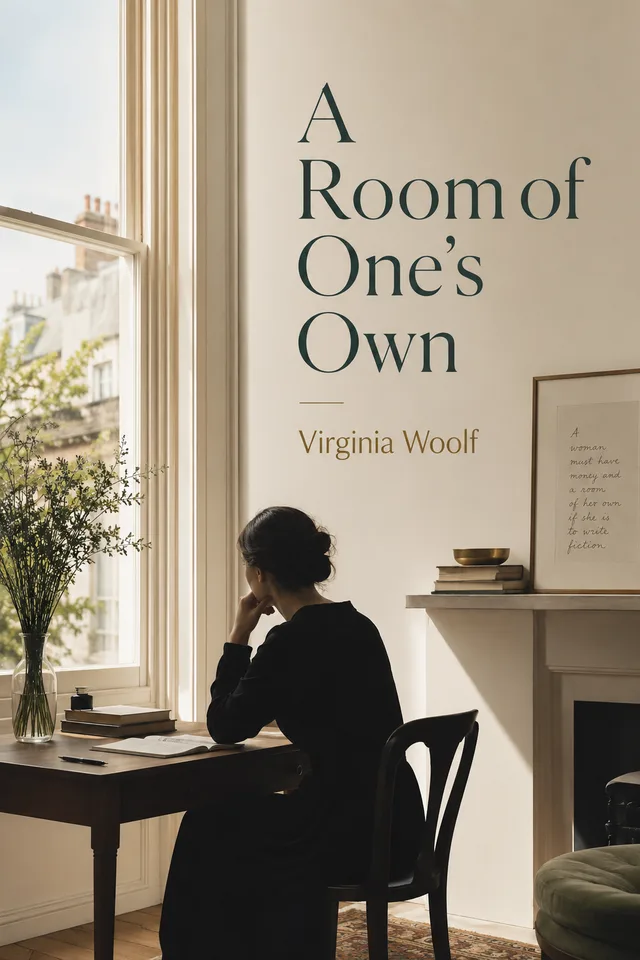
A Room of One’s Own
English BooksWhale Edition by Virginia Woolf
Virginia Woolf’s influential essay on women, literature, money, space, and creative freedom.
- Preview
- A sample from the prepared text
- Formats
- Online reader, EPUB, PDF
- Access
- Library claim
Book introduction
A Room of One’s Own
A Room of One’s Own argues that material independence and private space are essential to women’s writing. Blending lecture, fiction, criticism, and social history, Woolf created one of the defining modern essays on literature and gender.
BooksWhale edition
How this edition was prepared
This edition is based on a public domain text and has been prepared for digital reading by BooksWhale.
Public domain basis
Why this edition can be shared
A Room of One’s Own was first published in 1929. Its pre-1931 publication date supports the public-domain basis for this original English text in the United States.
Read preview
A sample from the prepared text
Preview selected from the prepared reader text.
Preview chapterFull textRead preview
A Room of One’s Own
Virginia Woolf
Preview chapterCHAPTER IPreview
But, you may say, we asked you to speak about women and fiction—what
has that got to do with a room of one’s own? I will try to explain. When
you asked me to speak about women and fiction I sat down on the banks of
a river and began to wonder what the words meant. They might mean simply
a few remarks about Fanny Burney; a few more about Jane Austen; a
tribute to the Brontë and a sketch of Haworth Parsonage under snow; some
witticisms if possible about Miss Mitford; a respectful allusion to
George Eliot; a reference to Mrs. Gaskell and one would have done. But
at second sight the words seemed not so simple. The title women and
fiction might mean, and you may have meant it to mean, women and what
they are like; or it might mean women and the fiction that they write;
or it might mean women and the fiction that is written about them; or it
might mean that somehow all three are inextricably mixed together and
you want me to consider them in that light. But when I began to consider
the subject in this last way, which seemed the most interesting, I soon
saw that it had one fatal drawback. I should never be able to come to a
conclusion. I should never be able to fulfil what is, I understand, the
first duty of a lecturer—to hand you after an hour’s discourse a nugget
the mantelpiece for ever. All I could do was to offer you an opinion
upon one minor point—a woman must have money and a room of her own if
she is to write fiction; and that, as you will see, leaves the great
problem of the true nature of woman and the true nature of fiction
unsolved. I have shirked the duty of coming to a conclusion upon these
two questions—women and fiction remain, so far as I am concerned,
unsolved problems. But in order to make some amends I am going to do
what I can to show you how I arrived at this opinion about the room and
the money. I am going to develop in your presence as fully and freely as
I can the train of thought which led me to think this. Perhaps if I lay
bare the ideas, the prejudices, that lie behind this statement you will
find that they have some bearing upon women and some upon fiction. At
any rate, when a subject is highly controversial—and any question about
sex is that—one cannot hope to tell the truth. One can only show how
one came to hold whatever opinion one does hold. One can only give one’s
audience the chance of drawing their own conclusions as they observe the
limitations, the prejudices, the idiosyncrasies of the speaker. Fiction
here is likely to contain more truth than fact. Therefore I propose,
making use of all the liberties and licences of a novelist, to tell you
the story of the two days that preceded my coming here—how, bowed down
by the weight of the subject which you have laid upon my shoulders, I
pondered it, and made it work in and out of my daily life. I need not
say that what I am about to describe has no existence; Oxbridge is an
invention; so is Fernham; “I” is only a convenient term for somebody who
has no real being. Lies will flow from my lips, but there may perhaps be
some truth mixed up with them; it is for you to seek out this truth and
to decide whether any part of it is worth keeping. If not, you will of
course throw the whole of it into the waste-paper basket and forget all
about it.
Here then was I (call me Mary Beton, Mary Seton, Mary Carmichael or by
Preview chapterCHAPTER IIPreview
The scene, if I may ask you to follow me, was now changed. The leaves
were still falling, but in London now, not Oxbridge; and I must ask you
to imagine a room, like many thousands, with a window looking across
people’s hats and vans and motorcars to other windows, and on the table
inside the room a blank sheet of paper on which was written in large
letters Women and Fiction, but no more. The inevitable sequel to
lunching and dining at Oxbridge seemed, unfortunately, to be a visit to
the British Museum. One must strain off what was personal and accidental
in all these impressions and so reach the pure fluid, the essential oil
of truth. For that visit to Oxbridge and the luncheon and the dinner had
started a swarm of questions. Why did men drink wine and women water?
Why was one sex so prosperous and the other so poor? What effect has
poverty on fiction? What conditions are necessary for the creation of
works of art?—a thousand questions at once suggested themselves. But
one needed answers, not questions; and an answer was only to be had by
consulting the learned and the unprejudiced, who have removed themselves
above the strife of tongue and the confusion of body and issued the
result of their reasoning and research in books which are to be found in
the British Museum. If truth is not to be found on the shelves of the
pencil, is truth?
Thus provided, thus confident and enquiring, I set out in the pursuit of
truth. The day, though not actually wet, was dismal, and the streets in
the neighbourhood of the Museum were full of open coal-holes, down which
sacks were showering; four-wheeled cabs were drawing up and depositing
on the pavement corded boxes containing, presumably, the entire wardrobe
of some Swiss or Italian family seeking fortune or refuge or some other
desirable commodity which is to be found in the boarding-houses of
Bloomsbury in the winter. The usual hoarse-voiced men paraded the
streets with plants on barrows. Some shouted; others sang. London was
like a workshop. London was like a machine. We were all being shot
backwards and forwards on this plain foundation to make some pattern.
The British Museum was another department of the factory. The
swing-doors swung open; and there one stood under the vast dome, as if
one were a thought in the huge bald forehead which is so splendidly
encircled by a band of famous names. One went to the counter; one took a
slip of paper; one opened a volume of the catalogue, and..... the five
dots here indicate five separate minutes of stupefaction, wonder and
bewilderment. Have you any notion how many books are written about women
in the course of one year? Have you any notion how many are written by
men? Are you aware that you are, perhaps, the most discussed animal in
spend a morning reading, supposing that at the end of the morning I
be a herd of elephants, I thought, and a wilderness of spiders,
desperately referring to the animals that are reputed longest lived and
most multitudinously eyed, to cope with all this. I should need claws of
steel and beak of brass even to penetrate the husk. How shall I ever
find the grains of truth embedded in all this mass of paper? I asked
myself, and in despair began running my eye up and down the long list of
titles. Even the names of the books gave me food for thought. Sex and
its nature might well attract doctors and biologists; but what was
surprising and difficult of explanation was the fact that sex—woman,
that is to say—also attracts agreeable essayists, light-fingered
novelists, young men who have taken the M.A. degree; men who have taken
no degree; men who have no apparent qualification save that they are not
Table of contents
Inside this edition
- 01Full text
- 02CHAPTER I
- 03CHAPTER II
- 04CHAPTER III
- 05CHAPTER IV
- 06CHAPTER V
- 07CHAPTER VI
Language availability
Other languages
Additional language editions are not published yet. This section will link to other BooksWhale editions when they become available.
Request another language