English Edition
Literature
Afoot in England
English BooksWhale Edition by W. H. Hudson
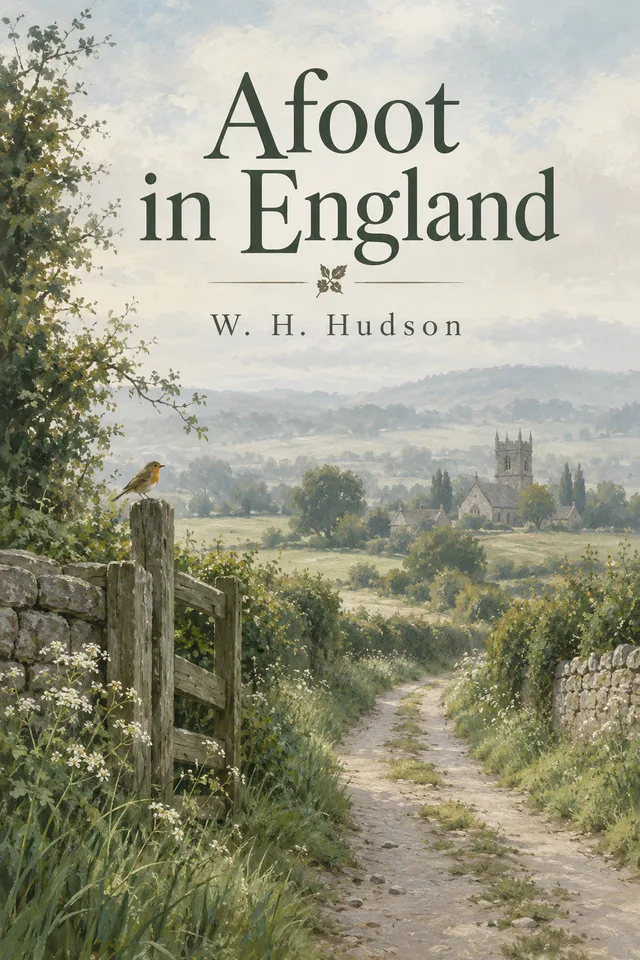
Hudson’s English walking essays find unexpected stories in village roads, old buildings, birds, landscapes, and encounters with strangers.
- Preview
- A sample from the prepared text
- Formats
- Online reader, EPUB, PDF
- Access
- Library claim
Book introduction
Afoot in England
W. H. Hudson travels on foot through southern England, turning away from prescribed sightseeing toward the experiences of the road. His twenty-five chapters visit villages, rivers, ancient sites, inns, and churches while attending closely to birds, weather, and the people he meets. Places such as Salisbury, Silchester, and Stonehenge become starting points for memories and arguments about travel, landscape, and the pleasure of discovering a country slowly.
BooksWhale edition
How this edition was prepared
This edition is based on a public domain text and has been prepared for digital reading by BooksWhale.
Public domain basis
Why this edition can be shared
W. H. Hudson died in 1922. The work was first published in 1909. This edition uses the public-domain English original.
Read preview
A sample from the prepared text
Preview selected from the prepared reader text.
Preview chapterChapter One: Guide-Books: An IntroductionRead preview
Guide-books are so many that it seems probable we have more than any other country—possibly more than all the rest of the universe together. Every county has a little library of its own—guides to its towns, churches, abbeys, castles, rivers, mountains; finally, to the county as a whole. They are of all prices and all sizes, from the diminutive paper-covered booklet, worth a penny, to the stout cloth-bound octavo volume which costs eight or ten or twelve shillings, or to the gigantic folio county history, the huge repository from which the guide-book maker gets his materials. For these great works are also guide-books, containing everything we want to learn, only made on so huge a scale as to be suited to the coat pockets of Brobdingnagians rather than of little ordinary men. The wonder of it all comes in when we find that these books, however old and comparatively worthless they may be, are practically never wholly out of date. When a new work is brought out (dozens appear annually) and, say, five thousand copies sold, it does not throw as many, or indeed any, copies of the old book out of circulation: it supersedes nothing. If any man can indulge in the luxury of a new up-to-date guide to any place, and gets rid of his old one (a rare thing to do), this will be snapped up by poorer men, who will treasure it and hand it down or on to others. Editions of 1860-50-40, and older, are still prized, not merely as keepsakes but for study or reference. Any one can prove this by going the round of a dozen second-hand booksellers in his own district in London. There will be tons of literary rubbish, and good stuff old and new, but few guidebooks—in some cases not one. If you ask your man at a venture for, say, a guide to Hampshire, he will most probably tell you that he has not one in stock; then, in his anxiety to do business, he will, perhaps, fish out a guide to Derbyshire, dated 1854—a shabby old book—and offer it for four or five shillings, the price of a Crabbe in eight volumes, or of Gibbon's Decline and Fall in six volumes, bound in calf. Talk to this man, and to the other eleven, and they will tell you that there is always a sale for guide-books—that the supply does not keep pace with the demand. It may be taken as a fact that most of the books of this kind published during the last half-century—many millions of copies in the aggregate—are still in existence and are valued possessions.
There is nothing to quarrel with in all this. As a people we run about a great deal; and having curious minds we naturally wish to know all there is to be known, or all that is interesting to know, about the places we visit. Then, again, our time as a rule being limited, we want the whole matter—history, antiquities, places of interest in the neighbourhood, etc. in a nutshell. The brief book serves its purpose well enough; but it is not thrown away like the newspaper and the magazines; however cheap and badly got up it may be, it is taken home to serve another purpose, to be a help to memory, and nobody can have it until its owner removes himself (but not his possessions) from this planet; or until the broker seizes his belongings, and guide-books, together with other books, are disposed of in packages by the auctioneer.
In all this we see that guide-books are very important to us, and that there is little or no fault to be found with them, since even the worst give some guidance and enable us in after times mentally to revisit distant places. It may then be said that there are really no bad guide-books, and that those that are good in the highest sense are beyond praise. A reverential sentiment, which is almost religious in character, connects itself in our minds with the very name of Murray. It is, however, possible to make an injudicious use of these books, and by so doing to miss the fine point of many a pleasure. The very fact that these books are guides to us and invaluable, and that we readily acquire the habit of taking them about with us and consulting them at frequent intervals, comes between us and that rarest and most exquisite enjoyment to be experienced amidst novel scenes. He that visits a place new to him for some special object rightly informs himself of all that the book can tell him. The knowledge may be useful; pleasure is with him a secondary object. But if pleasure be the main object, it will only be experienced in the highest degree by him who goes without book and discovers what old Fuller called the "observables" for himself. There will be no mental pictures previously formed; consequently what is found will not disappoint. When the mind has been permitted to dwell beforehand on any scene, then, however beautiful or grand it may be, the element of surprise is wanting and admiration is weak. The delight has been discounted.
Preview chapterChapter Two: On Going BackPreview
In looking over the preceding chapter it occurred to me that I had omitted something, or rather that it would have been well to drop a word of warning to those who have the desire to revisit a place where they have experienced a delightful surprise. Alas! they cannot have that sensation a second time, and on this account alone the mental image must always be better than its reality. Let the image—the first sharp impression—content us. Many a beautiful picture is spoilt by the artist who cannot be satisfied that he has made the best of his subject, and retouching his canvas to bring out some subtle charm which made the work a success loses it altogether. So in going back, the result of the inevitable disillusionment is that the early mental picture loses something of its original freshness. The very fact that the delightful place or scene was discovered by us made it the shining place it is in memory. And again, the charm we found in it may have been in a measure due to the mood we were in, or to the peculiar aspect in which it came before us at the first, due to the season, to atmospheric and sunlight effects, to some human interest, or to a conjunction of several favourable circumstances; we know we can never see it again in that aspect and with that precise feeling.
On this account I am shy of revisiting the places where I have experienced the keenest delight. For example, I have no desire to revisit that small ancient town among the hills, described in the last chapter; to go on a Sunday evening through that narrow gorge, filled with the musical roar of the church bells; to leave that great sound behind and stand again listening to the marvellous echo from the wooded hill on the other side of the valley. Nor would I care to go again in search of that small ancient lost church in the forest. It would not be early April with the clear sunbeams shining through the old leafless oaks on the floor of fallen yellow leaves with the cuckoo fluting before his time; nor would that straggling procession of villagers appear, headed by an old man in a smock frock with a big book in his hand; nor would I hear for the first time the strange history of the church which so enchanted me.
I will here give an account of yet another of the many well-remembered delightful spots which I would not revisit, nor even look upon again if I could avoid doing so by going several miles out of my way.
Never, I thought, had I seen a lovelier village with its old picturesque cottages shaded by ancient oaks and elms, and the great church with its stately tower looking dark against the luminous western sky. Dismounting again I stood for some time admiring the scene, wishing that I could make that village my home for the rest of my life, conscious at the same time that is was the mood, the season, the magical hour which made it seem so enchanting. Presently a young man, the first human figure that presented itself to my sight, appeared, mounted on a big carthorse and leading a second horse by a halter, and rode down into the pool to bathe the animals' legs and give them a drink. He was a sturdy-looking young fellow with a sun-browned face, in earth-coloured, working clothes, with a small cap stuck on the back of his round curly head; he probably imagined himself not a bad-looking young man, for while his horses were drinking he laid over on the broad bare backs and bending down studied his own reflection in the bright water. Then an old woman came out of a cottage close by, and began talking to him in her West Country dialect in a thin high-pitched cracked voice. Their talking was the only sound in the village; so silent was it that all the rest of its inhabitants might have been in bed and fast asleep; then, the conversation ended, the young man rode out with a great splashing and the old woman turned into her cottage again, and I was left in solitude.
Preview chapterChapter Three: Walking and CyclingPreview
But there were compensations, and one, perhaps the best of all, was that this method of seeing the country made us more intimate with the people we met and stayed with. They were mostly poor people, cottagers in small remote villages; and we, too, were poor, often footsore, in need of their ministrations, and nearer to them on that account than if we had travelled in a more comfortable way. I can recall a hundred little adventures we met with during those wanderings, when we walked day after day, without map or guide-book as our custom was, not knowing where the evening would find us, but always confident that the people to whom it would fall in the end to shelter us would prove interesting to know and would show us a kindness that money could not pay for. Of these hundred little incidents let me relate one.
As nothing further could be got out of him we went in search of Mrs. Flowerdew herself, and found her in a pretty vine-clad cottage. She was a young woman, very poorly dressed, with a pleasing but careworn face, and she had four small, bright, healthy, happy-faced children. They were all grouped round her as she stood in the doorway to speak to us, and they too were poorly dressed and poorly shod. When we told our tale she appeared ready to burst into tears. Oh, how unfortunate it was that she could not take us in! It would have made her so happy, and the few shillings would have been such a blessing! But what could she do now—the landlord's agent had put in a distress and carried off and sold all her best things. Every stick out of her nice spare room had been taken from them! Oh, it was cruel!
As we wished to hear more she told us the whole story. They had got behindhand with the rent, but that had often been the case, only this time it happened that the agent wanted a cottage for a person he wished to befriend, and so gave them notice to quit. But her husband was a high-spirited man and determined to stick to his rights, so he informed the agent that he refused to move until he received compensation for his improvements.
Questioned about these improvements, she led us through to the back to show us the ground, about half an acre in extent, part of which was used as a paddock for the donkey, and on the other part there were about a dozen rather sickly-looking young fruit trees. Her husband, she said, had planted the orchard and kept the fence of the paddock in order, and they refused to compensate him! Then she took us up to the spare room, empty of furniture, the floor thick with dust. The bed, table, chairs, washhandstand, toilet service—the things she had been so long struggling to get together, saving her money for months and months, and making so many journeys to the town to buy—all, all he had taken away and sold for almost nothing!
Then, actually with tears in her eyes, she said that now we knew why she couldn't take us in—why she had to seem so unkind.
But we are going to stay, we told her. It was a very good room; she could surely get a few things to put in it, and in the meantime we would go and forage for provisions to last us till Monday.
It is odd to find how easy it is to get what one wants by simply taking it! At first she was amazed at our decision, then she was delighted and said she would go out to her neighbours and try to borrow all that was wanted in the way of furniture and bedding. Then we returned to Mr. Brownjohn's to buy bread, bacon, and groceries, and he in turn sent us to Mr. Marling for vegetables. Mr. Marling heard us, and soberly taking up a spade and other implements led us out to his garden and dug us a mess of potatoes while we waited. In the meantime good Mrs. Flowerdew had not been idle, and we formed the idea that her neighbours must have been her debtors for unnumbered little kindnesses, so eager did they now appear to do her a good turn. Out of one cottage a woman was seen coming burdened with a big roll of bedding; from others children issued bearing cane chairs, basin and ewer, and so on, and when we next looked into our room we found it swept and scrubbed, mats on the floor, and quite comfortably furnished.
Table of contents
Inside this edition
- 01Chapter One: Guide-Books: An Introduction
- 02Chapter Two: On Going Back
- 03Chapter Three: Walking and Cycling
- 04Chapter Four: Seeking a Shelter
- 05Chapter Five: Wind, Wave, and Spirit
- 06Chapter Six: By Swallowfield
- 07Chapter Seven: Roman Calleva
- 08Chapter Eight: A Gold Day At Silchester
- 09Chapter Nine: Rural Rides
- 10Chapter Ten: The Last of His Name
- 11Chapter Eleven: Salisbury and Its Doves
- 12Chapter Twelve: Whitesheet Hill
- 13Chapter Thirteen: Bath and Wells Revisited
- 14Chapter Fourteen: The Return of the Native
- 15Chapter Fifteen: Summer Days on the Otter
- 16Chapter Sixteen: In Praise of the Cow
- 17Chapter Seventeen: An Old Road Leading Nowhere
- 18Chapter Eighteen: Branscombe
- 19Chapter Nineteen: Abbotsbury
- 20Chapter Twenty: Salisbury Revisited
- 21Chapter Twenty-One: Stonehenge
- 22Chapter Twenty-Two: The Village and "The Stones"
- 23Chapter Twenty-Three: Following a River
- 24Chapter Twenty-Four: Troston
- 25Chapter Twenty-Five: My Friend Jack
Language availability
Other languages
Additional language editions are not published yet. This section will link to other BooksWhale editions when they become available.
Request another language