English Edition
Politics
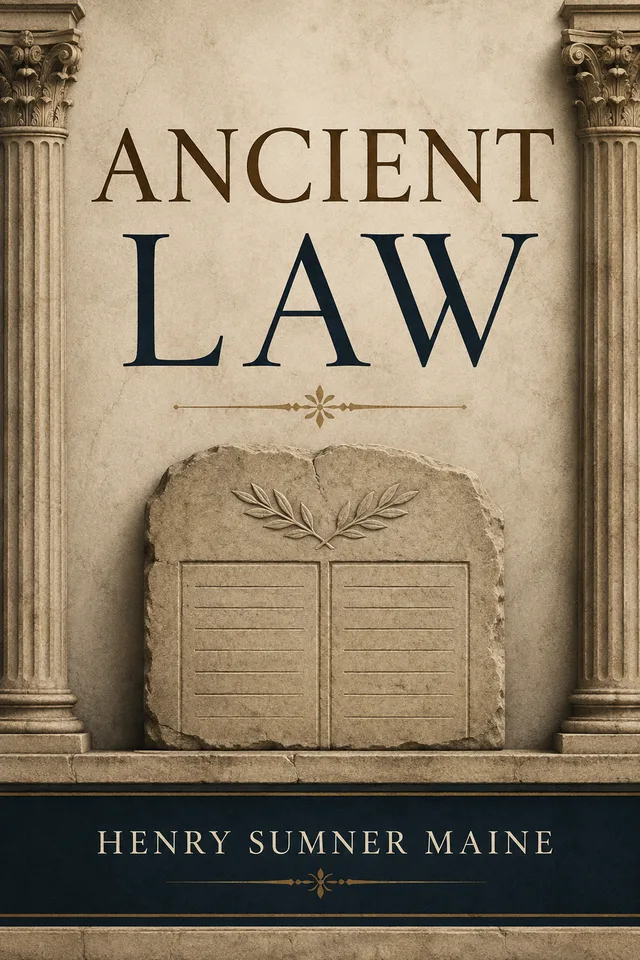
Ancient Law
English BooksWhale Edition by Henry Sumner Maine
A foundational work on law, society, custom, contract, family, property, and political development.
- Preview
- A sample from the prepared text
- Formats
- Online reader, EPUB, PDF
- Access
- Library claim
Book introduction
Ancient Law
Ancient Law traces the movement from status to contract and compares legal institutions across early societies. This English original edition is useful for readers of legal history, political theory, sociology, and institutional thought.
BooksWhale edition
How this edition was prepared
This edition is based on a public domain text and has been prepared for digital reading by BooksWhale.
Public domain basis
Why this edition can be shared
Henry Sumner Maine died in 1888, and Ancient Law was first published in 1861, supporting the public-domain basis for this English original edition.
Read preview
A sample from the prepared text
Preview selected from the prepared reader text.
Preview chapterFull textRead preview
Ancient Law
Henry Sumner Maine
Preview chapterPREFACEPreview
The chief object of the following pages is to indicate some of the earliest ideas of mankind, as they are reflected in Ancient Law, and to point out the relation of those ideas to modern thought. Much of the inquiry attempted could not have been prosecuted with the slightest hope of a useful result if there had not existed a body of law, like that of the Romans, bearing in its earliest portions the traces of the most remote antiquity and supplying from its later rules the staple of the civil institutions by which modern society is even now controlled. The necessity of taking the Roman law as a typical system has compelled the author to draw from it what may appear a disproportionate number of his illustrations; but it has not been his intention to write a treatise on Roman jurisprudence, and he has as much as possible avoided all discussions which might give that appearance to his work. The space allotted in the third and fourth chapters to certain philosophical theories of the Roman Jurisconsults has been appropriated to them for two reasons. In the first place, those theories appear to the author to have had a wider and more permanent influence on the thought and action of the world than is usually supposed. Secondly, they are believed to be the ultimate source of most of the views which have been prevalent, till quite recently, on the subjects treated of in this volume. It was impossible for the author to proceed far with his undertaking without stating his opinion on the origin, meaning, and value of those speculations.
Preview chapterH.S.M.Preview
LONDON, _January 1861_.
Table of contents
Inside this edition
- 01Full text
- 02PREFACE
- 03H.S.M.
- 04CHAPTER I
- 05ANCIENT CODES
- 06CHAPTER II
- 07LEGAL FICTIONS
- 08CHAPTER III
- 09LAW OF NATURE AND EQUITY
- 10civil.
- 11CHAPTER IV
- 12THE MODERN HISTORY OF THE LAW OF NATURE
- 13CHAPTER V
- 14PRIMITIVE SOCIETY AND ANCIENT LAW
- 15CHAPTER VI
- 16THE EARLY HISTORY OF TESTAMENTARY SUCCESSION
- 17CHAPTER VII
- 18ANCIENT AND MODERN IDEAS RESPECTING WILLS AND SUCCESSIONS
- 19CHAPTER VIII
- 20THE EARLY HISTORY OF PROPERTY
- 21CHAPTER IX
- 22THE EARLY HISTORY OF CONTRACT
- 23CHAPTER X
- 24THE EARLY HISTORY OF DELICT AND CRIME
Language availability
Other languages
Additional language editions are not published yet. This section will link to other BooksWhale editions when they become available.
Request another language