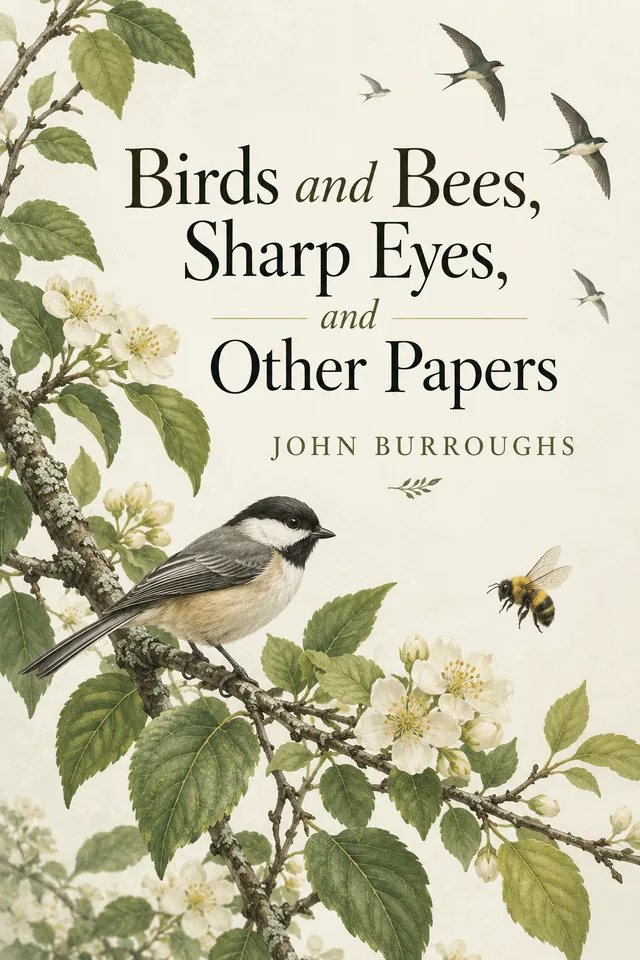
English Edition
Science
Birds and Bees, Sharp Eyes, and Other Papers
English BooksWhale Edition by John Burroughs
John Burroughs observes nesting birds, honeybees, fruit, woodland neighbors, and the patient attention that makes nature newly visible.
- Preview
- A sample from the prepared text
- Formats
- Online reader, EPUB, PDF
- Access
- Library claim
Book introduction
Birds and Bees, Sharp Eyes, and Other Papers
These nature essays turn ordinary fields, orchards, and woods into places of discovery. John Burroughs follows the dangers of nesting, the behavior of bees, the cultivation of apples, and the strategies of familiar wild animals. The collection brings together Birds and Bees with Sharp Eyes and Other Papers, inviting readers to notice the unexpected complexity of creatures and landscapes close to home.
BooksWhale edition
How this edition was prepared
This edition is based on a public domain text and has been prepared for digital reading by BooksWhale.
Public domain basis
Why this edition can be shared
Original English work by John Burroughs, who died in 1921. The source is the public-domain transcription from Project Gutenberg; modern editorial apparatus and illustrations are excluded.
Read preview
A sample from the prepared text
Preview selected from the prepared reader text.
Preview chapterBIRDS.Read preview
BIRDS.
Preview chapterBIRD ENEMIES.Preview
How surely the birds know their enemies! See how the wrens and robins and bluebirds pursue and scold the cat, while they take little or no notice of the dog! Even the swallow will fight the cat, and, relying too confidently upon its powers of flight, sometimes swoops down so near to its enemy that it is caught by a sudden stroke of the cat's paw. The only case I know of in which our small birds fail to recognize their enemy is furnished by the shrike; apparently the little birds do not know that this modest-colored bird is an assassin. At least, I have never seen them scold or molest him, or utter any outcries at his presence, as they usually do at birds of prey. Probably it is because the shrike is a rare visitant, and is not found in this part of the country during the nesting season of our songsters.
But the birds have nearly all found out the trick the jay, and when he comes sneaking through the trees in May and June in quest of eggs, he is quickly exposed and roundly abused. It is amusing to see the robins hustle him out of the tree which holds their nest. They cry "Thief, thief!" to the top of their voices as they charge upon him, and the jay retorts in a voice scarcely less complimentary as he makes off.
The jays have their enemies also, and need to keep an eye on their own eggs. It would be interesting to know if jays ever rob jays, or crows plunder crows; or is there honor among thieves even in the feathered tribes? I suspect the jay is often punished by birds which are otherwise innocent of nest-robbing. One season I found a jay's nest in a small cedar on the side of a wooded ridge. It held five eggs, every one of which had been punctured. Apparently some bird had driven its sharp beak through their shells, with the sole intention of destroying them, for no part of the contents of the eggs had been removed. It looked like a case of revenge; as if some thrush or warbler, whose nest had suffered at the hands of the jays, had watched its opportunity, and had in this way retaliated upon its enemies. An egg for an egg. The jays were lingering near, very demure and silent, and probably ready to join a crusade against nest-robbers.
The great bugaboo of the birds is the owl. The owl snatches them from off their roosts at night, and gobbles up their eggs and young in their nests. He is a veritable ogre to them, and his presence fills them with consternation and alarm.
One season, to protect my early cherries I placed a large stuffed owl amid the branches of the tree. Such a racket as there instantly began about my grounds is not pleasant to think upon! The orioles and robins fairly "shrieked out their affright." The news instantly spread in every direction, and apparently every bird in town came to see that owl in the cherry-tree, and every bird took a cherry, so that I lost more fruit than if I had left the owl in-doors. With craning necks and horrified looks the birds alighted upon the branches, and between their screams would snatch off a cherry, as if the act was some relief to their outraged feelings.
The chirp and chatter of the young of birds which build in concealed or inclosed places, like the woodpeckers, the house wren, the high-hole, the oriole, is in marked contrast to the silence of the fledglings of most birds that build open and exposed nests. The young of the sparrows,—unless the social sparrow be an exception,—warblers, fly-catchers, thrushes, never allow a sound to escape them; and on the alarm note of their parents being heard, sit especially close and motionless, while the young of chimney swallows, woodpeckers, and orioles are very noisy. The latter, in its deep pouch, is quite safe from birds of prey, except perhaps the owl. The owl, I suspect, thrusts its leg into the cavities of woodpeckers and into the pocket-like nest of the oriole, and clutches and brings forth the birds in its talons. In one case which I heard of, a screech-owl had thrust its claw into a cavity in a tree, and grasped the head of a red-headed woodpecker; being apparently unable to draw its prey forth, it had thrust its own round head into the hole, and in some way became fixed there, and had thus died with the woodpecker in its talons.
Preview chapterTHE TRAGEDIES OF THE NESTSPreview
The life of the birds, especially of our migratory song-birds, is a series of adventures and of hair-breadth escapes by flood and field. Very few of them probably die a natural death, or even live out half their appointed days. The home instinct is strong in birds as it is in most creatures; and I am convinced that every spring a large number of those which have survived the Southern campaign return to their old haunts to breed. A Connecticut farmer took me out under his porch, one April day, and showed me a phoebe bird's nest six stories high. The same bird had no doubt returned year after year; and as there was room for only one nest upon her favorite shelf, she had each season reared a new superstructure upon the old as a foundation. I have heard of a white robin—an albino—that nested several years in succession in the suburbs of a Maryland city. A sparrow with a very marked peculiarity of song I have heard several seasons in my own locality. But the birds do not all live to return to their old haunts: the bobolinks and starlings run a gauntlet of fire from the Hudson to the Savannah, and the robins and meadow-larks and other song-birds are shot by boys and pot-hunters in great numbers,—to say nothing of their danger from hawks and owls. But of those that do return, what perils beset their nests, even in the most favored localities! The cabins of the early settlers, when the country was swarming with hostile Indians, were not surrounded by such dangers. The tender households of the birds are not only exposed to hostile Indians in the shape of cats and collectors, but to numerous murderous and bloodthirsty animals, against whom they have no defense but concealment. They lead the darkest kind of pioneer life, even in our gardens and orchards, and under the walls of our houses. Not a day or a night passes, from the time the eggs are laid till the young are flown, when the chances are not greatly in favor of the nest being rifled and its contents devoured,—by owls, skunks, minks, and coons at night, and by crows, jays, squirrels, weasels, snakes, and rats during the day. Infancy, we say, is hedged about by many perils; but the infancy of birds is cradled and pillowed in peril. An old Michigan settler told me that the first six children that were born to him died; malaria and teething invariably carried them off when they had reached a certain age; but other children were born, the country improved, and by and by the babies weathered the critical period and the next six lived and grew up. The birds, too, would no doubt persevere six times and twice six times, if the season were long enough, and finally rear their family, but the waning summer cuts them short, and but a few species have the heart and strength to make even the third trial.
The first nest-builders in spring, like the first settlers near hostile tribes, suffer the most casualties. A large portion of the nests of April and May are destroyed; their enemies have been many months without eggs and their appetites are keen for them. It is a time, too, when other food is scarce, and the crows and squirrels are hard put. But the second nests of June, and still more the nests of July and August, are seldom molested. It is rarely that the nest of the goldfinch or the cedar-bird is harried.
My neighborhood on the Hudson is perhaps exceptionally unfavorable as a breeding haunt for birds, owing to the abundance of fish-crows and of red squirrels; and the season of which this chapter is mainly a chronicle, the season of 1881, seems to have been a black-letter one even for this place, for at least nine nests out of every ten that I observed during that spring and summer failed of their proper issue. From the first nest I noted, which was that of a bluebird,—built (very imprudently I thought at the time) in a squirrel-hole in a decayed apple-tree, about the last of April, and which came to naught, even the mother-bird, I suspect, perishing by a violent death,—to the last, which was that of a snow-bird, observed in August, among the Catskills, deftly concealed in a mossy bank by the side of a road that skirted a wood, where the tall thimble blackberries grew in abundance, from which the last young one was taken, when it was about half grown, by some nocturnal walker or daylight prowler, some untoward fate seemed hovering about them. It was a season of calamities, of violent deaths, of pillage and massacre, among our feathered neighbors. For the first time I noticed that the orioles were not safe in their strong, pendent nests. Three broods were started in the apple-trees, only a few yards from the house, where, for previous seasons, the birds had nested without molestation; but this time the young were all destroyed when about half grown. Their chirping and chattering, which was so noticeable one day, suddenly ceased the next. The nests were probably plundered at night, and doubtless by the little red screech-owl, which I know is a denizen of these old orchards, living in the deeper cavities of the trees. The owl could alight on the top of the nest, and easily thrust his murderous claw down into its long pocket and seize the young and draw them forth. The tragedy of one of the nests was heightened, or at least made more palpable, by one of the half-fledged birds, either in its attempt to escape or while in the clutches of the enemy, being caught and entangled in one of the horse-hairs by which the nest was stayed and held to the limb above. There it hung bruised and dead, gibbeted to its own cradle. This nest was the theatre of another little tragedy later in the season. Some time in August a bluebird, indulging its propensity to peep and pry into holes and crevices, alighted upon it and probably inspected the interior; but by some unlucky move it got its wings entangled in this same fatal horse-hair. Its efforts to free itself appeared only to result in its being more securely and hopelessly bound; and there it perished; and there its form, dried and embalmed by the summer heats, was yet hanging in September, the outspread wings and plumage showing nearly as bright as in life.
Table of contents
Inside this edition
- 01BIRDS.
- 02BIRD ENEMIES.
- 03THE TRAGEDIES OF THE NESTS
- 04BEES.
- 05AN IDYL OF THE HONEY-BEE.
- 06THE PASTORAL BEES
- 07II. SHARP EYES AND OTHER PAPERS
- 08SHARP EYES.
- 09THE APPLE.
- 10A TASTE OF MAINE BIRCH.
- 11WINTER NEIGHBORS.
- 12NOTES BY THE WAY.
- 13I. THE WEATHER-WISE MUSKRAT
- 14II. CHEATING THE SQUIRRELS.
- 15III. FOX AND HOUND.
- 16IV. THE WOODCHUCK
Language availability
Other languages
Additional language editions are not published yet. This section will link to other BooksWhale editions when they become available.
Request another language