English Edition
Literature
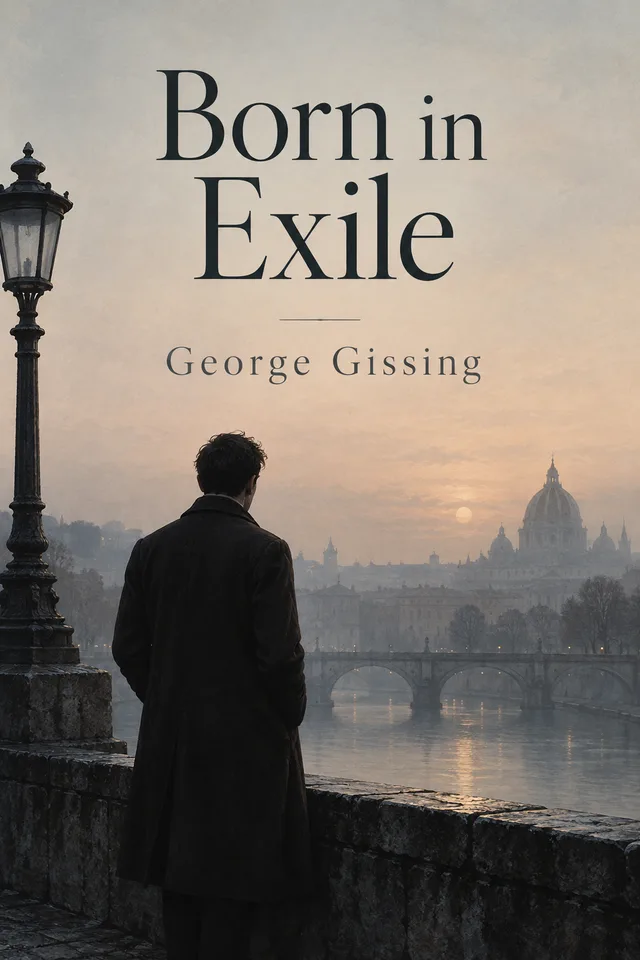
Born in Exile
English BooksWhale Edition by George Gissing
A late-Victorian novel of class anxiety, ambition, unbelief, and intellectual pride.
- Preview
- A sample from the prepared text
- Formats
- Online reader, EPUB, PDF
- Access
- Library claim
Book introduction
Born in Exile
Born in Exile follows Godwin Peak, an intelligent outsider whose social ambition and religious skepticism draw him into deception and moral conflict. George Gissing gives the novel a tense portrait of education, class mobility, and spiritual uncertainty.
BooksWhale edition
How this edition was prepared
This edition is based on a public domain text and has been prepared for digital reading by BooksWhale.
Public domain basis
Why this edition can be shared
George Gissing died in 1903, and Born in Exile was first published in 1892, supporting the public-domain basis for this English original edition.
Read preview
A sample from the prepared text
Preview selected from the prepared reader text.
Preview chapterFull textRead preview
Born in Exile
George Gissing
Born in Exile
By
George Gissing
JTABLE 4 7 1
Preview chapterPart IPreview
Part I
Preview chapterCHAPTER IPreview
The summer day in 1874 which closed the annual session of Whitelaw College was marked by a special ceremony, preceding the wonted distribution of academic rewards. At eleven in the morning (just as a heavy shower fell from the smoke-canopy above the roaring streets) the municipal authorities, educational dignitaries, and prominent burgesses of Kingsmill assembled on an open space before the College to unveil a statue of Sir Job Whitelaw. The honoured baronet had been six months dead. Living, he opposed the desire of his fellow-citizens to exhibit even on canvas his gnarled features and bald crown; but when his modesty ceased to have a voice in the matter, no time was lost in raising a memorial of the great manufacturer, the self-made millionaire, the borough member in three Parliaments, the enlightened and benevolent founder of an institute which had conferred humane distinction on the money-making Midland town. Beneath such a sky, orations were necessarily curtailed; but Sir Job had always been impatient of much talk. An interval of two or three hours dispersed the rain-clouds and bestowed such grace of sunshine as Kingsmill might at this season temperately desire; then, whilst the marble figure was getting dried,--with soot-stains which already foretold its negritude of a year hence,--again streamed towards the College a varied multitude, official, parental, pupillary. The students had nothing distinctive in their garb, but here and there flitted the cap and gown of Professor or lecturer, signal for doffing of beavers along the line of its progress.
Among the more deliberate of the throng was a slender, upright, ruddy-cheeked gentleman of middle age, accompanied by his wife and a daughter of sixteen. On alighting from a carriage, they first of all directed their steps towards the statue, conversing together with pleasant animation. The father (Martin Warricombe, Esq. of Thornhaw, a small estate some five miles from Kingsmill,) had a countenance suggestive of engaging qualities--genial humour, mildness, a turn for meditation, perhaps for study. His attire was informal, as if he disliked abandoning the freedom of the country even when summoned to urban ceremonies. He wore a grey felt hat, and a light jacket which displayed the straightness of his shoulders. Mrs. Warricombe and her daughter were more fashionably equipped, with taste which proclaimed their social standing. Save her fresh yet delicate complexion the lady had no particular personal charm. Of the young girl it could only be said that she exhibited a graceful immaturity, with perchance a little more earnestness than is common at her age; her voice, even when she spoke gaily, was seldom audible save by the person addressed.
Coming to a pause before Sir Job, Mr. Warricombe put on a pair of eyeglasses which had dangled against his waistcoat, and began to scrutinise carefully the sculptured lineaments. He was addressing certain critical remarks to his companions when an interruption appeared in the form of a young man whose first words announced his relation to the group.
'I say, you're very late! There'll be no getting a decent seat, if you don't mind. Leave Sir Job till afterwards.'
'The statue somehow disappoints me,' observed his father, placidly.
'Oh, it isn't bad, I think,' returned the youth, in a voice not unlike his father's, save for a note of excessive self-confidence. He looked about eighteen; his comely countenance, with its air of robust health and habitual exhilaration, told of a boyhood passed amid free and joyous circumstances. It was the face of a young English plutocrat, with more of intellect than such visages are wont to betray; the native vigour of his temperament had probably assimilated something of the modern spirit. 'I'm glad,' he continued, 'that they haven't stuck him in a toga, or any humbug of that sort. The old fellow looks baggy, but so he was. They ought to have kept his chimney-pot, though. Better than giving him those scraps of hair, when everyone knows he was as bald as a beetle.'
Table of contents
Inside this edition
- 01Full text
- 02Part I
- 03CHAPTER I
- 04CHAPTER II
- 05CHAPTER III
- 06CHAPTER IV
- 07CHAPTER V
- 08Part II
- 09CHAPTER I
- 10CHAPTER II
- 11CHAPTER III
- 12CHAPTER IV
- 13Part III
- 14CHAPTER I
- 15CHAPTER II
- 16CHAPTER III
- 17CHAPTER IV
- 18CHAPTER V
- 19Part IV
- 20CHAPTER I
- 21CHAPTER II
- 22CHAPTER III
- 23CHAPTER IV
- 24CHAPTER V
- 25Part V
- 26CHAPTER I
- 27CHAPTER II
- 28CHAPTER III
- 29CHAPTER IV
- 30Part VI
- 31CHAPTER I
- 32CHAPTER II
- 33CHAPTER III
- 34CHAPTER IV
- 35Part VII
- 36CHAPTER I
- 37CHAPTER II
- 38CHAPTER III
Language availability
Other languages
Additional language editions are not published yet. This section will link to other BooksWhale editions when they become available.
Request another language