English Edition
Literature
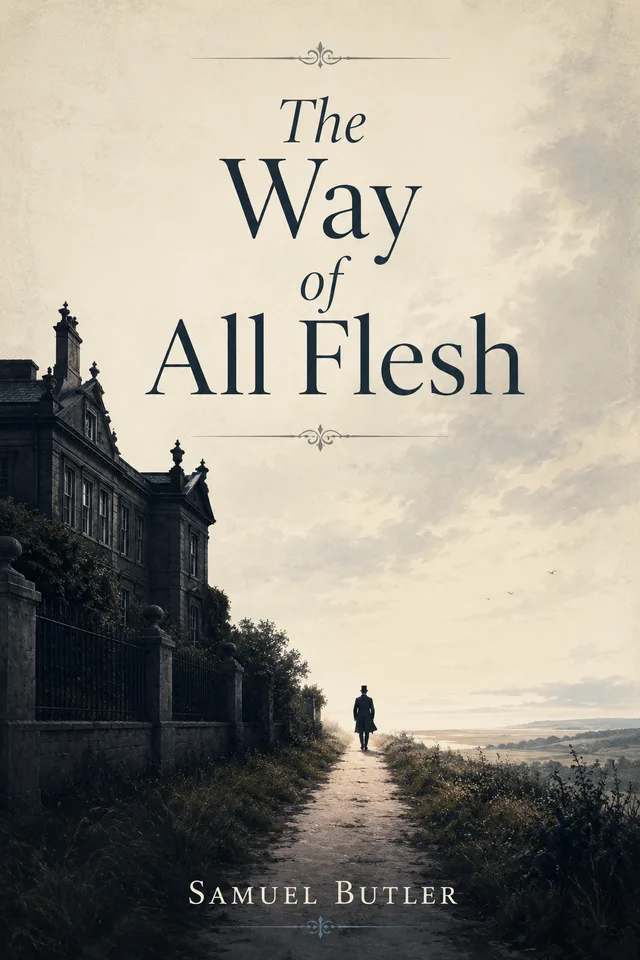
The Way of All Flesh
English BooksWhale Edition by Samuel Butler
A sharp family novel about Victorian authority, hypocrisy, inheritance, and one young man’s escape into intellectual freedom.
- Preview
- A sample from the prepared text
- Formats
- Online reader, EPUB, PDF
- Access
- Library claim
Book introduction
The Way of All Flesh
The Way of All Flesh follows Ernest Pontifex through a household ruled by piety, punishment, and social expectation. Samuel Butler turns family history into a satire of Victorian education, religion, class manners, and inherited obedience, while tracing the difficult formation of an independent mind.
BooksWhale edition
How this edition was prepared
This edition is based on a public domain text and has been prepared for digital reading by BooksWhale.
Public domain basis
Why this edition can be shared
Samuel Butler died in 1902; the work was first published around 1903. These dates support the public-domain basis for this English edition.
Read preview
A sample from the prepared text
Preview selected from the prepared reader text.
Preview chapterFull textRead preview
The Way of All Flesh
by Samuel Butler
“We know that all things work together for good to them that love God.”—ROM. viii. 28
Preview chapterPREFACEPreview
Samuel Butler began to write “The Way of All Flesh” about the year 1872, and was engaged upon it intermittently until 1884. It is therefore, to a great extent, contemporaneous with “Life and Habit,” and may be taken as a practical illustration of the theory of heredity embodied in that book. He did not work at it after 1884, but for various reasons he postponed its publication. He was occupied in other ways, and he professed himself dissatisfied with it as a whole, and always intended to rewrite or at any rate to revise it. His death in
1902 prevented him from doing this, and on his death-bed he gave me
clearly to understand that he wished it to be published in its present form. I found that the MS. of the fourth and fifth chapters had disappeared, but by consulting and comparing various notes and sketches, which remained among his papers, I have been able to supply the missing chapters in a form which I believe does not differ materially from that which he finally adopted. With regard to the chronology of the events recorded, the reader will do well to bear in mind that the main body of the novel is supposed to have been written in the year 1867, and the last chapter added as a postscript in 1882.
R. A. STREATFEILD.
Preview chapterCHAPTER IPreview
When I was a small boy at the beginning of the century I remember an old man who wore knee-breeches and worsted stockings, and who used to hobble about the street of our village with the help of a stick. He must have been getting on for eighty in the year 1807, earlier than which date I suppose I can hardly remember him, for I was born in 1802. A few white locks hung about his ears, his shoulders were bent and his knees feeble, but he was still hale, and was much respected in our little world of Paleham. His name was Pontifex.
His wife was said to be his master; I have been told she brought him a little money, but it cannot have been much. She was a tall, square-shouldered person (I have heard my father call her a Gothic woman) who had insisted on being married to Mr Pontifex when he was young and too good-natured to say nay to any woman who wooed him. The pair had lived not unhappily together, for Mr Pontifex’s temper was easy and he soon learned to bow before his wife’s more stormy moods.
Mr Pontifex was a carpenter by trade; he was also at one time parish clerk; when I remember him, however, he had so far risen in life as to be no longer compelled to work with his own hands. In his earlier days he had taught himself to draw. I do not say he drew well, but it was surprising he should draw as well as he did. My father, who took the living of Paleham about the year 1797, became possessed of a good many of old Mr Pontifex’s drawings, which were always of local subjects, and so unaffectedly painstaking that they might have passed for the work of some good early master. I remember them as hanging up framed and glazed in the study at the Rectory, and tinted, as all else in the room was tinted, with the green reflected from the fringe of ivy leaves that grew around the windows. I wonder how they will actually cease and come to an end as drawings, and into what new phases of being they will then enter.
Not content with being an artist, Mr Pontifex must needs also be a musician. He built the organ in the church with his own hands, and made a smaller one which he kept in his own house. He could play as much as he could draw, not very well according to professional standards, but much better than could have been expected. I myself showed a taste for music at an early age, and old Mr Pontifex on finding it out, as he soon did, became partial to me in consequence.
It may be thought that with so many irons in the fire he could hardly be a very thriving man, but this was not the case. His father had been a day labourer, and he had himself begun life with no other capital than his good sense and good constitution; now, however, there was a goodly show of timber about his yard, and a look of solid comfort over his whole establishment. Towards the close of the eighteenth century and not long before my father came to Paleham, he had taken a farm of about ninety acres, thus making a considerable rise in life. Along with the farm there went an old-fashioned but comfortable house with a charming garden and an orchard. The carpenter’s business was now carried on in one of the outhouses that had once been part of some conventual buildings, the remains of which could be seen in what was called the Abbey Close. The house itself, embosomed in honeysuckles and creeping roses, was an ornament to the whole village, nor were its internal arrangements less exemplary than its outside was ornamental. Report said that Mrs Pontifex starched the sheets for her best bed, and
Table of contents
Inside this edition
- 01Full text
- 02PREFACE
- 03CHAPTER I
- 04I can well believe it.
- 05I differed from my father.
- 06CHAPTER II
- 07CHAPTER III
- 08CHAPTER IV
- 09I hear a silent tongue that speaks thy praise.
- 10CHAPTER V
- 11CHAPTER VI
- 12CHAPTER VII
- 13CHAPTER VIII
- 14CHAPTER IX
- 15CHAPTER X
- 16CHAPTER XI
- 17CHAPTER XII
- 18CHAPTER XIII
- 19CHAPTER XIV
- 20CHAPTER XV
- 21CHAPTER XVI
- 22CHAPTER XVII
- 23CHAPTER XVIII
- 24CHAPTER XIX
- 25I will continue my story.
- 26CHAPTER XX
- 27CHAPTER XXI
- 28CHAPTER XXII
- 29CHAPTER XXIII
- 30CHAPTER XXIV
- 31CHAPTER XXV
- 32CHAPTER XXVI
- 33CHAPTER XXVII
- 34CHAPTER XXVIII
- 35CHAPTER XXIX
- 36CHAPTER XXX
- 37CHAPTER XXXI
- 38CHAPTER XXXII
- 39CHAPTER XXXIII
- 40CHAPTER XXXIV
- 41CHAPTER XXXV
- 42CHAPTER XXXVI
- 43CHAPTER XXXVII
- 44CHAPTER XXXVIII
- 45CHAPTER XXXIX
- 46CHAPTER XL
- 47CHAPTER XLI
- 48I means and I’ll stick to—character or no character.”
- 49CHAPTER XLII
- 50X
- 51CHAPTER XLIII
- 52CHAPTER XLIV
- 53CHAPTER XLV
- 54CHAPTER XLVI
- 55CHAPTER XLVII
- 56CHAPTER XLVIII
- 57CHAPTER XLIX
- 58CHAPTER L
- 59CHAPTER LI
- 60CHAPTER LII
- 61CHAPTER LIII
- 62I continue turning over my file of Ernest’s letters and find as follows—
- 63CHAPTER LIV
- 64I think this may do for the present.
- 65CHAPTER LV
- 66CHAPTER LVI
- 67CHAPTER LVII
- 68CHAPTER LVIII
- 69CHAPTER LIX
- 70CHAPTER LX
- 71CHAPTER LXI
- 72I got her into a cab with me, and we went off to the police station. She talked without ceasing.
- 73CHAPTER LXII
- 74CHAPTER LXIII
- 75CHAPTER LXIV
- 76CHAPTER LXV
- 77CHAPTER LXVI
- 78CHAPTER LXVII
- 79C. P.”
- 80CHAPTER LXVIII
- 81CHAPTER LXIX
- 82CHAPTER LXX
- 83CHAPTER LXXI
- 84I think the devil must have chuckled and made tolerably sure of his game this time.
- 85CHAPTER LXXII
- 86CHAPTER LXXIII
- 87CHAPTER LXXIV
- 88CHAPTER LXXV
- 89CHAPTER LXXVI
- 90CHAPTER LXXVII
- 91CHAPTER LXXVIII
- 92CHAPTER LXXIX
- 93I explained that there was no occasion to consider money in this case.
- 94CHAPTER LXXX
- 95CHAPTER LXXXI
- 96I begged him to keep quiet a little longer and not talk about taking a shop.
- 97I said: “You cannot tell your father and mother—it would drive them mad.”
- 98CHAPTER LXXXII
- 99I knew he would come, I knew, I knew he could come.”
- 100CHAPTER LXXXIII
- 101CHAPTER LXXXIV
- 102I had already long since come to that conclusion myself.
- 103CHAPTER LXXXV
- 104CHAPTER LXXXVI
- 105I may presently take
Language availability
Other languages
Additional language editions are not published yet. This section will link to other BooksWhale editions when they become available.
Request another language