English Edition
Literature
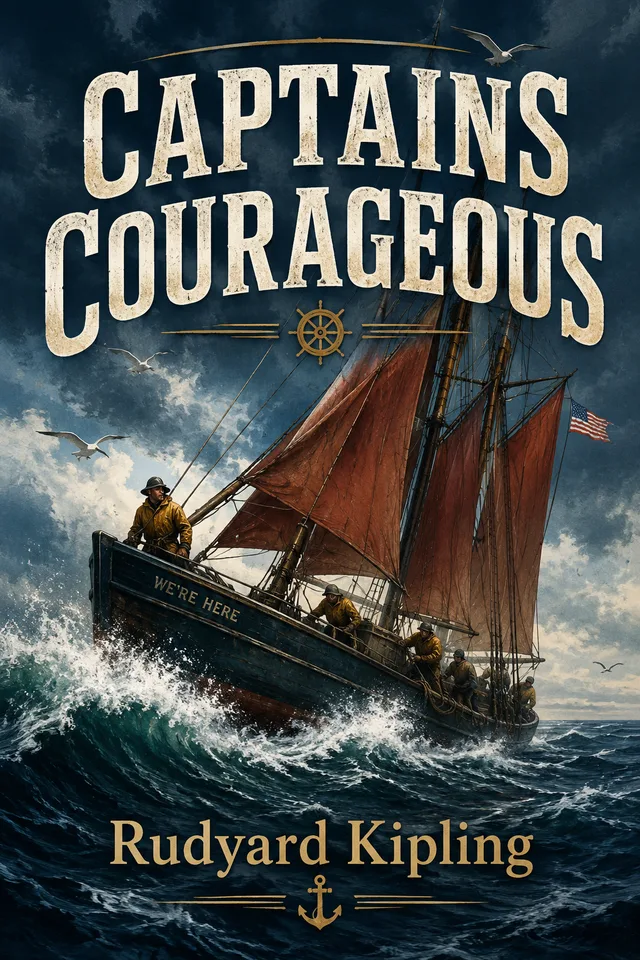
Captains Courageous
English BooksWhale Edition by Rudyard Kipling
Kipling’s sea adventure about a spoiled boy reshaped by labor, danger, and fellowship on a fishing schooner.
- Preview
- A sample from the prepared text
- Formats
- Online reader, EPUB, PDF
- Access
- Library claim
Book introduction
Captains Courageous
“Captains Courageous” sends Harvey Cheyne from privilege into the hard discipline of the North Atlantic fishing world. Kipling’s novel combines maritime adventure, coming-of-age transformation, nautical detail, and a tough ethic of skill and work.
BooksWhale edition
How this edition was prepared
This edition is based on a public domain text and has been prepared for digital reading by BooksWhale.
Public domain basis
Why this edition can be shared
Captains Courageous is a public-domain work: the author died in 1936, and the text was first published in 1897. This edition uses the original English text.
Read preview
A sample from the prepared text
Preview selected from the prepared reader text.
Preview chapterFull textRead preview
Captains Courageous
Preview chapterA STORY OF THE GRAND BANKSPreview
by
Rudyard Kipling
TO JAMES CONLAND, M.D., Brattleboro, Vermont
I ploughed the land with horses, But my heart was ill at ease, For the old sea-faring men Came to me now and then, With their sagas of the seas.
Longfellow.
Preview chapterCHAPTER IPreview
The weather door of the smoking-room had been left open to the North Atlantic fog, as the big liner rolled and lifted, whistling to warn the fishing-fleet.
"That Cheyne boy's the biggest nuisance aboard," said a man in a frieze overcoat, shutting the door with a bang. "He isn't wanted here. He's too fresh."
A white-haired German reached for a sandwich, and grunted between bites: "I know der breed. Ameriga is full of dot kind. I dell you you should imbort ropes' ends free under your dariff."
"Pshaw! There isn't any real harm to him. He's more to be pitied than anything," a man from New York drawled, as he lay at full length along the cushions under the wet skylight. "They've dragged him around from hotel to hotel ever since he was a kid. I was talking to his mother this morning. She's a lovely lady, but she don't pretend to manage him. He's going to Europe to finish his education."
"Education isn't begun yet." This was a Philadelphian, curled up in a corner. "That boy gets two hundred a month pocket-money, he told me. He isn't sixteen either."
"Railroads, his father, aind't it?" said the German.
"Yep. That and mines and lumber and shipping. Built one place at San Diego, the old man has; another at Los Angeles; owns half a dozen railroads, half the lumber on the Pacific slope, and lets his wife spend the money," the Philadelphian went on lazily. "The West don't suit her, she says. She just tracks around with the boy and her nerves, trying to find out what'll amuse him, I guess. Florida, Adirondacks, Lakewood, Hot Springs, New York, and round again. He isn't much more than a second-hand hotel clerk now. When he's finished in Europe he'll be a holy terror."
"What's the matter with the old man attending to him personally?" said a voice from the frieze ulster.
"Old man's piling up the rocks. 'Don't want to be disturbed, I guess. He'll find out his error a few years from now. 'Pity, because there's a heap of good in the boy if you could get at it."
"Mit a rope's end; mit a rope's end!" growled the German.
Once more the door banged, and a slight, slim-built boy perhaps fifteen years old, a half-smoked cigarette hanging from one corner of his mouth, leaned in over the high footway. His pasty yellow complexion did not show well on a person of his years, and his look was a mixture of irresolution, bravado, and very cheap smartness. He was dressed in a cherry-coloured blazer, knickerbockers, red stockings, and bicycle shoes, with a red flannel cap at the back of the head. After whistling between his teeth, as he eyed the company, he said in a loud, high voice: "Say, it's thick outside. You can hear the fish-boats squawking all around us. Say, wouldn't it be great if we ran down one?"
"Shut the door, Harvey," said the New Yorker. "Shut the door and stay outside. You're not wanted here."
"Who'll stop me?" he answered, deliberately. "Did you pay for my passage, Mister Martin? 'Guess I've as good right here as the next man."
He picked up some dice from a checkerboard and began throwing, right hand against left.
"Say, gen'elmen, this is deader'n mud. Can't we make a game of poker between us?"
There was no answer, and he puffed his cigarette, swung his legs, and drummed on the table with rather dirty fingers. Then he pulled out a roll of bills as if to count them.
"How's your mamma this afternoon?" a man said. "I didn't see her at lunch."
"In her state-room, I guess. She's 'most always sick on the ocean. I'm going to give the stewardess fifteen dollars for looking after her. I don't go down more 'n I can avoid. It makes me feel mysterious to pass that butler's-pantry place. Say, this is the first time I've been on the ocean."
Table of contents
Inside this edition
- 01Full text
- 02A STORY OF THE GRAND BANKS
- 03CHAPTER I
- 04CHAPTER II
- 05CHAPTER III
- 06CHAPTER IV
- 07CHAPTER V
- 08CHAPTER VI
- 09CHAPTER VII
- 10CHAPTER VIII
- 11CHAPTER IX
- 12CHAPTER X
Language availability
Other languages
Additional language editions are not published yet. This section will link to other BooksWhale editions when they become available.
Request another language