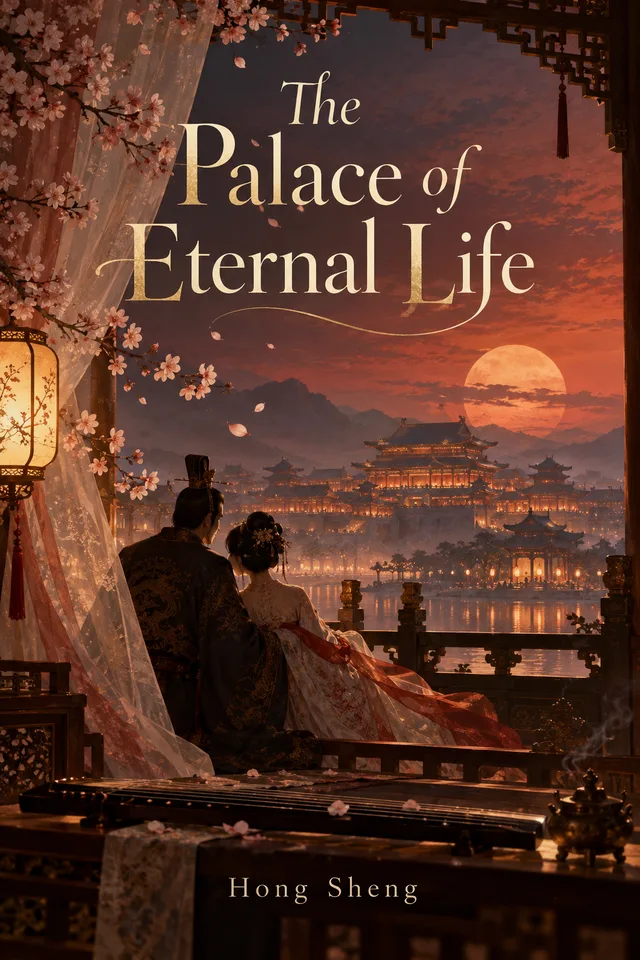
English Edition
Literature
The Palace of Eternal Life
English BooksWhale Edition by Hong Sheng
Original title: 长生殿
A landmark Qing drama of imperial love, music, memory, rebellion, and tragic splendor.
- Preview
- A sample from the prepared text
- Formats
- Online reader, EPUB, PDF
- Access
- Library claim
Book introduction
The Palace of Eternal Life
The Palace of Eternal Life is one of the great classical Chinese dramas, centered on Emperor Xuanzong, Yang Guifei, love, political disorder, memory, and the cost of desire. This English edition introduces Hong Sheng’s theatrical masterpiece to readers interested in Chinese opera, court romance, and historical tragedy.
BooksWhale edition
How this edition was prepared
This edition is based on a public domain text and has been prepared for digital reading by BooksWhale.
Public domain basis
Why this edition can be shared
Hong Sheng died in 1704, and The Palace of Eternal Life was completed around 1688. These dates support the public-domain basis for the Chinese source text; this English edition uses an authorized translation prepared from that source.
Read preview
A sample from the prepared text
Preview selected from the prepared reader text.
Preview chapterFull textRead preview
The Palace of Eternal Life
洪昇
Preview chapterForewordPreview
Among the masterpieces of Chinese classical drama, The Palace of Eternal Life (Changsheng Dian) by Hong Sheng (1645–1704) stands as a lyrical summit of emotional depth and poetic grandeur. Written during the early Qing dynasty, it transforms the historical tragedy of Emperor Xuanzong of Tang and his beloved consort Yang Guifei into a cosmic meditation on love, loss, and immortality. Drawing upon Bai Juyi’s celebrated poem The Song of Everlasting Sorrow and the Biography of the Song of Everlasting Sorrow by Chen Hong, Hong Sheng expanded a brief episode of history into a magnificent forty-scene drama that blends realism with transcendence, passion with moral reflection. At its heart, The Palace of Eternal Life explores the tension between earthly desire and heavenly order. The love between the emperor and Yang Guifei is depicted with exquisite tenderness, yet their happiness provokes the downfall of an empire. When rebellion forces the emperor to order Yang’s death at Mawei Slope, human affection confronts the demands of political destiny. But Hong Sheng refuses to leave the story in despair. Through divine intervention, Yang’s spirit is transported to the celestial realm, where the lovers are ultimately reunited beyond time and mortality. In this way, the play transforms personal tragedy into metaphysical reconciliation — a poetic vision of eternity that transcends the suffering of the world.
Stylistically, Hong Sheng’s drama epitomizes the mature chuanqi form: refined, musically sophisticated, and rich in allusion. Its verse passages, alternating between delicate lyricism and grand rhetoric, evoke the aesthetic ideals of late Ming and early Qing culture — a world still haunted by political collapse but consoled by art’s promise of permanence. The playwright’s command of language rivals that of Tang Xianzu, author of The Peony Pavilion, yet Hong’s tone is more restrained, his moral outlook more Confucian. He wrote not merely to lament passion’s ruin, but to reveal how true affection, purified by trial, becomes eternal. The Palace of Eternal Life is therefore more than a love story; it is a philosophical allegory of harmony between Heaven and humanity. Its enduring beauty lies in the balance it achieves between sensual imagery and spiritual vision, between historical narrative and cosmic imagination. For over three centuries, it has remained one of the most beloved works of the Chinese stage — performed, quoted, and cherished for its universal message: that love, when sincere and self-transcending, can conquer death itself. Through Hong Sheng’s masterful art, the sorrow of impermanence becomes the promise of eternity.
Preface to The Palace of Eternal Life Having read Bai Letian’s (Bai Juyi’s) Song of Everlasting Sorrow and the Yuan playwright’s Autumn Rain on the Phoenix Tree, I would often feel uneasy for several days afterward. The southern play Startled Swan also borders on the obscene. From ancient times, playwrights of romantic tales have won fame by their depictions of love; yet in recent works, most are entirely fictitious, filled with endless exchanges of sentimental verses—common enough, yet departing from classical propriety. Therefore, I have taken fragments from history, borrowing the story of the Tianbao reign, and woven them into this play. All indecent expressions found in historical records I have entirely deleted—not to conceal blemishes, but to follow the moral sincerity of poets and scholars. Nevertheless, joy taken to the extreme must lead to sorrow; this, too, serves as a warning to future generations.
Throughout all ages, whenever people have indulged in luxury and pursued sensual desires, ruin and regret have inevitably followed. The Lady Yang, though she overturned a nation with her beauty, perished in the end. If she had knowledge after death, how boundless her remorse would be! Were it not for the depth of her regret and resentment, how could one speak of her attaining immortality? Confucius, when editing the Book of Documents, included the “Oath of Qin,” praising its ruler for repenting after defeat—perhaps this is a similar case. Yet it is difficult for a play to end with pure elegance; I have therefore borrowed the Moon Palace to bring the work to completion. Indeed, the moment when one listens to music in the Palace of Cold Radiance (Guanghan) is also the day of one’s ascent to immortality. The lovers, reunited as twin stars, are born again in the heaven of Trāyastriṃśa; but in the end, all attachments of love return to emptiness. When, in the still night, one hears the distant bell, one may awaken from the dream at last.
Preview chapterAct 1: General IntroductionPreview
[Tune: Nanlü – Prologue] [Manjianghong] (Secondary Male enters.) In love’s arena through all ages, Who has ever been true to the end? Yet if two hearts are sincerely bound, Their union shall endure forever. What matter if a thousand miles divide the South from the North? What of life and death, when two hearts are one? I laugh at the men and women of the world, Sorrowing over their missed and hindered fates— They only lack true feeling. Ah, the griefs of love’s realm! Those who have love but no destiny are countless indeed. Yet if one speaks in terms of life and death, Love’s bond ever draws souls together; Thus the trees by the Green Mound bear witness to it. Their constancy moves metal and stone, Stirs Heaven and Earth, Shines beneath the bright sun, And is inscribed in enduring history. Loyal ministers and filial sons alike— All spring from the power of feeling. The sages did not abolish the music of Zheng and Wei,
And we, their followers, seek meaning through musical transformation. Borrowing from The Outer Biography of Lady Yang Taizhen, I compose new songs— They speak only of feeling. The household prelude must trace every strand of emotion, And the whole should flow with unbroken breath. Modern playwrights have long forgotten this method; In this work, The Melody of Guangling is revived anew. [Tune: Zhonglü – Slow Verse] [Qinyuanchun] During the Tianbao reign of Emperor Xuanzong, His consort, Lady Yang Yuhuan, Was bound to him by a predestined love from a former life. (Emphasize the words “predestined love”—they prove the heavenly link that joins beginning and end.) From the bath at Huaqing, she first received imperial favor; At the Festival of the Seven Sisters, they vowed eternal devotion with fragrant incense. Her wondrous dance newly created, Her clear song not yet ended— When suddenly, the war drums of Fanyang thundered in revolt.
At Mawei Post, the six armies refused to march, And she, the adorned beauty, met her doom. The Emperor’s westward flight to Shu was filled with sorrow; In the realms below and above, they were forever sundered. Yet her wandering spirit repented and was admitted among the immortals; When the Emperor returned and reburied her, only the sachet remained. The Cowherd and the Weaving Maid bore witness to their love, And the Immortal Messenger carried the paired tokens— The gold hairpin and the jade box—to her once more. In the Moon Palace they met again; The story of the Rainbow Skirt Dance spread far and wide in verse and song. (Commentary by Xu: In the tune [Qinyuanchun], five sets of parallel couplets adhere perfectly to the musical mode.) Emperor Ming of Tang delighted in the Rainbow Skirt Banquet; Lady Yang’s soul was broken by the rebellion at Yuyang. The guest from the Hongdu Academy led a meeting in the Palace of Cold Radiance;
The Weaving Maid’s starry vow bore witness to the Palace of Eternal Life.
Table of contents
Inside this edition
- 01Full text
- 02Foreword
- 03Act 1: General Introduction
- 04Act 2: The Pledge of Love
- 05Act 3: Buying Influence
- 06Act 4: Spring Slumber
- 07Act 5: The Spring Outing at the Purification Festival
- 08Act 6: The Whispered Suspicion
- 09Act 7: The Favor Enjoyed
- 10Act 8: Offering Her Hair
- 11Act 9: The Recall
- 12Act 10: The Ominous Prophecy
- 13Act 11: Hearing the Music
- 14Act 12: Composing the Melody
- 15Act 13: The Deceit of Power
- 16Act 14: Stealing the Melody
- 17Act 15: Presenting the Fruit
- 18Act 16: The Dance of the Jade Plate
- 19Act 17: The Encirclement
- 20Act 18: Night of Resentment
- 21Act 19: The Brocade Tower
- 22Act 20: The Intelligence Report
- 23Act 21: Spying on the Bath
- 24Act 22: The Secret Oath
- 25Act 23: The Fall of Tong Pass
- 26Act 24: The Sudden Upheaval
- 27Act 25: The Burial of the Jade
- 28Act 26: Offering of Rice
- 29Act 27: The Spirit’s Pursuit
- 30Act 28: Cursing the Traitor
- 31Scene 2 – The Rebel’s Feast
- 32Act 29: Hearing the Bells
- 33Act 30: Repentance of Love
- 34Scene 1: The Desolate Shrine at Mawei
- 35Scene 2: The Spirit Appears
- 36Act 31: Suppressing the Rebels
- 37Scene 1: The Tang Army Assembles
- 38Scene 2: The Rebel Camp
- 39Scene 3: The Battle
- 40Act 32: The Image
- 41Scene 1: The Emperor’s Reflection
- 42Scene 2: The Temple Dedication
- 43Act 33: The Divine Appeal
- 44Scene 1 — The Weaver Girl Descends
- 45Scene 2 — The Earth God Appears
- 46Scene 3 — The Tale of the Wronged Spirit
- 47Scene 4 — The Death at Mawei
- 48Scene 5 — The Ghost’s Feelings
- 49Scene 6 — Her Repentance
- 50Scene 7 — The Weaver Girl’s Judgment
- 51Act 34: The Assassination of the Traitor
- 52Scene 1 — Li Zhu’er’s Plot
- 53Scene 2 — The Emperor’s Chamber
- 54Scene 3 — The Murder
- 55Scene 4 — The Alarm
- 56Act 35: The Recovery of the Capital
- 57Scene 1 — The Triumphant Return
- 58Scene 2 — Restoring Order
- 59Scene 3 — Preparing to Welcome the Emperor
- 60Act 36: Viewing the Stocking
- 61Scene 1 — The Innkeeper’s Treasure
- 62Scene 2 — The Guests Arrive
- 63Scene 3 — The Soldier Joins
- 64Scene 4 — The Viewing
- 65Act 37: The Transformation of the Corpse
- 66Scene 1 — The Wandering Spirit
- 67Scene 2 — Return to the Palace
- 68Scene 3 — Memories at the Hall of Eternal Life
- 69Scene 4 — The Bridge of Distant Looking
- 70Scene 5 — The Place of Death
- 71Scene 6 — The Heavenly Edict
- 72Scene 7 — The Resurrection
- 73Scene 8 — The Departure to Heaven
- 74Scene 9 — The Ascension
- 75Act 38: The Song of the Pipa
- 76Scene 1 — The Old Musician’s Lament
- 77Scene 2 — Li Guinian’s Song
- 78Scene 3 — The Old Glory Remembered
- 79Scene 4 — The Young Seeker
- 80Scene 5 — The Gathering at Jiu Peak Temple
- 81Scene 6 — The Ballad of the Tang Dynasty
- 82Scene 7 — The Entry of Lady Yang
- 83Scene 8 — The Emperor’s Devotion
- 84Scene 9 — The “Rainbow Skirt and Feathered Robe”
- 85Scene 10 — The Fall of Chang’an
- 86Scene 11 — The Death at Mawei
- 87Scene 12 — The Desolation of Chang’an
- 88Scene 13 — The Revelation
- 89Act 39: The Private Memorial
- 90Scene 1 — The Nuns of the Pure Maiden Convent
- 91Scene 2 — Memories of the Palace
- 92Scene 3 — The Secret Memorial
- 93Scene 4 — The Old Musician Returns
- 94Scene 5 — The Reunion
- 95Scene 6 — Shared Lament
- 96Act 40: The Immortal Remembrance
- 97Scene 1 — The Immortal Returns
- 98Scene 2 — The Memory of Separation
- 99Scene 3 — The Lunar Envoy Arrives
- 100Scene 4 — The Purpose Revealed
- 101Act 41: Beholding the Moon
- 102Scene 1 — The Emperor’s Return
- 103Scene 2 — The Emperor’s Solitude
- 104Scene 3 — The Moonlight and the Tomb
- 105Scene 4 — The Emperor’s Sorrow Deepens
- 106Scene 5 — The Final Soliloquy
- 107Act 42: The Post Station Prepares
- 108Scene 1 — The Postmaster’s Panic
- 109Scene 2 — The “Female” Workers
- 110Scene 3 — The Old Woman and the Stocking
- 111Scene 4 — The Burial Drill
- 112Act 43: The Reburial
- 113Scene 1 — The Emperor’s Return to Mawei
- 114Scene 2 — The Emperor’s Lament
- 115Scene 3 — The Empty Grave
- 116Scene 4 — The Mystery of the Missing Body
- 117Scene 5 — The Reburial Completed
- 118Act 44: Reunion in Heaven
- 119Scene 1 — The Cowherd Awaits
- 120Scene 2 — Reflection on Human Love
- 121Scene 3 — The Weaving Maid Arrives
- 122Scene 4 — The Lovers Discuss Mortals
- 123Scene 5 — The Celestial Moral
- 124Act 45: Dream in the Rain
- 125Scene 1 — The Emperor Alone in the Southern Palace
- 126Scene 2 — The Rain and the Song
- 127Scene 3 — The Emperor Falls Asleep
- 128Scene 4 — The Dream
- 129Scene 5 — The Night Journey
- 130Scene 6 — The Empty Post Station
- 131Scene 7 — Awakening
- 132Act 46: Summoning the Soul
- 133Scene 1 — The Taoist Arrives to Summon the Spirit
- 134Scene 2 — The Altar and the Invocation
- 135Scene 3 — The Summoning Begins
- 136Scene 4 — Failure of the First Summons
- 137Scene 5 — The Spirit Journey
- 138Scene 6 — Meeting the Weaver Maid in Heaven
- 139Scene 7 — The Revelation of Penglai
- 140Scene 8 — Journey to the Isles of Immortals
- 141Act 47: Mending the Regret
- 142Scene 1 — The Weaver Maid Prepares the Reunion
- 143Scene 2 — Lady Yang Arrives in Heaven
- 144Scene 3 — The Weaver Maid Questions the Emperor’s Betrayal
- 145Scene 4 — Lady Yang’s Defense
- 146Scene 5 — The Weaver Maid’s Counsel
- 147Scene 6 — The Weaver Maid Promises to Mend the Bond
- 148Scene 7 — The Weaver Maid’s Blessing
- 149Act 48: Expressing Affection
- 150Scene 1 — The Taoist Reaches Penglai Mountain
- 151Scene 2 — The Celestial Maid Appears
- 152Scene 3 — Lady Yang Returns
- 153Scene 4 — The Emperor’s Longing
- 154Scene 5 — The Proof of Love
- 155Act 49: Receiving the Message
- 156Scene 1 — The Emperor’s Illness and Longing
- 157Scene 2 — The Waiting and Despair
- 158Scene 3 — The Message Arrives
- 159Scene 4 — The Emperor’s Grief
- 160Act 50: Reunion
- 161Scene 1 — The Taoist’s Mission
- 162Scene 2 — The Emperor Ascends to the Moon Palace
- 163Scene 3 — The Path of Light
- 164Scene 4 — The Moon Goddess Prepares
- 165Scene 5 — Lady Yang Arrives
- 166Scene 6 — The Reunion
- 167Scene 7 — The Lovers Speak
- 168Scene 8 — The Heavenly Edict
- 169Scene 9 — The Celestial Feast
- 170Scene 10 — The Dance of “The Rainbow Skirt and Feathered Garments”
Language availability
Other languages
Additional language editions are not published yet. This section will link to other BooksWhale editions when they become available.
Request another language