English Edition
Literature
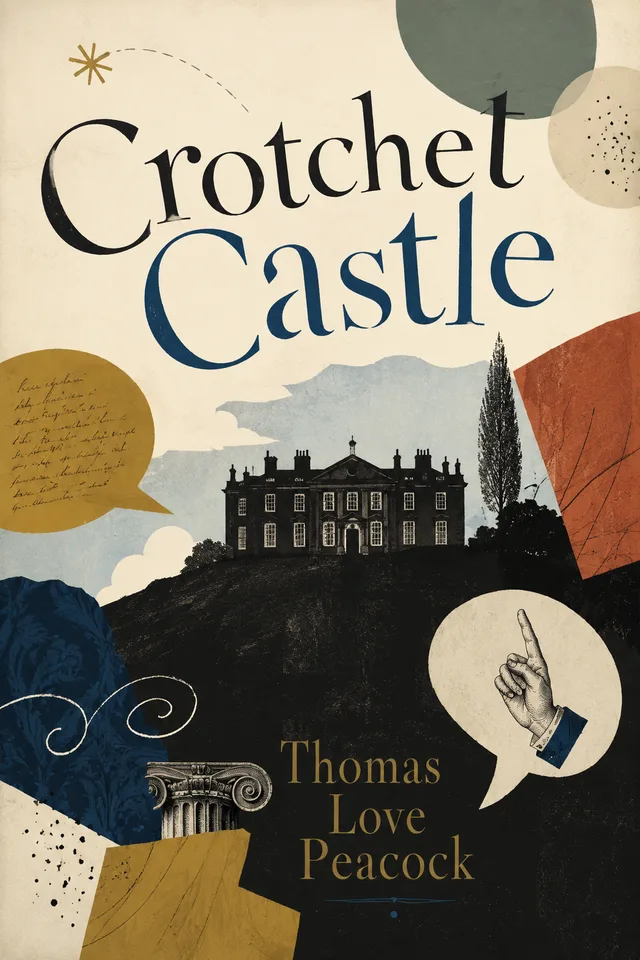
Crotchet Castle
English BooksWhale Edition by Thomas Love Peacock
A satirical country-house novel of eccentric talkers, reform schemes, politics, learning, and comic argument.
- Preview
- A sample from the prepared text
- Formats
- Online reader, EPUB, PDF
- Access
- Library claim
Book introduction
Crotchet Castle
Crotchet Castle gathers philosophers, reformers, antiquarians, lovers, and social theorists into Peacock’s sparkling comic dialogue. This English edition suits readers of satirical fiction, Romantic-era debate, political comedy, and intellectual parody.
BooksWhale edition
How this edition was prepared
This edition is based on a public domain text and has been prepared for digital reading by BooksWhale.
Public domain basis
Why this edition can be shared
Thomas Love Peacock died in 1866, and Crotchet Castle was first published in 1831. These dates support the public-domain basis for this English original edition.
Read preview
A sample from the prepared text
Preview selected from the prepared reader text.
Preview chapterFull textRead preview
Crotchet Castle
Thomas Love Peacock
Preview chapterINTRODUCTION.Preview
THOMAS LOVE PEACOCK was born at Weymouth in 1785. His first poem, “The Genius of the Thames,” was in its second edition when he became one of the friends of Shelley. That was in 1812, when Shelley’s age was twenty, Peacock’s twenty-seven. The acquaintance strengthened, until Peacock became the friend in whose judgment Shelley put especial trust. There were many points of agreement. Peacock, at that time, shared, in a more practical way, Shelley’s desire for root and branch reform; both wore poets, although not equally gifted, and both loved Plato and the Greek tragedians. In “Crotchet Castle” Peacock has expressed his own delight in Greek literature through the talk of the Reverend Dr. Folliott.
But Shelley’s friendship for Peacock included a trust in him that was maintained by points of unlikeness. Peacock was shrewd and witty. He delighted in extravagance of a satire which usually said more than it meant, but always rested upon a foundation of good sense. Then also there was a touch of the poet to give grace to the utterances of a clear-headed man of the world. It was Peacock who gave its name to
Shelley’s poem of “Alastor, or the Spirit of Solitude,” published in
1816. The “Spirit of Solitude” being treated as a spirit of evil,
Peacock suggested calling it “Alastor,” since the Greek ἀλάστωρ means an evil genius.
Peacock’s novels are unlike those of other men: they are the genuine expressions of an original and independent mind. His reading and his thinking ran together; there is free quotation, free play of wit and satire, grace of invention too, but always unconventional. The story is always pleasant, although always secondary to the play of thought for which it gives occasion. He quarrelled with verse, whimsically but in all seriousness, in an article on “The Four Ages of Poetry,” contributed in 1820 to a short-lived journal, “Ollier’s Literary Miscellany.” The four ages were, he said, the iron age, the Bardic; the golden, the Homeric; the silver, the Virgilian; and the brass, in which he himself lived. “A poet in our time,” he said, “is a semi-barbarian in a civilised community... The highest inspirations of poetry are resolvable into three ingredients: the rant of unregulated passion, the whining of exaggerated feeling, and the cant of factitious sentiment; and can, therefore, serve only to ripen a splendid lunatic like Alexander, a puling driveller like Werter, or a morbid dreamer like Wordsworth.” In another part of this essay he says: “While the historian and the philosopher are advancing in and accelerating the progress of knowledge, the poet is wallowing in the rubbish of departed ignorance, and raking up the ashes of dead savages to find gewgaws and rattles for the grown babies of the age. Mr. Scott digs up the poacher and cattle-stealers of the ancient Border. Lord Byron cruises for thieves and pirates on the shores of the Morea and among the Greek islands. Mr. Southey wades through ponderous volumes of travels and old chronicles, from which he carefully selects all that is false, useless, and absurd, as being essentially poetical; and when he has a commonplace book full of monstrosities, strings them into an epic.” And so forth; Peacock going on to characterise, in further illustration of his argument, Wordsworth, Coleridge, Moore, and Campbell. He did not refer to Shelley; and Shelley read his friend’s whimsical attack on poetry with all good humour, proceeding to reply to it with a “Defence of Poetry,” which would have appeared in the same journal, if the journal had survived. In this novel of “Crotchet Castle” there is the same good-humoured exaggeration in the treatment of “our learned friend”—Lord Brougham—to whom and to whose labours for the Diffusion of Useful Knowledge there are repeated allusions. In one case Peacock associates the labours of “our learned friend” for the general instruction of the masses with encouragement of robbery (page 172), and in another with body-snatching, or, worse,—murder for dissection (page 99). “The Lord deliver me from the learned friend!” says Dr. Folliott. Brougham’s elevation to a peerage in November, 1830, as Lord Brougham and Vaux, is referred to on page 177, where he is called Sir Guy do Vaux. It is not to be forgotten, in the reading, that this story was written in 1831, the year before the passing of the Reform Bill. It ends with a scene suggested by the agricultural riots of that time. In the ninth chapter, again, there is a passage dealing with Sir Walter Scott after the fashion of the criticisms in the “Four Ages of Poetry.” But this critical satire gave nobody pain. Always there was a ground-work of good sense, and the broad sweep of the satire was utterly unlike the nibbling censure of the men whose wit is tainted with ill-humour. We may see also that the poet’s nature cannot be expelled. In this volume we should find the touch of a poet’s hand in the tale itself when dealing with the adventures of Mr. Chainmail, while he stays at the Welsh mountain inn, if the story did not again and again break out into actual song, for it includes half-a-dozen little poems.
Preview chapterCHAPTER I.Preview
CHAPTER I.
Table of contents
Inside this edition
- 01Full text
- 02INTRODUCTION.
- 03CHAPTER I.
- 04THE VILLA.
- 05HENRY V.
- 06CHAPTER II.
- 07THE MARCH OF MIND.
- 08part of my system. Nothing but my great friendship for Mr. Crotchet
- 09CHAPTER III.
- 10THE ROMAN CAMP.
- 11CHAPTER IV.
- 12THE PARTY.
- 13CHAPTER V.
- 14CHARACTERS.
- 15RABELAIS.
- 16CHAPTER VI.
- 17THEORIES.
- 18CHAPTER VII.
- 19THE SLEEPING VENUS.
- 20CHAPTER VIII.
- 21SCIENCE AND CHARITY.
- 22FORTEGUERRI.
- 23CHAPTER IX.
- 24THE VOYAGE.
- 25CHAPTER X.
- 26THE VOYAGE, CONTINUED.
- 27CHAPTER XI.
- 28CORRESPONDENCE.
- 29“MY DEAR CHILD,
- 30“TIMOTHY TOUCHANDGO.
- 31“DEAR MISS,
- 32“RODERICK ROBTHETILL.”
- 33“MY DEAR FATHER,
- 34“SUSANNAH TOUCHANDGO.
- 35CHAPTER XII.
- 36THE MOUNTAIN INN.
- 37CHAPTER XIII.
- 38THE LAKE—THE RUIN.
- 39ORLANDO INNAMORATO.
- 40CHAPTER XIV.
- 41THE DINGLE.
- 42CHAPTER XV.
- 43THE FARM.
- 44CHAPTER XVI.
- 45THE NEWSPAPER.
- 46LLYN-Y-DREIDDIAD-VRAWD.
- 47THE POOL OF THE DIVING FRIAR.
- 48CHAPTER XVII.
- 49THE INVITATION.
- 50CHAPTER XVIII.
- 51CHAINMAIL HALL.
- 52FLORENCE AND BLANCHFLOR.
- 53THE PRIEST AND THE MULBERRY TREE.
- 54CONCLUSION.
Language availability
Other languages
Additional language editions are not published yet. This section will link to other BooksWhale editions when they become available.
Request another language