English Edition
Literature
De Profundis
English BooksWhale Edition by Oscar Wilde
A public-domain classic on prison writing, suffering, love, humiliation, art, and spiritual reckoning.
- Preview
- A sample from the prepared text
- Formats
- Online reader, EPUB, PDF
- Access
- Library claim
Book introduction
De Profundis
De Profundis by Oscar Wilde remains a rewarding classic for readers interested in prison writing, suffering, love, humiliation, art, and spiritual reckoning. This English edition presents the original public-domain text in a clean BooksWhale format for online reading, EPUB, and PDF, with the work’s historical context and literary value kept clear.
BooksWhale edition
How this edition was prepared
This edition is based on a public domain text and has been prepared for digital reading by BooksWhale.
Public domain basis
Why this edition can be shared
De Profundis was first published in 1905. This edition uses the public-domain English original text, with publication date and rights status supporting public-domain use.
Read preview
A sample from the prepared text
Preview selected from the prepared reader text.
Preview chapterFull textRead preview
De Profundis
Oscar Wilde
Preview chapterPart 1Preview
DE PROFUNDIS
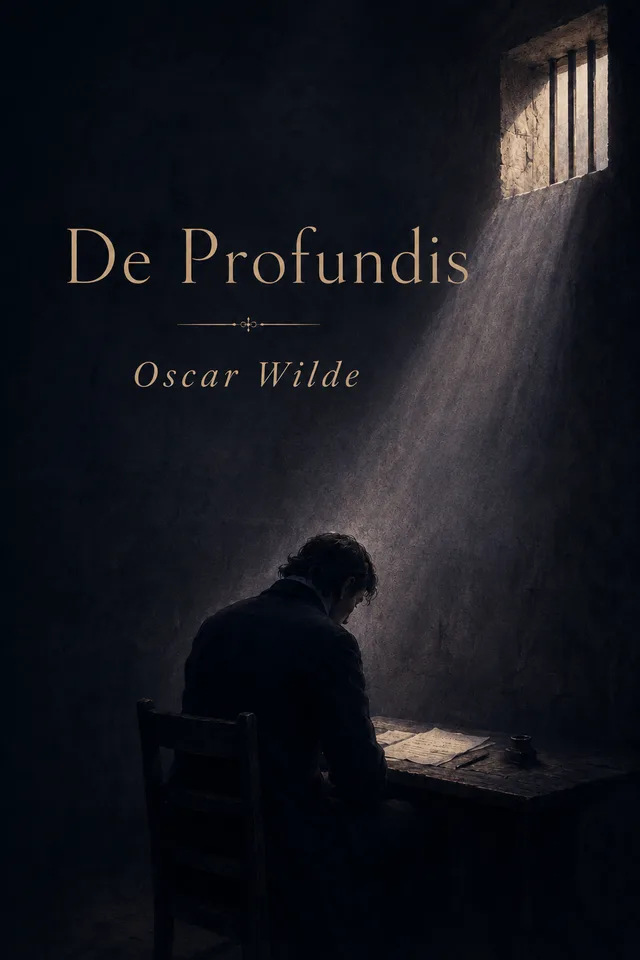
. . . Suffering is one very long moment. We cannot divide it by seasons. We can only record its moods, and chronicle their return. With us time itself does not progress. It revolves. It seems to circle round one centre of pain. The paralysing immobility of a life every circumstance of which is regulated after an unchangeable pattern, so that we eat and drink and lie down and pray, or kneel at least for prayer, according to the inflexible laws of an iron formula: this immobile quality, that makes each dreadful day in the very minutest detail like its brother, seems to communicate itself to those external forces the very essence of whose existence is ceaseless change. Of seed-time or harvest, of the reapers bending over the corn, or the grape gatherers threading through the vines, of the grass in the orchard made white with broken blossoms or strewn with fallen fruit: of these we know nothing and can know nothing.
For us there is only one season, the season of sorrow. The very sun and moon seem taken from us. Outside, the day may be blue and gold, but the light that creeps down through the thickly-muffled glass of the small iron-barred window beneath which one sits is grey and niggard. It is always twilight in one's cell, as it is always twilight in one's heart. And in the sphere of thought, no less than in the sphere of time, motion is no more. The thing that you personally have long ago forgotten, or can easily forget, is happening to me now, and will happen to me again to morrow. Remember this, and you will be able to understand a little of why I am writing, and in this manner writing. . . .
A week later, I am transferred here. Three more months go over and my mother dies. No one knew how deeply I loved and honoured her. Her death was terrible to me; but I, once a lord of language, have no words in which to express my anguish and my shame. She and my father had bequeathed me a name they had made noble and honoured, not merely in literature, art, archaeology, and science, but in the public history of my own country, in its evolution as a nation. I had disgraced that name eternally. I had made it a low by-word among low people. I had dragged it through the very mire. I had given it to brutes that they might make it brutal, and to fools that they might turn it into a synonym for folly. What I suffered then, and still suffer, is not for pen to write or paper to record. My wife, always kind and gentle to me, rather than that I should hear the news from indifferent lips, travelled, ill as she was, all the way from Genoa to England to break to me herself the tidings of so irreparable, so irremediable, a loss. Messages of sympathy reached me from all who had still affection for me. Even people who had not known me personally, hearing that a new sorrow had broken into my life, wrote to ask that some expression of their condolence should be conveyed to me. . . .
Three months go over. The calendar of my daily conduct and labour that hangs on the outside of my cell door, with my name and sentence written upon it, tells me that it is May. . . .
Prosperity, pleasure and success, may be rough of grain and common in fibre, but sorrow is the most sensitive of all created things. There is nothing that stirs in the whole world of thought to which sorrow does not vibrate in terrible and exquisite pulsation. The thin beaten-out leaf of tremulous gold that chronicles the direction of forces the eye cannot see is in comparison coarse. It is a wound that bleeds when any hand but that of love touches it, and even then must bleed again, though not in pain.
Preview chapterPart 2Preview
Now I have realised that it is in me, I see quite clearly what I ought to do; in fact, must do. And when I use such a phrase as that, I need not say that I am not alluding to any external sanction or command. I admit none. I am far more of an individualist than I ever was. Nothing seems to me of the smallest value except what one gets out of oneself. My nature is seeking a fresh mode of self-realisation. That is all I am concerned with. And the first thing that I have got to do is to free myself from any possible bitterness of feeling against the world.
I am completely penniless, and absolutely homeless. Yet there are worse things in the world than that. I am quite candid when I say that rather than go out from this prison with bitterness in my heart against the world, I would gladly and readily beg my bread from door to door. If I got nothing from the house of the rich I would get something at the house of the poor. Those who have much are often greedy; those who have little always share. I would not a bit mind sleeping in the cool grass in summer, and when winter came on sheltering myself by the warm close-thatched rick, or under the penthouse of a great barn, provided I had love in my heart. The external things of life seem to me now of no importance at all. You can see to what intensity of individualism I have arrived--or am arriving rather, for the journey is long, and 'where I walk there are thorns.'
Of course I know that to ask alms on the highway is not to be my lot, and that if ever I lie in the cool grass at night-time it will be to write sonnets to the moon. When I go out of prison, R--- will be waiting for me on the other side of the big iron-studded gate, and he is the symbol, not merely of his own affection, but of the affection of many others besides. I believe I am to have enough to live on for about eighteen months at any rate, so that if I may not write beautiful books, I may at least read beautiful books; and what joy can be greater? After that, I hope to be able to recreate my creative faculty.
But were things different: had I not a friend left in the world; were there not a single house open to me in pity; had I to accept the wallet and ragged cloak of sheer penury: as long as I am free from all resentment, hardness and scorn, I would be able to face the life with much more calm and confidence than I would were my body in purple and fine linen, and the soul within me sick with hate.
And I really shall have no difficulty. When you really want love you will find it waiting for you.
I need not say that my task does not end there. It would be comparatively easy if it did. There is much more before me. I have hills far steeper to climb, valleys much darker to pass through. And I have to get it all out of myself. Neither religion, morality, nor reason can help me at all.
Morality does not help me. I am a born antinomian. I am one of those who are made for exceptions, not for laws. But while I see that there is nothing wrong in what one does, I see that there is something wrong in what one becomes. It is well to have learned that.
Religion does not help me. The faith that others give to what is unseen, I give to what one can touch, and look at. My gods dwell in temples made with hands; and within the circle of actual experience is my creed made perfect and complete: too complete, it may be, for like many or all of those who have placed their heaven in this earth, I have found in it not merely the beauty of heaven, but the horror of hell also. When I think about religion at all, I feel as if I would like to found an order for those who _cannot_ believe: the Confraternity of the Faithless, one might call it, where on an altar, on which no taper burned, a priest, in whose heart peace had no dwelling, might celebrate with unblessed bread and a chalice empty of wine. Every thing to be true must become a religion. And agnosticism should have its ritual no less than faith. It has sown its martyrs, it should reap its saints, and praise God daily for having hidden Himself from man. But whether it be faith or agnosticism, it must be nothing external to me. Its symbols must be of my own creating. Only that is spiritual which makes its own form. If I may not find its secret within myself, I shall never find it: if I have not got it already, it will never come to me.
Table of contents
Inside this edition
- 01Full text
- 02Part 1
- 03Part 2
- 04Part 3
- 05Part 4
- 06Part 5
- 07Part 6
- 08Part 7
- 09Part 8
Language availability
Other languages
Additional language editions are not published yet. This section will link to other BooksWhale editions when they become available.
Request another language