English Edition
Politics
Democracy and Social Ethics
English BooksWhale Edition by Jane Addams
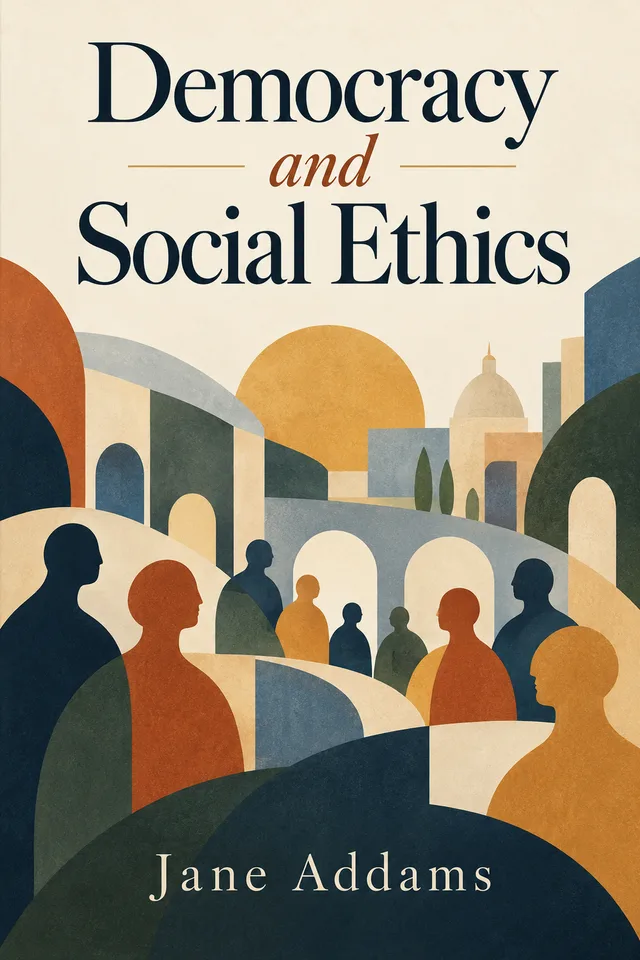
Jane Addams examines how democratic obligations reshape charity, family life, domestic service, industry, education, and political reform.
- Preview
- A sample from the prepared text
- Formats
- Online reader, EPUB, PDF
- Access
- Library claim
Book introduction
Democracy and Social Ethics
Drawing on social encounters associated with settlement work, Jane Addams asks how individual morality relates to a democratic society. Seven chapters consider charitable effort, obligations between parents and children, household service, industrial relations, educational methods, and political reform. The English text follows her argument that ethical judgment grows through participation in other people's lives.
BooksWhale edition
How this edition was prepared
This edition is based on a public domain text and has been prepared for digital reading by BooksWhale.
Public domain basis
Why this edition can be shared
Jane Addams died in 1935. This edition uses the original English text preserved by Project Gutenberg; publisher advertising and separate annotations are omitted.
Read preview
A sample from the prepared text
Preview selected from the prepared reader text.
Preview chapterPREFATORY NOTERead preview
The following pages present the substance of a course of twelve lectures on "Democracy and Social Ethics" which have been delivered at various colleges and university extension centres.
In putting them into the form of a book, no attempt has been made to change the somewhat informal style used in speaking. The "we" and "us" which originally referred to the speaker and her audience are merely extended to possible readers.
Acknowledgment for permission to reprint is extended to The Atlantic Monthly, The International Journal of Ethics, The American Journal of Sociology, and to The Commons.
Preview chapterCHAPTER I INTRODUCTIONPreview
It is well to remind ourselves, from time to time, that "Ethics" is but another word for "righteousness," that for which many men and women of every generation have hungered and thirsted, and without which life becomes meaningless.
Certain forms of personal righteousness have become to a majority of the community almost automatic. It is as easy for most of us to keep from stealing our dinners as it is to digest them, and there is quite as much voluntary morality involved in one process as in the other. To steal would be for us to fall sadly below the standard of habit and expectation which makes virtue easy. In the same way we have been carefully reared to a sense of family obligation, to be kindly and considerate to the members of our own households, and to feel responsible for their well-being. As the rules of conduct have become established in regard to our self-development and our families, so they have been in regard to limited circles of friends. If the fulfilment of these claims were all that a righteous life required, the hunger and thirst would be stilled for many good men and women, and the clew of right living would lie easily in their hands.
But we all know that each generation has its own test, the contemporaneous and current standard by which alone it can adequately judge of its own moral achievements, and that it may not legitimately use a previous and less vigorous test. The advanced test must indeed include that which has already been attained; but if it includes no more, we shall fail to go forward, thinking complacently that we have "arrived" when in reality we have not yet started.
To attain individual morality in an age demanding social morality, to pride one's self on the results of personal effort when the time demands social adjustment, is utterly to fail to apprehend the situation.
It is perhaps significant that a German critic has of late reminded us that the one test which the most authoritative and dramatic portrayal of the Day of Judgment offers, is the social test. The stern questions are not in regard to personal and family relations, but did ye visit the poor, the criminal, the sick, and did ye feed the hungry?
All about us are men and women who have become unhappy in regard to their attitude toward the social order itself; toward the dreary round of uninteresting work, the pleasures narrowed down to those of appetite, the declining consciousness of brain power, and the lack of mental food which characterizes the lot of the large proportion of their fellow-citizens. These men and women have caught a moral challenge raised by the exigencies of contemporaneous life; some are bewildered, others who are denied the relief which sturdy action brings are even seeking an escape, but all are increasingly anxious concerning their actual relations to the basic organization of society.
The test which they would apply to their conduct is a social test. They fail to be content with the fulfilment of their family and personal obligations, and find themselves striving to respond to a new demand involving a social obligation; they have become conscious of another requirement, and the contribution they would make is toward a code of social ethics. The conception of life which they hold has not yet expressed itself in social changes or legal enactment, but rather in a mental attitude of maladjustment, and in a sense of divergence between their consciences and their conduct. They desire both a clearer definition of the code of morality adapted to present day demands and a part in its fulfilment, both a creed and a practice of social morality. In the perplexity of this intricate situation at least one thing is becoming clear: if the latter day moral ideal is in reality that of a social morality, it is inevitable that those who desire it must be brought in contact with the moral experiences of the many in order to procure an adequate social motive.
Preview chapterCHAPTER II CHARITABLE EFFORTPreview
All those hints and glimpses of a larger and more satisfying democracy, which literature and our own hopes supply, have a tendency to slip away from us and to leave us sadly unguided and perplexed when we attempt to act upon them.
Our conceptions of morality, as all our other ideas, pass through a course of development; the difficulty comes in adjusting our conduct, which has become hardened into customs and habits, to these changing moral conceptions. When this adjustment is not made, we suffer from the strain and indecision of believing one hypothesis and acting upon another.
Probably there is no relation in life which our democracy is changing more rapidly than the charitable relation—that relation which obtains between benefactor and beneficiary; at the same time there is no point of contact in our modern experience which reveals so clearly the lack of that equality which democracy implies. We have reached the moment when democracy has made such inroads upon this relationship, that the complacency of the old-fashioned charitable man is gone forever; while, at the same time, the very need and existence of charity, denies us the consolation and freedom which democracy will at last give.
It is quite obvious that the ethics of none of us are clearly defined, and we are continually obliged to act in circles of habit, based upon convictions which we no longer hold. Thus our estimate of the effect of environment and social conditions has doubtless shifted faster than our methods of administrating charity have changed. Formerly when it was believed that poverty was synonymous with vice and laziness, and that the prosperous man was the righteous man, charity was administered harshly with a good conscience; for the charitable agent really blamed the individual for his poverty, and the very fact of his own superior prosperity gave him a certain consciousness of superior morality. We have learned since that time to measure by other standards, and have ceased to accord to the money-earning capacity exclusive respect; while it is still rewarded out of all proportion to any other, its possession is by no means assumed to imply the possession of the highest moral qualities. We have learned to judge men by their social virtues as well as by their business capacity, by their devotion to intellectual and disinterested aims, and by their public spirit, and we naturally resent being obliged to judge poor people so solely upon the industrial side. Our democratic instinct instantly takes alarm. It is largely in this modern tendency to judge all men by one democratic standard, while the old charitable attitude commonly allowed the use of two standards, that much of the difficulty adheres. We know that unceasing bodily toil becomes wearing and brutalizing, and our position is totally untenable if we judge large numbers of our fellows solely upon their success in maintaining it.
The daintily clad charitable visitor who steps into the little house made untidy by the vigorous efforts of her hostess, the washerwoman, is no longer sure of her superiority to the latter; she recognizes that her hostess after all represents social value and industrial use, as over against her own parasitic cleanliness and a social standing attained only through status.
The only families who apply for aid to the charitable agencies are those who have come to grief on the industrial side; it may be through sickness, through loss of work, or for other guiltless and inevitable reasons; but the fact remains that they are industrially ailing, and must be bolstered and helped into industrial health. The charity visitor, let us assume, is a young college woman, well-bred and open-minded; when she visits the family assigned to her, she is often embarrassed to find herself obliged to lay all the stress of her teaching and advice upon the industrial virtues, and to treat the members of the family almost exclusively as factors in the industrial system. She insists that they must work and be self-supporting, that the most dangerous of all situations is idleness, that seeking one's own pleasure, while ignoring claims and responsibilities, is the most ignoble of actions. The members of her assigned family may have other charms and virtues—they may possibly be kind and considerate of each other, generous to their friends, but it is her business to stick to the industrial side. As she daily holds up these standards, it often occurs to the mind of the sensitive visitor, whose conscience has been made tender by much talk of brotherhood and equality, that she has no right to say these things; that her untrained hands are no more fitted to cope with actual conditions than those of her broken-down family.
Table of contents
Inside this edition
- 01PREFATORY NOTE
- 02CHAPTER I INTRODUCTION
- 03CHAPTER II CHARITABLE EFFORT
- 04CHAPTER III FILIAL RELATIONS
- 05CHAPTER IV HOUSEHOLD ADJUSTMENT
- 06CHAPTER V INDUSTRIAL AMELIORATION
- 07CHAPTER VI EDUCATIONAL METHODS
- 08CHAPTER VII POLITICAL REFORM
Language availability
Other languages
Additional language editions are not published yet. This section will link to other BooksWhale editions when they become available.
Request another language