English Edition
History
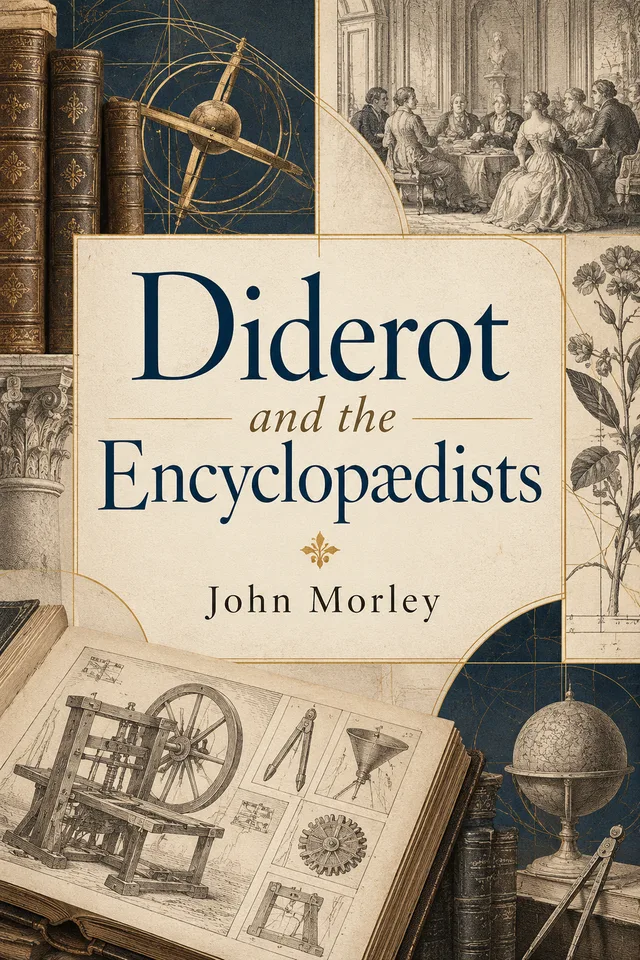
Diderot and the Encyclopædists
English BooksWhale Edition by John Morley
Both volumes trace Diderot’s life, the Encyclopædia, and the philosophical, artistic, and social debates of the French Enlightenment.
- Preview
- A sample from the prepared text
- Formats
- Online reader, EPUB, PDF
- Access
- Library claim
Book introduction
Diderot and the Encyclopædists
John Morley places Denis Diderot within the intellectual world of eighteenth-century France, examining the Encyclopædia, materialist philosophy, theater, art criticism, and the writers around him. This English edition brings together both original volumes, from Diderot’s youth to the concluding assessment of his influence. It also retains Morley’s appendix translation of Rameau’s Nephew as part of the original work.
BooksWhale edition
How this edition was prepared
This edition is based on a public domain text and has been prepared for digital reading by BooksWhale.
Public domain basis
Why this edition can be shared
John Morley died in 1923; this work was first published in 1878. The edition uses the original English text digitized by Project Gutenberg, excluding later platform material and annotations. Both volumes and Morley’s original appendix translation are included.
Read preview
A sample from the prepared text
Preview selected from the prepared reader text.
Preview chapterPREFACE.Read preview
The present work closes a series of studies on the literary preparation for the French Revolution. It differs from the companion volumes on Voltaire and Rousseau, in being much more fully descriptive. In the case of those two famous writers, every educated reader knows more or less of their performances. Of Diderot and his circle, such knowledge cannot be taken for granted, and I have therefore thought it best to occupy a considerable space, which I hope that those who do me the honour to read these pages will not find excessive, with what is little more than transcript or analysis. Such a method will at least enable the reader to see what those ideas really were, which the social and economic condition of France on the eve of the convulsion made so welcome to men. The shortcomings of the encyclopædic group are obvious enough. They have lately been emphasised in the ingenious and one-sided exaggerations of that brilliant man of letters, Mr. Taine. The social significance and the positive quality of much of their writing is more easily missed, and this side of their work it has been one of my principal objects, alike in the case of Voltaire, of Rousseau, and of Diderot, to bring into the prominence that it deserves in the history of opinion.
The edition of Diderot's works to which the references are made, is that in twenty volumes by the late Mr. Assézat and Mr. Maurice Tourneux. The only other serious book on Diderot with which I am acquainted is Rosenkranz's valuable Diderot's Leben, published in 1866, and abounding in full and patient knowledge. Of the numerous criticisms on Diderot by Raumer, Arndt, Hettner, Damiron, Bersot, and above all by Mr. Carlyle, I need not make more particular mention.
May, 1878.
Preview chapterVolume I — CHAPTER I. PRELIMINARY.Preview
There was a moment in the last century when the Gallican church hoped for a return of internal union and prosperity. This brief era of hope coincided almost exactly with the middle of the century. Voltaire was in exile at Berlin. The author of the Persian Letters and the Spirit of Laws was old and near his end. Rousseau was copying music in a garret. The Encyclopædia was looked for, but only as a literary project of some associated booksellers. The Jansenists, who had been so many in number and so firm in spirit five-and-twenty years earlier, had now sunk to a small minority of the French clergy. The great ecclesiastical body at length offered an unbroken front to its rivals, the great judicial bodies. A patriotic minister was indeed audacious enough to propose a tax upon ecclesiastical property, but the Church fought the battle and won. Troops had just been despatched to hunt and scatter the Protestants of the desert, and bigots exulted in the thought of pastors swinging on gibbets, and heretical congregations fleeing for their lives before the fire of orthodox musketry. The house of Austria had been forced to suffer spoliation at the hands of the infidel Frederick, but all the world was well aware that the haughty and devout Empress-Queen would seize a speedy opportunity of taking a crushing vengeance; France would this time be on the side of righteousness and truth. For the moment a churchman might be pardoned if he thought that superstition, ignorance, abusive privilege, and cruelty were on the eve of the smoothest and most triumphant days that they had known since the Reformation.
We now know how illusory this sanguine anticipation was destined to prove, and how promptly. In little more than forty years after the triumphant enforcement of the odious system of confessional certificates, then the crowning event of ecclesiastical supremacy, Paris saw the Feast of the Supreme Being, and the adoration of the Goddess of Reason. The Church had scarcely begun to dream before she was rudely and peremptorily awakened. She found herself confronted by the most energetic, hardy, and successful assailants whom the spirit of progress ever inspired. Compared with the new attack, Jansenism was no more than a trifling episode in a family quarrel. Thomists and Molinists became as good as confederates, and Quietism barely seemed a heresy. In every age, even in the very depth of the times of faith, there had arisen disturbers of the intellectual peace. Almost each century after the resettlement of Europe by Charlemagne had procured some individual, or some little group, who had ventured to question this or that article of the ecclesiastical creed, to whom broken glimpses of new truth had come, and who had borne witness against the error or inconsistency or inadequateness of old ways of thinking. The questions which presented themselves to the acuter minds of a hundred years ago, were present to the acuter minds who lived hundreds of years before that. The more deeply we penetrate into the history of opinion, the more strongly are we tempted to believe that in the great matters of speculation no question is altogether new, and hardly any answer is altogether new. But the Church had known how to deal with intellectual insurgents, from Abelard in the twelfth century down to Giordano Bruno and Vanini in the seventeenth. They were isolated; they were for the most part submissive; and if they were not, the arm of the Church was very long and her grasp mortal. And all these meritorious precursors were made weak by one cardinal defect, for which no gifts of intellectual acuteness could compensate. They had the scientific idea, but they lacked the social idea. They could have set opinion right about the efficacy of the syllogism, and the virtue of entities and quiddities. They could have taught Europe earlier than the Church allowed it to learn that the sun does not go round the earth, and that it is the earth which goes round the sun. But they were wholly unfitted to deal with the prodigious difficulties of moral and social direction. This function, so immeasurably more important than the mere discovery of any number of physical relations, it was the glory of the Church to have discharged for some centuries with as much success as the conditions permitted. We are told indeed by writers ignorant alike of human history and human nature, that only physical science can improve the social condition of man. The common sense of the world always rejects this gross fallacy. The acquiescence for so many centuries in the power of the great directing organisation of Western Europe, notwithstanding its intellectual inadequateness, was the decisive expression of that rejection.
Preview chapterVolume I — CHAPTER II. YOUTH.Preview
Denis Diderot was born at Langres in 1713, being thus a few months younger than Rousseau (1712), nearly twenty years younger than Voltaire (1694), nearly two years younger than Hume (1711), and eleven years older than Kant (1724). His stock was ancient and of good repute. The family had been engaged in the great local industry, the manufacture of cutlery, for no less than two centuries in direct line. Diderot liked to dwell on the historic prowess of his town, from the days of Julius Cæsar and the old Lingones and Sabinus, down to the time of the Great Monarch. With the taste of his generation for tracing moral qualities to a climatic source, he explained a certain vivacity and mobility in the people of his district by the great frequency and violence of its atmospheric changes from hot to cold, from calm to storm, from rain to sunshine. "Thus they learn from earliest infancy to turn to every wind. The man of Langres has a head on his shoulders like the weathercock at the top of the church spire. It is never fixed at one point; if it returns to the point it has left, it is not to stop there. With an amazing rapidity in their movements, their desires, their plans, their fancies, their ideas, they are cumbrous in speech. For myself, I belong to my country side." This was thoroughly true. He inherited all the versatility of his compatriots, all their swift impetuosity, and something of their want of dexterity in expression.
His father was one of the bravest, most upright, most patient, most sensible of men. Diderot never ceased to regret that the old man's portrait had not been taken with his apron on, his spectacles pushed up, and a hand on the grinder's wheel. After his death, none of his neighbours could speak of him to his son without tears in their eyes. Diderot, wild and irregular as were his earlier days, had always a true affection for his father. "One of the sweetest moments of my life," he once said, "was more than thirty years ago, and I remember it as if it were yesterday, when my father saw me coming home from school, my arms laden with the prizes I had carried off, and my shoulders burdened with the wreaths they had given me, which were too big for my brow and had slipped over my head. As soon as he caught sight of me some way off, he threw down his work, hurried to the door to meet me, and fell a-weeping. It is a fine sight—a grave and sterling man melted to tears." Of his mother we know less. He had a sister, who seems to have possessed the rough material of his own qualities. He describes her as "lively, active, cheerful, decided, prompt to take offence, slow to come round again, without much care for present or future, never willing to be imposed on by people or circumstance; free in her ways, still more free in her talk; she is a sort of Diogenes in petticoats.... She is the most original and the most strongly-marked creature I know; she is goodness itself, but with a peculiar physiognomy." His only brother showed some of the same native stuff, but of thinner and sourer quality. He became an abbé and a saint, peevish, umbrageous, and as excessively devout as his more famous brother was excessively the opposite. "He would have been a good friend and a good brother," wrote Diderot, "if religion had not bidden him trample under foot such poor weaknesses as these. He is a good Christian, who proves to me every minute of the day how much better it would be to be a good man. He shows that what they call evangelical perfection is only the mischievous art of stifling nature, which would most likely have spoken as lustily in him as in me."
Table of contents
Inside this edition
- 01PREFACE.
- 02Volume I — CHAPTER I. PRELIMINARY.
- 03Volume I — CHAPTER II. YOUTH.
- 04Volume I — CHAPTER III. EARLY WRITINGS.
- 05Volume I — CHAPTER IV. THE NEW PHILOSOPHY.
- 06Section II.
- 07Section III.
- 08Volume I — CHAPTER V. THE ENCYCLOPÆDIA.
- 09Section II.
- 10Section III.
- 11Volume I — CHAPTER VI. SOCIAL LIFE (1759-1770).
- 12Volume I — CHAPTER VII. THE STAGE.
- 13Volume I — CHAPTER VIII. RAMEAU'S NEPHEW.
- 14Volume II — CHAPTER I. OTHER DIALOGUES.
- 15Volume II — CHAPTER II ROMANCE.
- 16Volume II — CHAPTER III. ART.
- 17Volume II — CHAPTER IV. ST. PETERSBURG AND THE HAGUE.
- 18Volume II — CHAPTER V. HELVÉTIUS.
- 19Volume II — CHAPTER VI. HOLBACH’S SYSTEM OF NATURE.
- 20Volume II — CHAPTER VII. RAYNAL’S HISTORY OF THE INDIES.
- 21Volume II — CHAPTER VIII. DIDEROT’S CLOSING YEARS.
- 22Volume II — CHAPTER IX. CONCLUSION.
- 23Section I.
- 24Section II.
- 25Section III.
- 26Section IV.
- 27Section V.
- 28Volume II — APPENDIX. RAMEAU’S NEPHEW: A TRANSLATION.
Language availability
Other languages
Additional language editions are not published yet. This section will link to other BooksWhale editions when they become available.
Request another language