English Edition
History
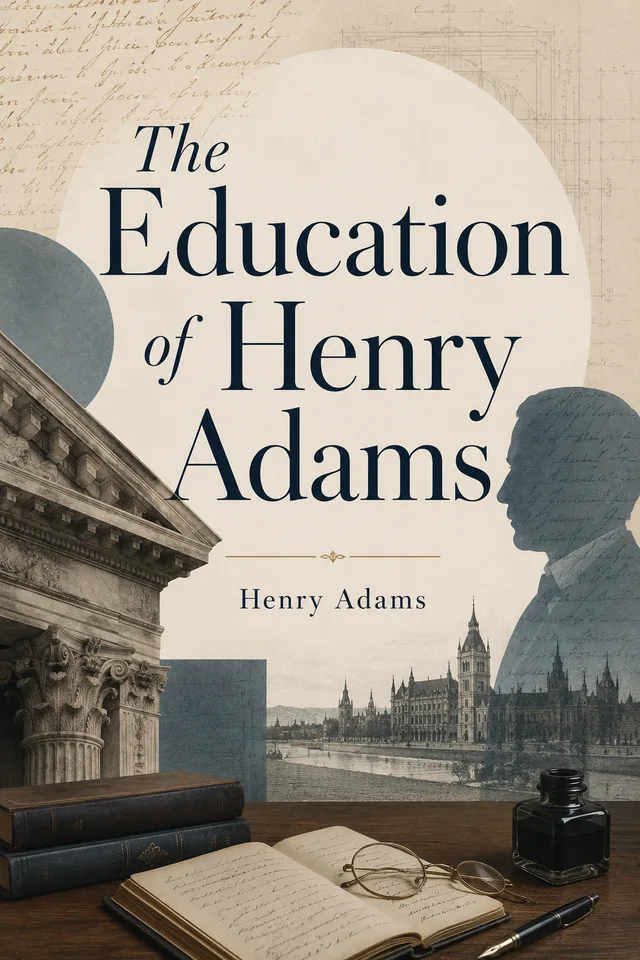
The Education of Henry Adams
English BooksWhale Edition by Henry Adams
A reflective autobiography of power, failure, history, technology, and American intellectual life.
- Preview
- A sample from the prepared text
- Formats
- Online reader, EPUB, PDF
- Access
- Library claim
Book introduction
The Education of Henry Adams
The Education of Henry Adams turns autobiography into a study of nineteenth-century change, following Adams from a presidential family through diplomacy, journalism, teaching, science, and disillusion. The book connects Washington politics, Europe, medieval faith, the dynamo, and modern uncertainty in a singular meditation on history and education.
BooksWhale edition
How this edition was prepared
This edition is based on a public domain text and has been prepared for digital reading by BooksWhale.
Public domain basis
Why this edition can be shared
Henry Adams died in 1918, and The Education of Henry Adams was privately printed in 1907 and published for general circulation in 1918. These dates support the public-domain basis for the original English text used in this edition.
Read preview
A sample from the prepared text
Preview selected from the prepared reader text.
Preview chapterFull textRead preview
The Education of Henry Adams
Henry Adams
EDITOR'S PREFACE
THIS volume, written in 1905 as a sequel to the same author's "Mont Saint Michel and Chartres," was privately printed, to the number of one hundred copies, in 1906, and sent to the persons interested, for their assent, correction, or suggestion. The idea of the two books was thus explained at the end of Chapter XXIX: --
"Any schoolboy could see that man as a force must be measured by motion from a fixed point. Psychology helped here by suggesting a unit--the point of history when man held the highest idea of himself as a unit in a unified universe. Eight or ten years of study had led Adams to think he might use the century 1150-1250, expressed in Amiens Cathedral and the Works of Thomas Aquinas, as the unit from which he might measure motion down to his own time, without assuming anything as true or untrue, except relation. The movement might be studied at once in philosophy and mechanics. Setting himself to the task, he began a volume which he mentally knew as 'Mont-Saint-Michel and Chartres: a Study of Thirteenth-Century Unity.' From that point he proposed to fix a position for himself, which he could label: 'The Education of Henry Adams: a Study of Twentieth-Century Multiplicity.' With the help of these two points of relation, he hoped to project his lines forward and backward indefinitely, subject to correction from any one who should know better."
The "Chartres" was finished and privately printed in 1904. The "Education" proved to be more difficult. The point on which the author failed to please himself, and could get no light from readers or friends, was the usual one of literary form. Probably he saw it in advance, for he used to say, half in jest, that his great ambition was to complete St. Augustine's "Confessions," but that St. Augustine, like a great artist, had worked from multiplicity to unity, while he, like a small one, had to reverse the method and work back from unity to multiplicity. The scheme became unmanageable as he approached his end.
Probably he was, in fact, trying only to work into it his favorite theory of history, which now fills the last three or four chapters of the "Education," and he could not satisfy himself with his workmanship. At all events, he was still pondering over the problem in 1910, when he tried to deal with it in another way which might be more intelligible to students. He printed a small volume called "A Letter to American Teachers," which he sent to his associates in the American Historical Association, hoping to provoke some response. Before he could satisfy himself even on this minor point, a severe illness in the spring of 1912 put an end to his literary activity forever.
The matter soon passed beyond his control. In 1913 the Institute of Architects published the "Mont-Saint-Michel and Chartres." Already the "Education" had become almost as well known as the "Chartres," and was freely quoted by every book whose author requested it. The author could no longer withdraw either volume; he could no longer rewrite either, and he could not publish that which he thought unprepared and unfinished, although in his opinion the other was historically purposeless without its sequel. In the end, he preferred to leave the "Education" unpublished, avowedly incomplete, trusting that it might quietly fade from memory. According to his theory of history as explained in Chapters XXXIII and XXXIV, the teacher was at best helpless, and, in the immediate future, silence next to good-temper was the mark of sense. After midsummer, 1914, the rule was made absolute.
The Massachusetts Historical Society now publishes the "Education" as it was printed in 1907, with only such marginal corrections as the author made, and it does this, not in opposition to the author's judgment, but only to put both volumes equally within reach of students who have occasion to consult them.
Preview chapterCHAPTER IPreview
QUINCY (1838-1848)
UNDER the shadow of Boston State House, turning its back on the house of John Hancock, the little passage called Hancock Avenue runs, or ran, from Beacon Street, skirting the State House grounds, to Mount Vernon Street, on the summit of Beacon Hill; and there, in the third house below Mount Vernon Place, February 16, 1838, a child was born, and christened later by his uncle, the minister of the First Church after the tenets of Boston Unitarianism, as Henry Brooks Adams.
Had he been born in Jerusalem under the shadow of the Temple and circumcised in the Synagogue by his uncle the high priest, under the name of Israel Cohen, he would scarcely have been more distinctly branded, and not much more heavily handicapped in the races of the coming century, in running for such stakes as the century was to offer; but, on the other hand, the ordinary traveller, who does not enter the field of racing, finds advantage in being, so to speak, ticketed through life, with the safeguards of an old, established traffic. Safeguards are often irksome, but sometimes convenient, and if one needs them at all, one is apt to need them badly. A hundred years earlier, such safeguards as his would have secured any young man's success; and although in 1838 their value was not very great compared with what they would have had in 1738, yet the mere accident of starting a twentieth-century career from a nest of associations so colonial,--so troglodytic--as the First Church, the Boston State House, Beacon Hill, John Hancock and John Adams, Mount Vernon Street and Quincy, all crowding on ten pounds of unconscious babyhood, was so queer as to offer a subject of curious speculation to the baby long after he had witnessed the solution. What could become of such a child of the seventeenth and eighteenth centuries, when he should wake up to find himself required to play the game of the twentieth? Had he been consulted, would he have cared to play the game at all, holding such cards as he held, and suspecting that the game was to be one of which neither he nor any one else back to the beginning of time knew the rules or the risks or the stakes?
He was not consulted and was not responsible, but had he been taken into the confidence of his parents, he would certainly have told them to change nothing as far as concerned him. He would have been astounded by his own luck. Probably no child, born in the year, held better cards than he. Whether life was an honest game of chance, or whether the cards were marked and forced, he could not refuse to play his excellent hand. He could never make the usual plea of irresponsibility. He accepted the situation as though he had been a party to it, and under the same circumstances would do it again, the more readily for knowing the exact values. To his life as a whole he was a consenting, contracting party and partner from the moment he was born to the moment he died. Only with that understanding--as a consciously assenting member in full partnership with the society of his age--had his education an interest to himself or to others.
As it happened, he never got to the point of playing the game at all; he lost himself in the study of it, watching the errors of the players; but this is the only interest in the story, which otherwise has no moral and little incident. A story of education--seventy years of it--the practical value remains to the end in doubt, like other values about which men have disputed since the birth of Cain and Abel; but the practical value of the universe has never been stated in dollars. Although every one cannot be a Gargantua-Napoleon-Bismarck and walk off with the great bells of Notre Dame, every one must bear his own universe, and most persons are moderately interested in learning how their neighbors have managed to carry theirs.
Preview chapterCHAPTER IIPreview
BOSTON (1848-1854)
PETER CHARDON BROOKS, the other grandfather, died January 1, 1849, bequeathing what was supposed to be the largest estate in Boston, about two million dollars, to his seven surviving children: four sons--Edward, Peter Chardon, Gorham, and Sydney; three daughters--Charlotte, married to Edward Everett; Ann, married to Nathaniel Frothingham, minister of the First Church; and Abigail Brown, born April 25, 1808, married September 3, 1829, to Charles Francis Adams, hardly a year older than herself. Their first child, born in 1830, was a daughter, named Louisa Catherine, after her Johnson grandmother; the second was a son, named John Quincy, after his President grandfather; the third took his father's name, Charles Francis; while the fourth, being of less account, was in a way given to his mother, who named him Henry Brooks, after a favorite brother just lost. More followed, but these, being younger, had nothing to do with the arduous process of educating.
The Adams connection was singularly small in Boston, but the family of Brooks was singularly large and even brilliant, and almost wholly of clerical New England stock. One might have sought long in much larger and older societies for three brothers-in-law more distinguished or more scholarly than Edward Everett, Dr. Frothingham, and Mr. Adams. One might have sought equally long for seven brothers-in-law more unlike. No doubt they all bore more or less the stamp of Boston, or at least of Massachusetts Bay, but the shades of difference amounted to contrasts. Mr. Everett belonged to Boston hardly more than Mr. Adams. One of the most ambitious of Bostonians, he had broken bounds early in life by leaving the Unitarian pulpit to take a seat in Congress where he had given valuable support to J. Q. Adams's administration; support which, as a social consequence, led to the marriage of the President's son, Charles Francis, with Mr. Everett's youngest sister-in-law, Abigail Brooks. The wreck of parties which marked the reign of Andrew Jackson had interfered with many promising careers, that of Edward Everett among the rest, but he had risen with the Whig Party to power, had gone as Minister to England, and had returned to America with the halo of a European reputation, and undisputed rank second only to Daniel Webster as the orator and representative figure of Boston. The other brother-in-law, Dr. Frothingham, belonged to the same clerical school, though in manner rather the less clerical of the two. Neither of them had much in common with Mr. Adams, who was a younger man, greatly biassed by his father, and by the inherited feud between Quincy and State Street;
but personal relations were friendly as far as a boy could see, and the innumerable cousins went regularly to the First Church every Sunday in winter, and slept through their uncle's sermons, without once thinking to ask what the sermons were supposed to mean for them. For two hundred years the First Church had seen the same little boys, sleeping more or less soundly under the same or similar conditions, and dimly conscious of the same feuds; but the feuds had never ceased, and the boys had always grown up to inherit them. Those of the generation of 1812 had mostly disappeared in 1850; death had cleared that score; the quarrels of John Adams, and those of John Quincy Adams were no longer acutely personal; the game was considered as drawn; and Charles Francis Adams might then have taken his inherited rights of political leadership in succession to Mr. Webster and Mr. Everett, his seniors. Between him and State Street the relation was more natural than between Edward Everett and State Street; but instead of doing so, Charles Francis Adams drew himself aloof and renewed the old war which had already lasted since 1700. He could not help it. With the record of J. Q. Adams fresh in the popular memory, his son and his only representative could not make terms with the slave-power, and the slave-power overshadowed all the great Boston interests. No doubt Mr. Adams had principles of his own, as well as inherited, but even his children, who as yet had no principles, could equally little follow the lead of Mr. Webster or even of Mr. Seward. They would have lost in consideration more than they would have gained in patronage.
Table of contents
Inside this edition
- 01Full text
- 02CHAPTER I
- 03CHAPTER II
- 04CHAPTER III
- 05CHAPTER IV
- 06CHAPTER V
- 07CHAPTER VI
- 08CHAPTER VII
- 09CHAPTER VIII
- 10CHAPTER IX
- 11CHAPTER X
- 12CHAPTER XI
- 13CHAPTER XII
- 14CHAPTER XIII
- 15CHAPTER XIV
- 16CHAPTER XV
- 17CHAPTER XVI
- 18CHAPTER XVII
- 19CHAPTER XVIII
- 20CHAPTER XIX
- 21CHAPTER XX
- 22CHAPTER XXI
- 23CHAPTER XXII
- 24CHAPTER XXIII
- 25CHAPTER XXIV
- 26CHAPTER XXV
- 27CHAPTER XXVI
- 28CHAPTER XXVII
- 29CHAPTER XXVIII
- 30CHAPTER XXIX
- 31CHAPTER XXX
- 32CHAPTER XXXI
- 33CHAPTER XXXII
- 34CHAPTER XXXIII
- 35CHAPTER XXXIV
- 36CHAPTER XXXV
Language availability
Other languages
Additional language editions are not published yet. This section will link to other BooksWhale editions when they become available.
Request another language