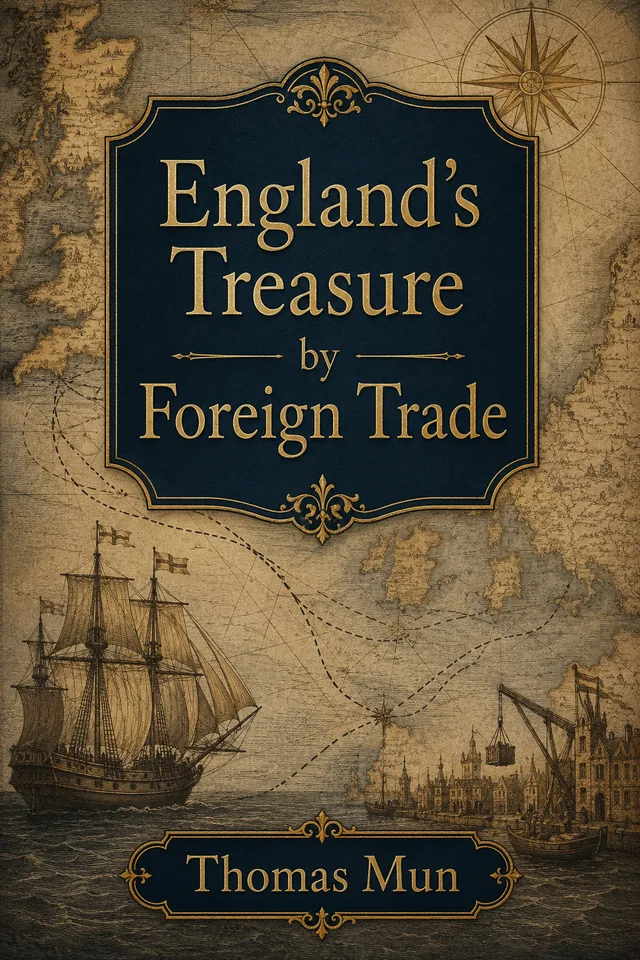
English Edition
Economics
England’s Treasure by Foreign Trade
English BooksWhale Edition by Thomas Mun
A foundational mercantilist argument about trade balance, national wealth, and early modern commerce.
- Preview
- A sample from the prepared text
- Formats
- Online reader, EPUB, PDF
- Access
- Library claim
Book introduction
England’s Treasure by Foreign Trade
Thomas Mun’s treatise explains how foreign trade, export surplus, bullion, shipping, and state policy were understood in early modern economic thought. The work is a key source for the history of mercantilism and the development of political economy.
BooksWhale edition
How this edition was prepared
This edition is based on a public domain text and has been prepared for digital reading by BooksWhale.
Public domain basis
Why this edition can be shared
Public domain original text; author died in 1641.
Read preview
A sample from the prepared text
Preview selected from the prepared reader text.
Preview chapterFull textRead preview
England’s Treasure by Foreign Trade
Preview chapterChapter 1Preview
Chap. I The Qualities which are required in a perfect Merchant of Forraign Trade. T he love and service of our Country consisteth not so much in the knowledge of those duties which are to be performed by others, as in the skilful practice of that which is done our selves; and therefore (my Son) it is now fit that I say something of the Merchant, which I hope in due time shall be thy Vocation: Yet herein are my thougths free from all Ambition, although I rank thee in a place of so high esteem; for the Merchant is worthily called The Steward of the Kingdoms Stock, by way of Commerce with other Nations; a work of no less Reputation than Trust, which ought to be performed with great skill and conscience, that so the private gain may ever accompany the publique good. And because the nobleness of this profession may the better stir up thy desires and endeavours to obtain those abilities which may effect it worthily, I well briefly set down the excellent qualities which are required in a perfect Merchant.
Arithmetician, and a good Accomptant, by that noble order of Debtor and Creditor, which is used onely amongst Merchants; also to be expert in the order and form of Charter-parties. Bills of Lading, Invoyces, Contracts, Bills of Exchange, and policies of Ensurance.
Commanders, Officers and Mariners, all which concern the Merchant as he is an Owner of Ships.
the like; to be able to give account thereof in all occasions for the good of his Countrey.
Thus have I briefly shewed thee a pattern for thy diligence, the Merchant in his qualities; which in truth are such and so many, that I find no other profession which leadeth into more worldly knowledge. And it cannot be denied but that their sufficiency doth appear likewise in the excellent government of State at Venice, Luca, Genoua, Florence, the low Countreys, and divers other places of Christendom. And in those States also where they are least esteemed, yet is their skill and knowledge often used by those who sit in the highest places of Authority: It is therefore an act beyond rashness in some, who do dis-enable their Counsel and judgment (even in books printed) making them uncapable of those ways and means which do either enrich or empoverish a Common-wealth, when in truth this is only effected by the mystery of their trade, as I shall plainly shew in that which followeth. It is true indeed that many Merchants here in England finding less encouragement given to their profession than in other Countreys, and seeing themselves not so well esteeemed as their Noble Vocation requireth, and according to the great consequence of the same, doe not therefore labour to attain There is more honour and profit in an Industrious life, than in a great Inheritance which wasteth for want of vertue. unto the excellencie of their profession, neither is it practised by the Nobility of this Kingdom as it is in other States from the Father to the Son throughout their generations, to the great encrease of their wealth, and maintenance of their names and families: Whereas the memory of our richest Merchants is suddenly extinguished; the Son being left rich, scorneth the profession of his Father, conceiving more honor to be a Gentleman (although but in name) to consume his estate in dark ignorance and excess, than to follow the steps of his Father as an Industrious Merchant to maintain and advance his Fortunes. But now leaving the Merchants praise we will come to his practice, or at least to so much thereof as concerns the bringing of Treasure into the Kingdom.
Preview chapterChapter 2Preview
Chap. II The Means to enrich this Kingdom, and to encrease our Treasure. A lthough a Kingdom may be enriched by gifts received, or by purchase taken from some other Nations, yet these are things uncertain and of small consideration when they happen. Forraign Trade is the Rule of our Treasure. The ordinary means therefore to encrease our wealth and treasure is by Forraign Trade, wherein wee must ever observe this rule; to sell more to strangers yearly than wee consume of theirs in value. For suppose that when this Kingdom is pletifully served with the Cloth, Lead, Tinn, Iron, Fish and other native commodities, we doe yearly export the overplus to forraign Countries to the value of twenty two hundred thousand pounds; by which means we are enabled beyond the Seas to buy and bring in forraign wares for our use and Consumption, to the value of twenty hundred thousand pounds; By this order duly kept in our trading, we may rest assured that this order duly kept in our trading, we may rest assured that the Kingdom shall be enriched yearly two hundred thousand pounds, which must be brought to us in so much Treasure; because that part of our stock which is not returned to us in wares must necessarily be brought home in treasure. For in this case it cometh to pass in the stock of a Kingdom, as in the estate of a private man; who is supposed to have one thousand pounds yearly revenue and two thousand pounds of ready money in his Chest: If such a man through excess shall spend one thousand five hundred pounds per annum, all his ready mony will be gone in four years; and in the like time his said money will be doubled if he take a Frugal course to spend but five hundred pounds per annum; which rule never faileth likewise in the Common-wealth, but in some cases (of no great moment) which I will hereafter declare, when I shall shew by whom and in what manner this ballance of the Kingdoms account ought to be drawn up yearly, or so often as it shall please the State to discover how much we gain or lose by trade with forraign Nations. But first I will say something concerning those ways and means which will encrease our exportations and diminish our importations of wares; which being done, I will then set down some other arguments both affirmative and negative to strengthen that which is here declared, and thereby to shew that all the other means which are commonly supposed to enrich the Kingdom with Treasure are altogether insufficient and meer fallacies.
Table of contents
Inside this edition
- 01Full text
- 02Chapter 1
- 03Chapter 2
- 04Chapter 3
- 05Chapter 4
- 06Chapter 5
- 07Chapter 6
- 08Chapter 7
- 09Chapter 8
- 10Chapter 9
- 11Chapter 10
- 12Chapter 11
- 13Chapter 12
- 14Chapter 13
- 15Chapter 14
- 16Chapter 15
- 17Chapter 16
- 18Chapter 17
- 19Chapter 18
- 20Chapter 19
- 21Chapter 20
- 22Chapter 21
Language availability
Other languages
Additional language editions are not published yet. This section will link to other BooksWhale editions when they become available.
Request another language