English Edition
Literature
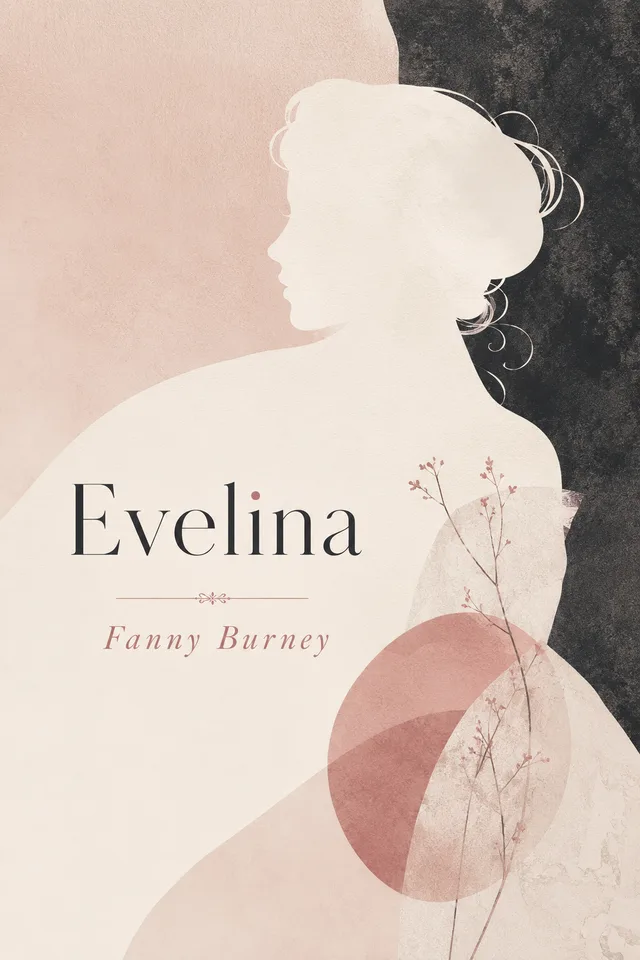
Evelina
English BooksWhale Edition by Fanny Burney
A witty epistolary novel about a young woman entering London society, manners, courtship, and female reputation.
- Preview
- A sample from the prepared text
- Formats
- Online reader, EPUB, PDF
- Access
- Library claim
Book introduction
Evelina
Evelina records a young woman’s first encounters with fashionable society, written through letters full of embarrassment, observation, humor, and sharp social detail. Burney explores courtship, class, legitimacy, public behavior, and the risks faced by women in drawing rooms, assemblies, theatres, and pleasure gardens. It is a key novel of manners before Austen.
BooksWhale edition
How this edition was prepared
This edition is based on a public domain text and has been prepared for digital reading by BooksWhale.
Public domain basis
Why this edition can be shared
Fanny Burney died in 1840, and Evelina was first published in 1778. These dates support the public-domain basis for this English original edition.
Read preview
A sample from the prepared text
Preview selected from the prepared reader text.
Preview chapterFull textRead preview
Evelina
EVELINA OR THE HISTORY OF A YOUNG LADY'S ENTRANCE INTO THE WORLD BY FANNY BURNEY ORIGINAL INSCRIPTION: TO DR. BURNEY Oh, Author of my being!-far more dear To me than light, than nourishment, or rest, Hygeia's blessings, Rapture's burning tear, Or the life-blood that mantles in my breast!
If in my heart the love of Virtue glows, 'T was planted there by an unerring rule;
From thy example the pure flame arose, Thy life, my precept,-thy good works, my school.
Could my weak pow'rs thy num'rous virtues trace, By filial love each fear should be repress'd, The blush of Incapacity I'd chace, And stand, Recorder of thy worth, confess'd:
But since my niggard stars that gift refuse, Concealment is the only boon I claim;
Obscure be still the unsuccessful Muse, Who cannot raise, but would not sink, thy fame.
Oh! of my life at once the source and joy!
If e'er thy eyes these feeble lines survey, Let not their folly their intent destroy;
Accept the tribute-but forget the lay.
ORIGINAL DEDICATION.
TO THE AUTHORS OF THE MONTHLY AND CRITICAL REVIEWS.
GENTLEMEN, The liberty which I take in addressing to you the trifling production of a few idle hours, will doubtless move your wonder, and probably your contempt. I will not, however, with the futility of apologies, intrude upon your time, but briefly acknowledge the motives of my temerity; lest, by a premature exercise of that patience which I hope will befriend me, I should lessen its benevolence, and be accessary to my own condemnation.
Without name, without recommendation, and unknown alike to success and disgrace, to whom can I so properly apply for patronage, as to those who publicly profess themselves Inspectors of all literary performances?
The extensive plan of your critical observations,-which, not confined to works of utility or ingenuity, is equally open to those of frivolous amusement,-and, yet worse than frivolous, dullness,-encourages me to seek for your protection, since,-perhaps for my sins!-it intitles me to your annotations. To resent, therefore, this offering, however insignificant, would ill become the universality of your undertaking;
though not to despise it may, alas! be out of your power.
The language of adulation, and the incense of flattery, though the natural inheritance, and constant resource, from time immemorial, of the Dedicator, to me offer nothing but the wistful regret that I dare not invoke their aid. Sinister views would be imputed to all I could say; since, thus situated, to extol your judgment, would seem the effect of art, and to celebrate your impartiality, be attributing to suspecting it.
As magistrates of the press, and Censors for the public,-to which you are bound by the sacred ties of integrity to exert the most spirited impartiality, and to which your suffrages should carry the marks of pure, dauntless, irrefragable truth-to appeal to your MERCY, were to solicit your dishonour; and therefore,-though 'tis sweeter than frankincense,-more grateful to the senses than all the odorous perfumes of Arabia,-and though It droppeth like the gentle rain from heaven Upon the place beneath,- I court it not! to your justice alone I am intitled, and by that I must abide. Your engagements are not to the supplicating authors;
but to the candid public, which will not fail to crave The penalty and forfeit of your bond.
No hackneyed writer, inured to abuse, and callous to criticism, here braves your severity;-neither does a half-starved garretteer, Oblig'd by hunger-and request of friends,- implore your lenity: your examination will be alike unbiassed by partiality and prejudice;-no refractory murmuring will follow your censure, no private interest will be gratified by your praise.
Let not the anxious solicitude with which I recommend myself to your
Preview chapternotice, expose me to your derision. Remember, Gentlemen, you were allPreview
young writers once, and the most experienced veteran of your corps may, by recollecting his first publication, renovate his first terrors, and learn to allow for mine. For though Courage is one of the noblest virtues of this nether sphere; and though scarcely more requisite in the field of battle, to guard the fighting hero from disgrace, than in the private commerce of the world, to ward off that littleness of soul which leads, by steps imperceptible, to all the base train of the inferior passions, and by which the too timid mind is betrayed into a servility derogatory to the dignity of human nature! yet is it a virtue of no necessity in a situation such as mine; a situation which removes, even from cowardice itself, the sting of ignominy;-for surely that courage may easily be dispensed with, which would rather excite disgust than admiration! Indeed, it is the peculiar privilege of an author, to rob terror of contempt, and pusillanimity of reproach.
Here let me rest- and snatch myself, while I yet am able, from the fascination of EGOTISM:-a monster who has more votaries than ever did homage to the most popular deity of antiquity; and whose singular quality is, that while he excites a blind and involuntary adoration in almost every individual, his influence is universally disallowed, his power universally contemned, and his worship, even by his followers, never mentioned but with abhorence.
In addressing you jointly, I mean but to mark the generous sentiments by which liberal criticism, to the utter annihilation of envy, jealousy, and all selfish views, ought to be distinguished.
I have the honour to be, GENTLEMEN, Your most obedient Humble Servant, *** **** ORIGINAL PREFACE.
IN the republic of letters, there is no member of such inferior rank, or who is so much disdained by his brethren of the quill, as the humble Novelist; nor is his fate less hard in the world at large, since, among the whole class of writers, perhaps not one can be named of which the votaries are more numerous but less respectable.
Yet, while in the annals of those few of our predecessors, to whom this species of writing is indebted for being saved from contempt, and rescued from depravity, we can trace such names as Rousseau, Johnson,(1)Marivaux, Fielding, Richardson, and Smollett, no man need blush at starting from the same post, though many, nay, most men, may sigh at finding themselves distanced.
The following letters are presented to the Public-for such, by novel writers, novel readers will be called,-with a very singular mixture of timidity and confidence, resulting from the peculiar situation of the editor; who, though trembling for their success from a consciousness of their imperfections, yet fears not being involved in their disgrace, while happily wrapped up in a mantle of impenetrable obscurity.
To draw characters from nature, though not from life, and to mark the manners of the times, is the attempted plan of the following letters. For this purpose, a young female, educated in the most secluded retirement, makes, at the age of seventeen, her first appearance upon the great and busy stage of life; with a virtuous mind, a cultivated understanding, and a feeling heart, her ignorance of the forms, and inexperience in the manners of the world, occasion all the little incidents which these volumes record, and which form the natural progression of the life of a young woman of obscure birth, but conspicuous beauty, for the first six months after her Entrance into the world.
Perhaps, were it possible to effect the total extirpation of novels, our young ladies in general, and boarding-school damsels in particular, might profit from their annihilation; but since the distemper they have spread seems incurable, since their contagion bids defiance to the medicine of advice or reprehension, and since they are found to baffle all the mental art of physic, save what is prescribed by the slow regimen of Time, and bitter diet of Experience; surely all attempts to contribute to the number of those which may be read, if not with advantage, at least without injury, ought rather to be encouraged than contemned.
Preview chapterLETTER IPreview
LADY HOWARD TO THE REV. MR. VILLARS Howard Grove, Kent.
CAN any thing, my good Sir, be more painful to a friendly mind, than a necessity of communicating disagreeable intelligence? Indeed it is sometimes difficult to determine, whether the relator or the receiver of evil tidings is most to be pitied.
I have just had a letter from Madame Duval; she is totally at a loss in what manner to behave; she seems desirous to repair the wrongs she has done, yet wishes the world to believe her blameless. She would fain cast upon another the odium of those misfortunes for which she alone is answerable. Her letter is violent, sometimes abusive, and that of you!-you, to whom she is under obligations which are greater even than her faults, but to whose advice she wickedly imputes all the sufferings of her much injured daughter, the late Lady Belmont. The chief purport of her writing I will acquaint you with; the letter itself is not worthy your notice.
She tells me that she has, for many years past, been in continual expectation of making a journey to England, which prevented her writing for information concerning this melancholy subject, by giving her hopes of making personal inquiries; but family occurrences have still detained her in France, which country she now sees no prospect of quitting. She has, therefore, lately used her utmost endeavors to obtain a faithful account of whatever related to her ill-advised daughter; the result of which giving her some reason to apprehend, that, upon her death-bed, she bequeathed an infant orphan to the world, she most graciously says, that if you, with whom she understands the child is placed, will procure authentic proofs of its relationship to her, you may sent it to Paris, where she will properly provide for it.
This woman is, undoubtedly, at length, self-convicted of her most unnatural behaviour; it is evident, from her writing, that she is still as vulgar and illiterate as when her first husband, Mr. Evelyn, had the weakness to marry her; nor does she at all apologize for addressing herself to me, though I was only once in her company.
Her letter has excited in my daughter Mirvan, a strong desire to be informed of the motives which induced Madame Duval to abandon the unfortunate Lady Belmont, at a time when a mother's protection was peculiarly necessary for her peace and her reputation. Notwithstanding I was personally acquainted with all the parties concerned in that affair, the subject always appeared of too delicate a nature to be spoken of with the principals; I cannot, therefore, satisfy Mrs. Mirvan otherwise than by applying to you.
By saying that you may send the child, Madame Duval aims at conferring, where she most owes obligation. I pretend not to give you advice;
you, to whose generous protection this helpless orphan is indebted for every thing, are the best and only judge of what she ought to do; but I am much concerned at the trouble and uneasiness which this unworthy woman may occasion you.
My daughter and my grandchild join with me in desiring to be most kindly remembered to the amiable girl; and they bid me remind you, that the annual visit to Howard Grove, which we were formerly promised, has been discontinued for more than four years. I am, dear Sir, with great regard, Your most obedient friend and servant, M. HOWARD.
Table of contents
Inside this edition
- 01Full text
- 02notice, expose me to your derision. Remember, Gentlemen, you were all
- 03LETTER I
- 04LETTER II
- 05letter to your Ladyship, I had never heard that she manifested any
- 06LETTER III [Written some months after the last]
- 07LETTER IV
- 08notice, has too much sensibility to be indifferent to it; but she
- 09LETTER V
- 10LETTER VI
- 11LETTER VII
- 12LETTER VIII
- 13LETTER IX
- 14LETTER X
- 15LETTER XI
- 16LETTER XII
- 17LETTER XIII
- 18LETTER XIV.
- 19letter, from London, of your Evelina's writing! But, believe me, it
- 20LETTER XV
- 21LETTER XVI
- 22LETTER XVII
- 23LETTER XVIII
- 24LETTER XIX
- 25LETTER XX
- 26LETTER XXI
- 27LETTER XXII
- 28LETTER XXIII
- 29LETTER XXIV
- 30LETTER XXV
- 31LETTER XXVI
- 32LETTER XXVII
- 33LETTER XXVIII
- 34LETTER XXIX
- 35LETTER XXX
- 36LETTER XXXI
- 37LETTER XXXII
- 38LETTER XXXIII
- 39letter. Indeed there seems to be a sort of tacit agreement between
- 40LETTER XXXIV
- 41letter, which obliged him instantly to leave the Grove, and that he
- 42letter might be intercepted.
- 43letter I so
- 44LETTER XXXV
- 45LETTER XXXVI
- 46LETTER XXXVII
- 47LETTER XXXVIII
- 48LETTER XXXIX
- 49LETTER XL
- 50LETTER XLI
- 51LETTER XLII
- 52LETTER XLIII
- 53letter. Not heeding, as I suppose, how he went, in turning the corner
- 54LETTER XLIV
- 55notice of it: for to be sure, thinks I, he must needs be a gentleman,
- 56LETTER XLV
- 57LETTER XLVI
- 58LETTER XLVII.
- 59LETTER XLVIII.
- 60LETTER XLIX.
- 61LETTER L.
- 62LETTER LI.
- 63LETTER LII.
- 64LETTER LIII.
- 65LETTER LIV.
- 66LETTER LV.
- 67LETTER LVI.
- 68LETTER LVII.
- 69letter;-this cold, this inanimate letter, which will but ill express
- 70LETTER LVIII.
- 71LETTER LIX.
- 72letter been the most respectful that could be written, the clandestine
- 73LETTER LX.
- 74LETTER LXI.
- 75letter: but I have been very ill, and Mr. Villars was so much alarmed,
- 76LETTER LXII.
- 77LETTER LXIII.
- 78letter, could not be in his senses. Oh that intemperance should have
- 79LETTER LXIV.
- 80notice, is merely owing to an accident, which, I am sure, is very
- 81LETTER LXV.
- 82LETTER LXVI.
- 83letter, quitted Paris, and flew to give him his personal assistance and
- 84LETTER LXVII.
- 85LETTER LXVIII.
- 86LETTER LXIX.
- 87LETTER LXX.
- 88LETTER LXXI.
- 89letter arrives. I hope you will not be displeased at my compliance,
- 90LETTER LXXII.
- 91letter, I kept my room,-for I was equally unable and unwilling to
- 92letter, though I saw that Lord Orville seemed quite confounded at my
- 93notice. But chiefly I was struck to see, that he suffered Sir Clement,
- 94LETTER LXXIII.
- 95LETTER LXXIV. [Inclosed in the preceding Letter.]
- 96LETTER LXXV.
- 97LETTER LXXVI.
- 98letter. She was charmed to find your opinion agreed with her own,
- 99LETTER LXXVII.
- 100letter is not-"
- 101letter, he did not hesitate to acknowledge me."
- 102LETTER LXXVIII.
- 103LETTER LXXIX.
- 104LETTER LXXX.
- 105LETTER LXXXI.
- 106LETTER LXXXII.
- 107letter was from; the importance of the contents he well knew; and,
- 108letter as he returned it; and, pressing my hand affectionately to
- 109LETTER LXXXIII.
- 110LETTER LXXXIV.
Language availability
Other languages
Additional language editions are not published yet. This section will link to other BooksWhale editions when they become available.
Request another language