English Edition
Literature
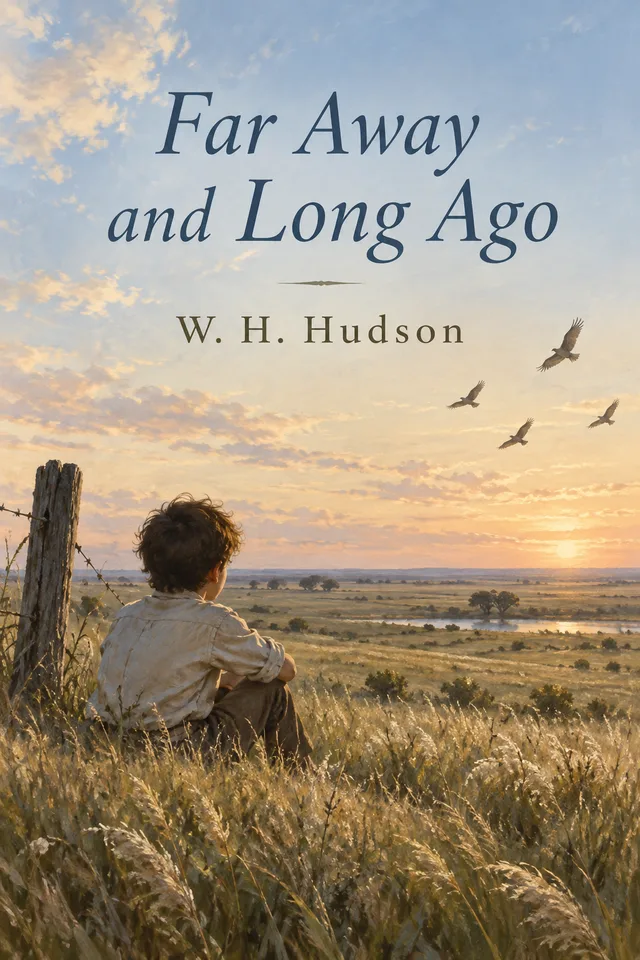
Far Away and Long Ago
English BooksWhale Edition by W. H. Hudson
A luminous memoir of childhood, nature, memory, birds, landscape, and the Argentine pampas.
- Preview
- A sample from the prepared text
- Formats
- Online reader, EPUB, PDF
- Access
- Library claim
Book introduction
Far Away and Long Ago
Far Away and Long Ago recalls W. H. Hudson’s childhood in Argentina through vivid natural observation, family memory, landscape, birds, and rural life. This edition suits readers of nature writing, memoir, South American childhood narratives, and classic English prose.
BooksWhale edition
How this edition was prepared
This edition is based on a public domain text and has been prepared for digital reading by BooksWhale.
Public domain basis
Why this edition can be shared
W. H. Hudson died in 1922, and Far Away and Long Ago was first published in 1918. These dates support the public-domain basis for this original English edition.
Read preview
A sample from the prepared text
Preview selected from the prepared reader text.
Preview chapterFull textRead preview
Far Away and Long Ago
W. H. Hudson
Preview chapterCHAPTER I: EARLIEST MEMORIESPreview
Preamble--The house where I was born--The singular Ombu tree--A tree
without a name--The plain--The ghost of a murdered slave--Our
playmate, the old sheep-dog--A first riding-lesson--The cattle: an
evening scene--My mother--Captain Scott--The hermit and his awful
penance.
It was never my intention to write an autobiography. Since I took to
writing in my middle years I have, from time to time, related some
incident of my boyhood, and these are contained in various chapters in
The Naturalist in La Plata, Birds and Man, Adventures among Birds,
and other works, also in two or three magazine articles: all this
material would have been kept back if I had contemplated such a book
as this. When my friends have asked me in recent years why I did not
write a history of my early life on the pampas, my answer was that I
had already told all that was worth telling in these books. And I
really believed it was so; for when a person endeavours to recall his
early life in its entirety he finds it is not possible: he is like
one who ascends a hill to survey the prospect before him on a day of
heavy cloud and shadow, who sees at a distance, now here, now there,
some feature in the landscape--hill or wood or tower or spire--touched
and made conspicuous by a transitory sunbeam while all else remains in
obscurity. The scenes, people, events we are able by an effort to call
up do not present themselves in order; there is no order, no sequence
or regular progression--nothing, in fact, but isolated spots or
patches, brightly illumined and vividly seen, in the midst of a wide
shrouded mental landscape.
It is easy to fall into the delusion that the few things thus
distinctly remembered and visualized are precisely those which were
most important in our life, and on that account were saved by memory
while all the rest has been permanently blotted out. That is indeed
how our memory serves and fools us; for at some period of a man's
life--at all events of some lives--in some rare state of the mind, it
is all at once revealed to him as by a miracle that nothing is ever
blotted out.
It was through falling into some such state as that, during which I
had a wonderfully clear and continuous vision of the past, that I was
tempted--forced I may say--to write this account of my early years. I
will relate the occasion, as I imagine that the reader who is a
psychologist will find as much to interest him in this incident as in
anything else contained in the book.
I was feeling weak and depressed when I came down from London one
November evening to the south coast: the sea, the clear sky, the
bright colours of the afterglow kept me too long on the front in an
east wind in that low condition, with the result that I was laid up
for six weeks with a very serious illness. Yet when it was over I
looked back on those six weeks as a happy time! Never had I thought so
little of physical pain. Never had I felt confinement less--I who
feel, when I am out of sight of living, growing grass, and out of
sound of birds' voices and all rural sounds, that I am not properly
alive!
On the second day of my illness, during an interval of comparative
ease, I fell into recollections of my childhood, and at once I had
that far, that forgotten past with me again as I had never previously
had it. It was not like that mental condition, known to most persons,
when some sight or sound or, more frequently, the perfume of some
flower, associated with our early life, restores the past suddenly and
Preview chapterCHAPTER II: MY NEW HOMEPreview
We quit our old home--A winter day journey--Aspect of the country--Our
new home--A prisoner in the barn--The plantation--A paradise of rats--
An evening scene--The people of the house--A beggar on horseback--Mr.
Trigg our schoolmaster--His double nature--Impersonates an old woman--
Reading Dickens--Mr. Trigg degenerates--Once more a homeless wanderer
on the great plain.
The incidents and impressions recorded in the preceding chapter
relate, as I have said, to the last year or two of my five years of
life in the place of my birth. Further back my memory refuses to take
me. Some wonderful persons go back to their second or even their first
year; I can't, and could only tell from hearsay what I was and did up
to the age of three. According to all accounts, the clouds of glory I
brought into the world--a habit of smiling at everything I looked at
and at every person that approached me--ceased to be visibly trailed
at about that age; I only remember myself as a common little boy--just
a little wild animal running about on its hind legs, amazingly
interested in the world in which it found itself.
Here, then, I begin, aged five, at an early hour on a bright, cold
morning in June--midwinter in that southern country of great plains or
pampas; impatiently waiting for the loading and harnessing to be
finished; then the being lifted to the top with the other little ones
--at that time we were five; finally, the grand moment when the start
was actually made with cries and much noise of stamping and snorting
of horses and rattling of chains. I remember a good deal of that long
journey, which began at sunrise and ended between the lights some time
after sunset; for it was my very first, and I was going out into the
unknown. I remember how, at the foot of the slope at the top of which
the old home stood, we plunged into the river, and there was more
noise and shouting and excitement until the straining animals brought
us safely out on the other side. Gazing back, the low roof of the
house was lost to view before long, but the trees--the row of twenty-
five giant ombu-trees which gave the place its name--were visible,
blue in the distance, until we were many miles on our way.
The undulating country had been left behind; before us and on both
sides the land, far as one could see, was absolutely flat, everywhere
green with the winter grass, but flowerless at that season, and with
the gleam of water, over the whole expanse. It had been a season of
great rains, and much of the flat country had been turned into shallow
lakes. That was all there was to see, except the herds of cattle and
horses and an occasional horseman galloping over the plain, and the
sight at long distances of a grove or small plantation of trees,
marking the site of an estancia, or sheep and cattle farm, these
groves appearing like islands on the sea-like flat country. At length
this monotonous landscape faded and vanished quite away, and the
lowing of cattle and tremulous bleating of sheep died out of hearing,
so that the last leagues were a blank to me, and I only came back to
my senses when it was dark and they lifted me down, so stiff with cold
and drowsy that I could hardly stand on my feet.
Next morning I found myself in a new and strange world. The house to
my childish eyes appeared of vast size: it consisted of a long range
of rooms on the ground, built of brick, with brick floors and roof
thatched with rushes. The rooms at one end, fronting the road, formed
a store, where the people of the surrounding country came to buy and
Table of contents
Inside this edition
- 01Full text
- 02CHAPTER I: EARLIEST MEMORIES
- 03CHAPTER II: MY NEW HOME
- 04CHAPTER III: DEATH OF AN OLD DOG
- 05CHAPTER IV: THE PLANTATION
- 06CHAPTER V: ASPECTS OF THE PLAIN
- 07CHAPTER VI: SOME BIRD ADVENTURES
- 08CHAPTER VII: MY FIRST VISIT TO BUENOS AYRES
- 09CHAPTER VIII: THE TYRANT'S FALL AND WHAT FOLLOWED
- 10CHAPTER IX: OUR NEIGHBOURS AT THE POPLARS
- 11CHAPTER X: OUR NEAREST ENGLISH NEIGHBOUR
- 12CHAPTER XI: A BREEDER OF PIEBALDS
- 13CHAPTER XII: THE HEAD OF A DECAYED HOUSE
- 14CHAPTER XIII: A PATRIARCH OF THE PAMPAS
- 15CHAPTER XIV: THE DOVECOTE
- 16CHAPTER XV: SERPENT AND CHILD
- 17CHAPTER XVI: A SERPENT MYSTERY
- 18CHAPTER XVII: A BOY'S ANIMISM
- 19CHAPTER XVIII: THE NEW SCHOOLMASTER
- 20CHAPTER XIX: BROTHERS
- 21CHAPTER XX: BIRDING IN THE MARSHES
- 22CHAPTER XXI: WILD-FOWLING ADVENTURES
- 23CHAPTER XXII: BOYHOOD'S END
- 24CHAPTER XXIII: A DARKENED LIFE
- 25CHAPTER XXIV: LOSS AND GAIN
Language availability
Other languages
Additional language editions are not published yet. This section will link to other BooksWhale editions when they become available.
Request another language