English Edition
Literature
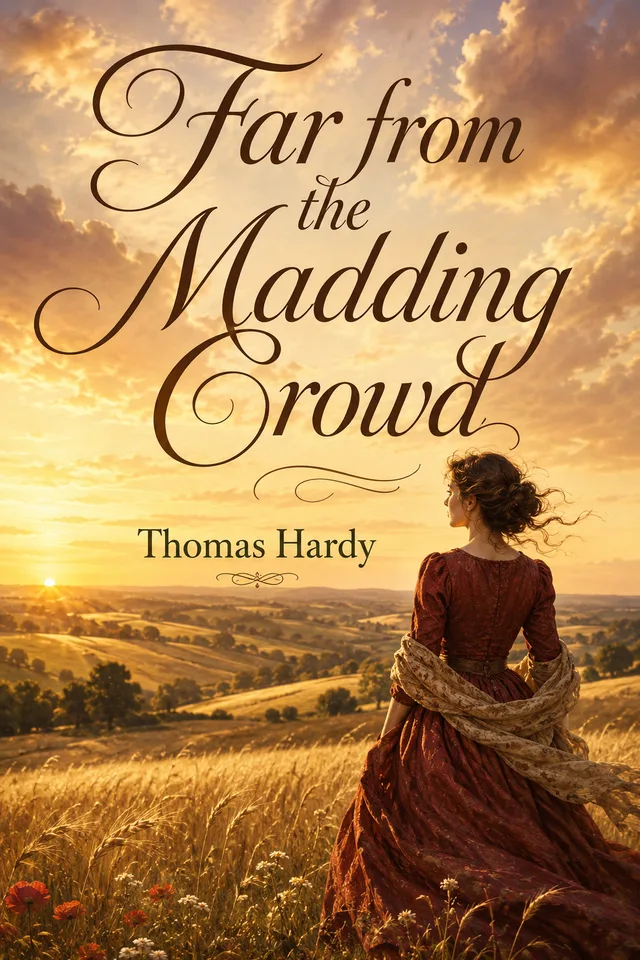
Far from the Madding Crowd
English BooksWhale Edition by Thomas Hardy
Bathsheba Everdene's choices among loyalty, passion, and vanity shape one of Hardy's richest pastoral dramas.
- Preview
- A sample from the prepared text
- Formats
- Online reader, EPUB, PDF
- Access
- Library claim
Book introduction
Far from the Madding Crowd
Far from the Madding Crowd follows Bathsheba Everdene as she inherits a farm and encounters Gabriel Oak, Sergeant Troy, and Farmer Boldwood. Thomas Hardy sets romance, labor, weather, and rural society within a Wessex landscape alive with beauty and consequence.
BooksWhale edition
How this edition was prepared
This edition is based on a public domain text and has been prepared for digital reading by BooksWhale.
Public domain basis
Why this edition can be shared
Thomas Hardy died in 1928, and Far from the Madding Crowd was first published in 1874. These dates support the public-domain basis for this English original-language edition.
Read preview
A sample from the prepared text
Preview selected from the prepared reader text.
Preview chapterFull textRead preview
Far from the Madding Crowd
Preview chapterCHAPTER I. DESCRIPTION OF FARMER OAK—AN INCIDENTPreview
When Farmer Oak smiled, the corners of his mouth spread till they were within an unimportant distance of his ears, his eyes were reduced to mere chinks, and diverging wrinkles appeared round them, extending upon his countenance like the rays in a rudimentary sketch of the rising sun.
His Christian name was Gabriel, and on working days he was a young man of sound judgment, easy motions, proper dress, and general good character. On Sundays he was a man of misty views, rather given to a postponing treatment of things, whose best clothes and seven-and-sixpenny umbrella were always hampering him: upon the whole, one who felt himself to occupy morally that vast middle space of Laodicean neutrality which lay between the Sacrament people of the parish and the drunken division of its inhabitants—that is, he went to church, but yawned privately by the time the congegation reached the Nicene creed, and thought of what there would be for dinner when he meant to be listening to the sermon. Or, to state his character as it stood in the scale of public opinion, when his friends and critics were in tantrums, he was considered rather a bad man; when they were pleased, he was rather a good man; when they were neither, he was a man whose moral colour was a kind of pepper-and-salt mixture.
Since he lived six times as many working-days as Sundays, Oak’s appearance in his old clothes was most peculiarly his own—the mental picture formed by his neighbours always presenting him as dressed in that way when their imaginations answered to the thought “Gabriel Oak.” He wore a low-crowned felt hat, spread out at the base by tight jamming upon the head for security in high winds, and a coat like Dr. Johnson’s; his lower extremities being encased in ordinary leather leggings and boots emphatically large, affording to each foot a roomy apartment so constructed that any wearer might stand in a river all day long and know nothing about it—their maker being a conscientious man who always endeavoured to compensate for any weakness in his cut by unstinted dimension and solidity.
Mr. Oak carried about him, by way of watch, what may be called a small silver clock; in other words, it was a watch as to shape and intention, and a small clock as to size. This instrument being several years older than Oak’s grandfather, had the peculiarity of going either too fast or not at all. The smaller of its hands, too, occasionally slipped round on the pivot, and thus, though the minutes were told with precision, nobody could be quite certain of the hour they belonged to. The stopping peculiarity of his watch Oak remedied by thumps and shakes, when it always went on again immediately, and he escaped any evil consequences from the other two defects by constant comparisons with and observations of the sun and stars, and by pressing his face close to the glass of his neighbours’ windows when passing their houses, till he could discern the hour marked by the green-faced timekeepers within. It may be mentioned that Oak’s fob being difficult of access, by reason of its somewhat high situation in the waistband of his trousers (which also lay at a remote height under his waistcoat), the watch was as a necessity pulled out by throwing the body extremely to one side, compressing the mouth and face to a mere mass of ruddy flesh on account of the exertion required, and drawing up the watch by its chain, like a bucket from a well.
But some thoughtful persons, who had seen him walking across one of his fields on a certain December morning—sunny and exceedingly mild—might have regarded Gabriel Oak in other aspects than these. In his face one might notice that many of the hues and curves of youth had tarried on to manhood: there even remained in his remoter crannies some relics of the boy. His height and breadth would have been sufficient to make his presence imposing, had they been exhibited with due consideration. But there is a way some men have, rural and urban alike—for which the mind is more responsible than flesh and sinew—a way of curtailing their dimensions by their manner of showing them; and from a quiet modesty that would have become a vestal, which seemed continually to impress upon him that he had no great claim on the world’s room, Oak walked unassumingly, and with a faintly perceptible bend, quite distinct from a bowing of the shoulders. This may be said to be a defect in an individual if he depends for his valuation as a total more upon his appearance than upon his capacity to wear well, which Oak did not. He had just reached the time of life at which “young” is ceasing to be the prefix of “man” in speaking of one. He was at the brightest period of masculine life, for his intellect and his emotions were clearly separated: he had passed the time during which the influence of youth indiscriminately mingles them in the character of impulse, and he had not yet arrived at the stage wherein they become united again, in the character of prejudice, by the influence of a wife and family. In short, he was twenty-eight, and a bachelor.
Preview chapterCHAPTER II. NIGHT—THE FLOCK—AN INTERIOR—ANOTHER INTERIORPreview
It was nearly midnight on the eve of St. Thomas’s, the shortest day in the year. A desolating wind wandered from the north over the hill whereon Oak had watched the yellow waggon and its occupant in the sunshine of a few days earlier.
Norcombe Hill—forming part of Norcombe Ewelease—was one of the spots which suggest to a passer-by that he is in the presence of a shape approaching the indestructible as nearly as any to be found on earth. It was a featureless convexity of chalk and soil—an ordinary specimen of those smoothly outlined protuberances of the globe which may remain undisturbed on some great day of confusion, when far grander heights and dizzy granite precipices topple down.
The hill was covered on its northern side by an ancient and decaying plantation of beeches, whose upper verge formed a line over the crest, fringing its arched curve against the sky, like a mane. To-night these trees sheltered the southern slope from the keenest blasts, which smote the wood and floundered through it with a sound as of grumbling, or gushed over its crowning boughs in a weakened moan. The dry leaves in the ditch simmered and boiled in the same breezes, a tongue of air occasionally ferreting out a few, and sending them spinning across the grass. A group or two of the latest in date amongst this dead multitude had remained on the twigs which bore them till this very mid-winter time, and in falling rattled against the trunks with smart taps.
Between this half-wooded, half-naked hill, and the vague, still horizon its summit indistinctly commanded, was a mysterious sheet of fathomless shade—the sounds only from which suggested that what it concealed bore some humble resemblance to features here. The thin grasses, more or less coating the hill, were touched by the wind in breezes of differing powers and almost differing natures—one rubbing the blades heavily, another raking them piercingly, another brushing them like a soft broom. The instinctive act of human-kind was to stand and listen, and learn how the trees on the right and the trees on the left wailed or chaunted to each other in the regular antiphonies of a cathedral choir; how hedges and other shapes to leeward then caught the note, lowering it to the tenderest sob; and how the hurrying gust then plunged into the south, to be heard no more.
The sky was clear—remarkably clear—and the twinkling of all the stars seemed to be but throbs of one body, timed by a common pulse. The North star was directly in the wind’s eye, and since evening the Bear had swung round it outwardly to the east, till it was now at a right angle with the meridian. A difference of colour in the stars—oftener read of than seen in England—was really perceptible here. The kingly brilliancy of Sirius pierced the eye with a steely glitter, the star called Capella was yellow, Aldebaran and Betelgueux shone with a fiery red.
To persons standing alone on a hill during a clear midnight such as this, the roll of the world eastward is almost a palpable movement. The sensation may be caused by the panoramic glide of the stars past earthly objects, which is perceptible in a few minutes of stillness, or by a fancy that the better outlook upon space afforded by a hill emphasizes terrestrial revolution, or by the wind, or by the solitude; but whatever be its origin, the impression of riding along is vivid and abiding. The poetry of motion is a phrase much in use, and to enjoy the epic form of that gratification it is necessary to stand on a hill at a small hour of the night, and, first enlarging the consciousness with a sense of difference from the mass of civilized mankind, who are horizontal and disregardful of all such proceedings at this time, long and quietly watch your stately progress through the stars. After such a nocturnal reconnoitre among these astral clusters, aloft from the customary haunts of thought and vision, some men may feel raised to a capability for eternity at once.
Table of contents
Inside this edition
- 01Full text
- 02CHAPTER I. DESCRIPTION OF FARMER OAK—AN INCIDENT
- 03CHAPTER II. NIGHT—THE FLOCK—AN INTERIOR—ANOTHER INTERIOR
- 04CHAPTER III. A GIRL ON HORSEBACK—CONVERSATION
- 05CHAPTER IV. GABRIEL’S RESOLVE—THE VISIT—THE MISTAKE
- 06CHAPTER V. DEPARTURE OF BATHSHEBA—A PASTORAL TRAGEDY
- 07CHAPTER VI. THE FAIR—THE JOURNEY—THE FIRE
- 08CHAPTER VII. RECOGNITION—A TIMID GIRL
- 09CHAPTER VIII. THE MALTHOUSE—THE CHAT—NEWS
- 10CHAPTER IX. THE HOMESTEAD—A VISITOR—HALF CONFIDENCES
- 11CHAPTER X. MISTRESS AND MEN
- 12CHAPTER XI. MELCHESTER MOOR—SNOW—A MEETING
- 13CHAPTER XII. FARMERS—A RULE—AN EXCEPTION
- 14CHAPTER XIII. SORTES SANCTORUM—THE VALENTINE
- 15CHAPTER XIV. EFFECT OF THE LETTER—SUNRISE
- 16CHAPTER XV. A MORNING MEETING—THE LETTER AGAIN
- 17CHAPTER XVI. ALL SAINTS’ AND ALL SOULS’
- 18CHAPTER XVII. IN THE MARKET-PLACE
- 19CHAPTER XVIII. BOLDWOOD IN MEDITATION—A VISIT
- 20CHAPTER XIX. THE SHEEP-WASHING—THE OFFER
- 21CHAPTER XX. PERPLEXITY—GRINDING THE SHEARS—A QUARREL
- 22CHAPTER XXI. TROUBLES IN THE FOLD—A MESSAGE
- 23CHAPTER XXII. THE GREAT BARN AND THE SHEEP-SHEARERS
- 24CHAPTER XXIII. EVENTIDE—A SECOND DECLARATION
- 25CHAPTER XXIV. THE SAME NIGHT—THE FIR PLANTATION
- 26CHAPTER XXV. THE NEW ACQUAINTANCE DESCRIBED
- 27CHAPTER XXVI. SCENE ON THE VERGE OF THE HAY-MEAD
- 28CHAPTER XXVII. HIVING THE BEES
- 29CHAPTER XXVIII. THE HOLLOW AMID THE FERNS
- 30CHAPTER XXIX. PARTICULARS OF A TWILIGHT WALK
- 31CHAPTER XXX. HOT CHEEKS AND TEARFUL EYES
- 32CHAPTER I. BLAME—FURY
- 33CHAPTER II. NIGHT—HORSES TRAMPING
- 34CHAPTER III. IN THE SUN—A HARBINGER
- 35CHAPTER IV. HOME AGAIN—A JUGGLER
- 36CHAPTER V. AT AN UPPER WINDOW
- 37CHAPTER VI. WEALTH IN JEOPARDY—THE REVEL
- 38CHAPTER VII. THE STORM—THE TWO TOGETHER
- 39CHAPTER VIII. RAIN—ONE SOLITARY MEETS ANOTHER
- 40CHAPTER IX. COMING HOME—A CRY
- 41CHAPTER X. ON CASTERBRIDGE HIGHWAY
- 42CHAPTER XI. SUSPICION—FANNY IS SENT FOR
- 43CHAPTER XII. JOSEPH AND HIS BURDEN—BUCK’S HEAD
- 44CHAPTER XIII. FANNY’S REVENGE
- 45CHAPTER XIV. UNDER A TREE—REACTION
- 46CHAPTER XV. TROY’S ROMANTICISM
- 47CHAPTER XVI. THE GURGOYLE: ITS DOINGS
- 48CHAPTER XVII. ADVENTURES BY THE SHORE
- 49CHAPTER XVIII. DOUBTS ARISE—DOUBTS VANISH
- 50CHAPTER XIX. OAK’S ADVANCEMENT—A GREAT HOPE
- 51CHAPTER XX. THE SHEEP FAIR—TROY TOUCHES HIS WIFE’S HAND
- 52CHAPTER XXI. BATHSHEBA TALKS WITH HER OUTRIDER
- 53CHAPTER XXII. CONVERGING COURSES
- 54I.
- 55II.
- 56III.
- 57IV.
- 58V.
- 59VI.
- 60VII.
- 61CHAPTER XXIII. CONCURRITUR—HORÆ MOMENTO
- 62CHAPTER XXIV. AFTER THE SHOCK
- 63CHAPTER XXV. THE MARCH FOLLOWING—“BATHSHEBA BOLDWOOD”
- 64CHAPTER XXVI. BEAUTY IN LONELINESS—AFTER ALL
- 65CHAPTER XXVII. A FOGGY NIGHT AND MORNING—CONCLUSION
Language availability
Other languages
Additional language editions are not published yet. This section will link to other BooksWhale editions when they become available.
Request another language