English Edition
Literature
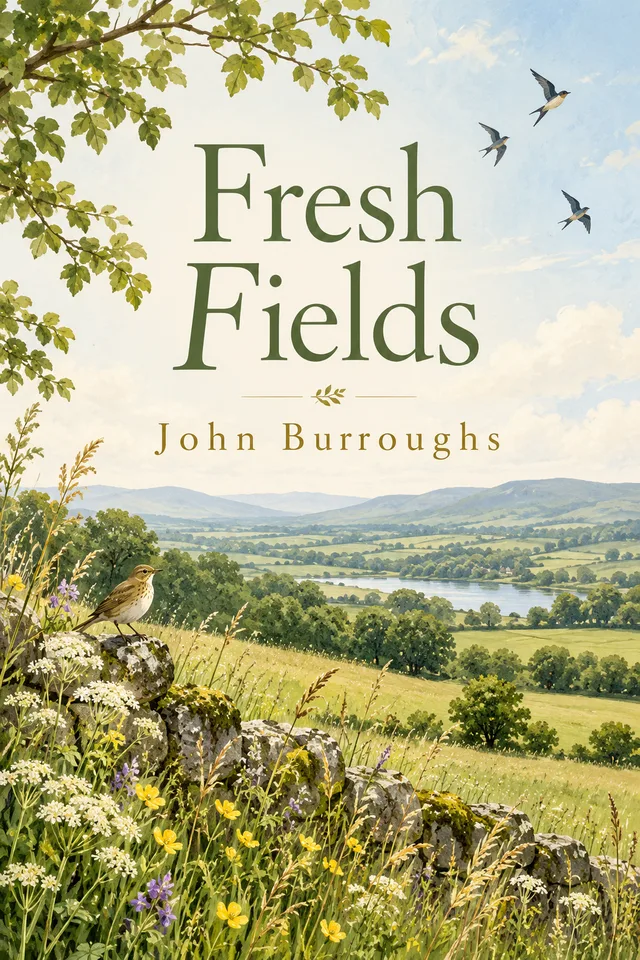
Fresh Fields
English BooksWhale Edition by John Burroughs
John Burroughs explores British landscapes, birds, literary homes, and rural life through the eyes of an American naturalist.
- Preview
- A sample from the prepared text
- Formats
- Online reader, EPUB, PDF
- Access
- Library claim
Book introduction
Fresh Fields
In these eleven essays, John Burroughs records journeys through Britain and compares its countryside with familiar American landscapes. Woods, wild flowers, birds and cultivated fields lead him toward reflections on the relations between nature and human settlement. Visits associated with Carlyle and Wordsworth give the collection a literary dimension, while the concluding sea passage returns attention to the experience of travel itself.
BooksWhale edition
How this edition was prepared
This edition is based on a public domain text and has been prepared for digital reading by BooksWhale.
Public domain basis
Why this edition can be shared
John Burroughs died in 1921. This edition uses the public-domain English original from Project Gutenberg, without later editorial notes or illustrations.
Read preview
A sample from the prepared text
Preview selected from the prepared reader text.
Preview chapterI NATURE IN ENGLANDRead preview
I NATURE IN ENGLAND
Preview chapterIPreview
The first whiff we got of transatlantic nature was the peaty breath of the peasant chimneys of Ireland while we were yet many miles at sea. What a homelike, fireside smell it was! it seemed to make something long forgotten stir within one. One recognizes it as a characteristic Old World odor, it savors so of the soil and of a ripe and mellow antiquity. I know no other fuel that yields so agreeable a perfume as peat. Unless the Irishman in one has dwindled to a very small fraction, he will be pretty sure to dilate his nostrils and feel some dim awakening of memory on catching the scent of this ancestral fuel. The fat, unctuous peat,—the pith and marrow of ages of vegetable growth,—how typical it is of much that lies there before us in the elder world; of the slow ripenings and accumulations, of extinct life and forms, decayed civilizations, of ten thousand growths and achievements of the hand and soul of man, now reduced to their last modicum of fertilizing mould!
With the breath of the chimney there came presently the chimney swallow, and dropped much fatigued upon the deck of the steamer. It was a still more welcome and suggestive token,—the bird of Virgil and of Theocritus, acquainted with every cottage roof and chimney in Europe, and with the ruined abbeys and castle walls. Except its lighter-colored breast, it seemed identical with our barn swallow; its little black cap appeared pulled down over its eyes in the same manner, and its glossy steel-blue coat, its forked tail, its infantile feet, and its cheerful twitter were the same. But its habits are different; for in Europe this swallow builds in chimneys, and the bird that answers to our chimney swallow, or swift, builds in crevices in barns and houses.
We did not suspect we had taken aboard our pilot in the little swallow, yet so it proved: this light navigator always hails from the port of bright, warm skies; and the next morning we found ourselves sailing between shores basking in full summer sunshine. Those who, after ten days of sorrowing and fasting in the desert of the ocean, have sailed up the Frith of Clyde, and thence up the Clyde to Glasgow, on the morning of a perfect mid-May day, the sky all sunshine, the earth all verdure, know what this experience is; and only those can know it. It takes a good many foul days in Scotland to breed one fair one; but when the fair day does come, it is worth the price paid for it. The soul and sentiment of all fair weather is in it; it is the flowering of the meteorological influences, the rose on this thorn of rain and mist. These fair days, I was told, may be quite confidently looked for in May; we were so fortunate as to experience a series of them, and the day we entered port was such a one as you would select from a hundred.
The traveler is in a mood to be pleased after clearing the Atlantic gulf; the eye in its exuberance is full of caresses and flattery, and the deck of a steamer is a rare vantage-ground on any occasion of sight-seeing; it affords just the isolation and elevation needed. Yet fully discounting these favorable conditions, the fact remains that Scotch sunshine is bewitching, and that the scenery of the Clyde is unequaled by any other approach to Europe. It is Europe, abridged and assorted and passed before you in the space of a few hours,—the highlands and lochs and castle-crowned crags on the one hand; and the lowlands, with their parks and farms, their manor halls and matchless verdure, on the other. The eye is conservative, and loves a look of permanence and order, of peace and contentment; and these Scotch shores, with their stone houses, compact masonry, clean fields, grazing herds, ivied walls, massive foliage, perfect roads, verdant mountains, etc., fill all the conditions. We pause an hour in front of Greenock, and then, on the crest of the tide, make our way slowly upward. The landscape closes around us. We can almost hear the cattle ripping off the lush grass in the fields. One feels as if he could eat grass himself. It is pastoral paradise. We can see the daisies and buttercups; and from above a meadow on the right a part of the song of a skylark reaches my ear. Indeed, not a little of the charm and novelty of this part of the voyage was the impression it made as of going afield in an ocean steamer. We had suddenly passed from a wilderness of waters into a verdurous, sunlit landscape, where scarcely any water was visible. The Clyde, soon after you leave Greenock, becomes little more than a large, deep canal, inclosed between meadow banks, and from the deck of the great steamer only the most charming rural sights and sounds greet you. You are at sea amid verdant parks and fields of clover and grain. You behold farm occupations—sowing, planting, plowing—as from the middle of the Atlantic. Playful heifers and skipping lambs take the place of the leaping dolphins and the basking swordfish. The ship steers her way amid turnip-fields and broad acres of newly planted potatoes. You are not surprised that she needs piloting. A little tug with a rope at her bow pulls her first this way and then that, while one at her stern nudges her right flank and then her left. Presently we come to the ship-building yards of the Clyde, where rural, pastoral scenes are strangely mingled with those of quite another sort. "First a cow and then an iron ship," as one of the voyagers observed. Here a pasture or a meadow, or a field of wheat or oats, and close beside it, without an inch of waste or neutral ground between, rise the skeletons of innumerable ships, like a forest of slender growths of iron, with the workmen hammering amid it like so many noisy woodpeckers. It is doubtful if such a scene can be witnessed anywhere else in the world,—an enormous mechanical, commercial, and architectural interest, alternating with the quiet and simplicity of inland farms and home occupations. You could leap from the deck of a half-finished ocean steamer into a field of waving wheat or Winchester beans. These vast shipyards appear to be set down here upon the banks of the Clyde without any interference with the natural surroundings of the place.
Preview chapterIIPreview
I had come to Great Britain less to see the noted sights and places than to observe the general face of nature. I wanted to steep myself long and well in that mellow, benign landscape, and put to further tests the impressions I had got of it during a hasty visit one autumn, eleven years before. Hence I was mainly intent on roaming about the country, it mattered little where. Like an attic stored with relics and heirlooms, there is no place in England where you cannot instantly turn from nature to scenes and places of deep historical or legendary or artistic interest.
My journal of travel is a brief one, and keeps to a few of the main lines. After spending a couple of days in Glasgow, we went down to Alloway, in Burns's country, and had our first taste of the beauty and sweetness of rural Britain, and of the privacy and comfort of a little Scotch inn. The weather was exceptionally fair, and the mellow Ayrshire landscape, threaded by the Doon, a perpetual delight. Thence we went north on a short tour through the Highlands,—up Loch Lomond, down Loch Katrine, and through the Trosachs to Callander, and thence to Stirling and Edinburgh. After a few days in the Scotch capital we set out for Carlyle's country, where we passed five delightful days. The next week found us in Wordsworth's land, and the 10th of June in London. After a week here I went down into Surrey and Hants, in quest of the nightingale, for four or five days. Till the middle of July I hovered about London, making frequent excursions into the country,—east, south, north, west, and once across the channel into France, where I had a long walk over the hills about Boulogne. July 15 we began our return journey northward, stopping a few days at Stratford, where I found the Red Horse Inn sadly degenerated from excess of travel. Thence again into the Lake region for a longer stay. From Grasmere we went into north Wales, and did the usual touring and sight-seeing around and over the mountains. The last week of July we were again in Glasgow, from which port we sailed on our homeward voyage July 29.
With a suitable companion, I should probably have made many long pedestrian tours. As it was, I took many short but delightful walks both in England and Scotland, with a half day's walk in the north of Ireland about Moville. 'Tis an admirable country to walk in,—the roads are so dry and smooth and of such easy grade, the footpaths so numerous and so bold, and the climate so cool and tonic. One night, with a friend, I walked from Rochester to Maidstone, part of the way in a slow rain and part of the way in the darkness. We had proposed to put up at some one of the little inns on the road, and get a view of the weald of Kent in the morning; but the inns refused us entertainment, and we were compelled to do the eight miles at night, stepping off very lively the last four in order to reach Maidstone before the hotels were shut up, which takes place at eleven o'clock. I learned this night how fragrant the English elder is while in bloom, and that distance lends enchantment to the smell. When I plucked the flowers, which seemed precisely like our own, the odor was rank and disagreeable; but at the distance of a few yards it floated upon the moist air, a spicy and pleasing perfume. The elder here grows to be a veritable tree; I saw specimens seven or eight inches in diameter and twenty feet high. In the morning we walked back by a different route, taking in Boxley Church, where the pilgrims used to pause on their way to Canterbury, and getting many good views of Kent grain-fields and hop-yards. Sometimes the road wound through the landscape like a footpath, with nothing between it and the rank-growing crops. An occasional newly-plowed field presented a curious appearance. The soil is upon the chalk formation, and is full of large fragments of flint. These work out upon the surface, and, being white and full of articulations and processes, give to the ground the appearance of being thickly strewn with bones,—with thigh bones greatly foreshortened. Yet these old bones in skillful hands make a most effective building material. They appear in all the old churches and ancient buildings in the south of England. Broken squarely off, the flint shows a fine semi-transparent surface that, in combination with coarser material, has a remarkable crystalline effect. One of the most delicious bits of architectural decoration I saw in England was produced, in the front wall of one of the old buildings attached to the cathedral at Canterbury, by little squares of these flints in brick panel-work. The cool, pellucid, illuminating effect of the flint was just the proper foil to the warm, glowing, livid brick.
Table of contents
Inside this edition
- 01I NATURE IN ENGLAND
- 02I
- 03II
- 04III
- 05IV
- 06II ENGLISH WOODS: A CONTRAST
- 07III IN CARLYLE'S COUNTRY
- 08IV A HUNT FOR THE NIGHTINGALE
- 09V ENGLISH AND AMERICAN SONG-BIRDS
- 10VI IMPRESSIONS OF SOME ENGLISH BIRDS
- 11VII IN WORDSWORTH'S COUNTRY
- 12VIII A GLANCE AT BRITISH WILD FLOWERS
- 13IX BRITISH FERTILITY
- 14I
- 15II
- 16X A SUNDAY IN CHEYNE ROW
- 17I
- 18II
- 19III
- 20IV
- 21XI AT SEA
Language availability
Other languages
Additional language editions are not published yet. This section will link to other BooksWhale editions when they become available.
Request another language