English Edition
Literature
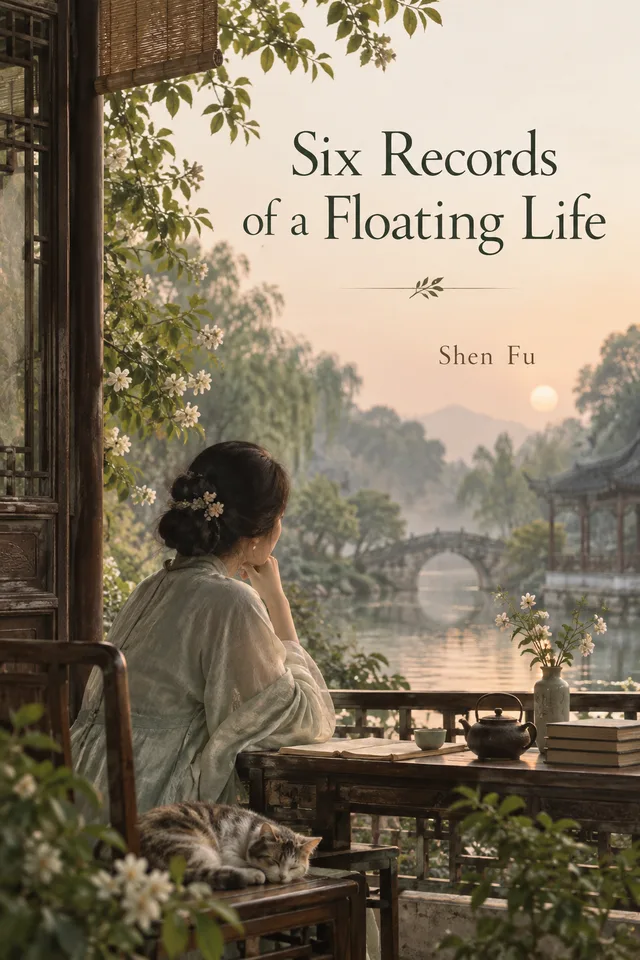
Six Records of a Floating Life
English BooksWhale Edition by Shen Fu
Original title: 浮生六记
A beloved autobiographical classic of marriage, travel, art, grief, and everyday beauty.
- Preview
- A sample from the prepared text
- Formats
- Online reader, EPUB, PDF
- Access
- Library claim
Book introduction
Six Records of a Floating Life
Six Records of a Floating Life is a graceful autobiographical work about Shen Fu and Chen Yun, domestic affection, painting, gardens, travel, poverty, illness, memory, and the fragile pleasures of ordinary life. This English edition offers a readable entry into one of China’s most intimate literary classics.
BooksWhale edition
How this edition was prepared
This edition is based on a public domain text and has been prepared for digital reading by BooksWhale.
Public domain basis
Why this edition can be shared
Shen Fu died in the nineteenth century, and Six Records of a Floating Life was first published in 1877 from earlier autobiographical writings. These dates support the public-domain basis for the Chinese source text; this English edition uses an authorized translation prepared from that source.
Read preview
A sample from the prepared text
Preview selected from the prepared reader text.
Preview chapterFull textRead preview
Six Records of a Floating Life
沈复
Preview chapterPrefacePreview
Shen Fu’s Six Records of a Floating Life is one of the most intimate and graceful works in the tradition of Chinese autobiographical literature. Written in the late eighteenth and early nineteenth centuries, this remarkable memoir offers neither a grand historical chronicle nor the life story of a celebrated statesman. Instead, it preserves the fragile details of an ordinary existence: affection between husband and wife, domestic pleasures, artistic friendships, travels, financial difficulties, illness, separation, and memory. It is precisely this modest scale that gives the book its enduring emotional power. Shen Fu was born in Suzhou in 1763, into a family connected with the educated gentry. His life, however, did not follow the secure path that such a background might suggest. He experienced repeated financial hardship, unstable employment, family conflict, and personal loss. Through these circumstances, he developed an unusually attentive eye for the small consolations of daily life. A garden arrangement, a shared meal, a moonlit evening, a painted landscape, or a conversation between companions could become, in his prose, a moment worthy of preservation.
At the emotional center of the work stands Shen Fu’s relationship with his wife, Chen Yun. Their marriage is described with a warmth and tenderness that remain striking even to modern readers. Yun appears not merely as an idealized spouse but as an intelligent, imaginative, humorous, and deeply sympathetic companion. The couple share interests in literature, gardening, food, travel, and aesthetic experiment. Their affection gives the memoir much of its charm, while the hardships they later endure lend it profound poignancy. The title Six Records of a Floating Life alludes to the Buddhist and Daoist sense of human existence as fleeting and uncertain. “Floating life” suggests a life carried along by circumstances, beautiful yet unstable, like a dream or a reflection on water. Shen Fu’s memoir repeatedly moves between delight and impermanence. Moments of happiness are intensely valued because they cannot last. The awareness of loss never entirely destroys pleasure; instead, it makes pleasure more vivid.
The surviving text is traditionally organized into several “records,” dealing with domestic happiness, leisure and aesthetic pursuits, sorrow and misfortune, and travel. Two of the original six sections have been lost, leaving the work incomplete. Yet this incompleteness seems almost appropriate to a memoir so concerned with the fragmentary nature of memory itself. What remains feels less like a carefully constructed autobiography than a collection of scenes rescued from time. For contemporary readers, Six Records of a Floating Life offers a rare window into the private emotional world of late imperial China. More importantly, it speaks across cultures and centuries about experiences that remain immediately recognizable: love, companionship, disappointment, beauty, regret, and the desire to remember what cannot be kept. Shen Fu’s quiet voice reminds us that a life need not be famous to be worth recording. In the fleeting details of one household and one marriage, he created a work of remarkable universality—an enduring meditation on how human beings find beauty within the uncertainties of a passing life.
Preview chapterVolume One: Joys of the BoudoirPreview
I was born on the twenty-second day of the eleventh month, in midwinter of the guiwei year of the Qianlong reign (1763). It was a time of peace and prosperity, and I was born into a scholar-official family, living beside Canglang Pavilion in Suzhou. Heaven’s kindness toward me could truly be said to have been complete in every respect. Su Dongpo wrote in a poem, “Events are like spring dreams, leaving no trace.” If I did not record them in writing, I would surely be failing to repay Heaven’s generosity toward me. Since the Book of Songs begins with “Guanju,” a poem about husband and wife, I too have placed the affairs of married life at the beginning. The rest is written in sequence. What troubles me is that I studied poorly in my youth and know relatively few characters. I am merely recording the facts and events as they actually occurred. If one insists on examining the rhetoric and structure of my writing, that would be like reproaching a stained mirror for not shining brightly enough.
When I was young, I was betrothed to a girl of the Yu family of Jinsha, but she died at the age of eight. I therefore married a daughter of the Chen family. Her name was Yun, her courtesy name Shuzhen, and she was the daughter of my maternal uncle, Mr. Xinyu. She was naturally intelligent and endowed with a delicate spirit. When she was first learning to speak, someone read the long poem “The Song of the Pipa” to her, and before long she could recite it from memory. Unfortunately, her father died when she was four. Her family then consisted only of her mother, née Jin, and her younger brother Kechang, and they were utterly impoverished. When Yun grew older, she became skilled in embroidery, weaving, and dyeing. The three members of the household depended entirely on her handicraft for their livelihood; even Kechang’s school fees were never allowed to fall into arrears. One day she came across a copy of “The Song of the Pipa” in a book basket. By identifying the characters one by one, she gradually learned to read. In the intervals between embroidery, she slowly taught herself to compose poetry, and once wrote such fine lines as:
“Autumn invades, making human shadows thin; Frost dyes the chrysanthemums plump.” When I was thirteen, I accompanied my mother on a visit to her family. I got along very well with Yun and was able to read her poems. Although I marveled at the purity and elegance of her talent, I also feared that such gifts might indicate a fragile fortune and a short life. Yet my heart was entirely set upon her and could not let go. I therefore said to my mother, “If I am allowed to choose my wife, I will marry no one but Sister Shuzhen.” My mother also liked her gentle and compliant nature. She took off a gold ring and gave it to her, thereby sealing our betrothal. This was on the sixteenth day of the seventh month in the yiwei year of Qianlong (1775). That winter, one of Yun’s female cousins was married, and I again accompanied my mother to their home. Yun and I were the same age, though she was ten months older. Since childhood we had addressed each other as elder sister and younger brother, so I still called her Sister Shu.
Everyone in the house was dressed in bright new clothes, while Yun alone wore plain and elegant garments, having merely changed into a pair of new shoes. I saw that the embroidery on her shoes was exquisitely done. When I asked about them and learned that she had made them herself, I realized that her cleverness was by no means confined to brush and ink. Her figure was graceful, with sloping shoulders and a long neck. She was slender without appearing bony. Her brows were curved, her eyes delicate, and her glance lively and radiant. Only two slightly protruding teeth detracted somewhat from perfect beauty. Yet her tender, charming manner was so captivating that it stirred the heart irresistibly. I asked to read her poetry manuscripts. Some consisted of only one couplet, others of three or four lines, and most were unfinished fragments. When I asked why, she smiled and said, “These are merely exercises written without a teacher. I only hope that one day I may meet a kindred spirit who can also be my teacher and help me polish them into finished poems.”
Table of contents
Inside this edition
- 01Full text
- 02Preface
- 03Volume One: Joys of the Boudoir
- 04Volume Two: Pleasures of Leisure
- 05Volume Three: Sorrows of Adversity
- 06Volume Four: The Pleasures of Wandering
- 07Volume Five: A Record of Experiences in Chūzan
- 08Volume Six: Notes on Nurturing Life and the Way
Language availability
Other languages
Additional language editions are not published yet. This section will link to other BooksWhale editions when they become available.
Request another language