English Edition
Literature
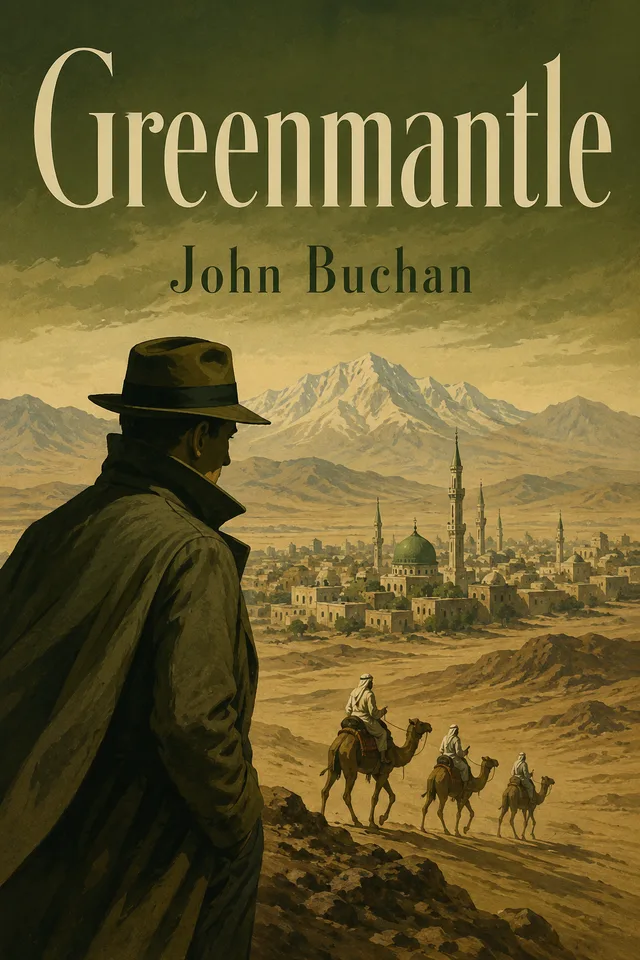
Greenmantle
English BooksWhale Edition by John Buchan
A wartime Richard Hannay mission crosses Europe and the Near East in search of a dangerous political secret.
- Preview
- A sample from the prepared text
- Formats
- Online reader, EPUB, PDF
- Access
- Library claim
Book introduction
Greenmantle
Greenmantle expands John Buchan's espionage world from Britain to wartime Europe, Constantinople, and the frontiers of empire. Richard Hannay and his companions follow rumors of a mysterious religious-political force, mixing adventure, intelligence work, endurance, and imperial intrigue.
BooksWhale edition
How this edition was prepared
This edition is based on a public domain text and has been prepared for digital reading by BooksWhale.
Public domain basis
Why this edition can be shared
John Buchan died in 1940, and Greenmantle was first published in 1916. These dates support the public-domain basis for this English original-language edition.
Read preview
A sample from the prepared text
Preview selected from the prepared reader text.
Preview chapterFull textRead preview
Greenmantle
Preview chapterCHAPTER I. A Mission is ProposedPreview
I had just finished breakfast and was filling my pipe when I got Bullivant’s telegram. It was at Furling, the big country house in Hampshire where I had come to convalesce after Loos, and Sandy, who was in the same case, was hunting for the marmalade. I flung him the flimsy with the blue strip pasted down on it, and he whistled.
“Hullo, Dick, you’ve got the battalion. Or maybe it’s a staff billet. You’ll be a blighted brass-hat, coming it heavy over the hard-working regimental officer. And to think of the language you’ve wasted on brass-hats in your time!”
I sat and thought for a bit, for the name “Bullivant’ carried me back eighteen months to the hot summer before the war. I had not seen the man since, though I had read about him in the papers. For more than a year I had been a busy battalion officer, with no other thought than to hammer a lot of raw stuff into good soldiers. I had succeeded pretty well, and there was no prouder man on earth than Richard Hannay when he took his Lennox Highlanders over the parapets on that glorious and bloody 25th day of September. Loos was no picnic, and we had had some ugly bits of scrapping before that, but the worst bit of the campaign I had seen was a tea-party to the show I had been in with Bullivant before the war started. [Major Hannay’s narrative of this affair has been published under the title of _The Thirty-nine Steps_.]
The sight of his name on a telegram form seemed to change all my outlook on life. I had been hoping for the command of the battalion, and looking forward to being in at the finish with Brother Boche. But this message jerked my thoughts on to a new road. There might be other things in the war than straightforward fighting. Why on earth should the Foreign Office want to see an obscure Major of the New Army, and want to see him in double-quick time?
“I’m going up to town by the ten train,” I announced; “I’ll be back in time for dinner.”
“Try my tailor,” said Sandy. “He’s got a very nice taste in red tabs. You can use my name.”
An idea struck me. “You’re pretty well all right now. If I wire for you, will you pack your own kit and mine and join me?”
“Right-o! I’ll accept a job on your staff if they give you a corps. If so be as you come down tonight, be a good chap and bring a barrel of oysters from Sweeting’s.”
I travelled up to London in a regular November drizzle, which cleared up about Wimbledon to watery sunshine. I never could stand London during the war. It seemed to have lost its bearings and broken out into all manner of badges and uniforms which did not fit in with my notion of it. One felt the war more in its streets than in the field, or rather one felt the confusion of war without feeling the purpose. I dare say it was all right; but since August 1914 I never spent a day in town without coming home depressed to my boots.
I took a taxi and drove straight to the Foreign Office. Sir Walter did not keep me waiting long. But when his secretary took me to his room I would not have recognized the man I had known eighteen months before.
His big frame seemed to have dropped flesh and there was a stoop in the square shoulders. His face had lost its rosiness and was red in patches, like that of a man who gets too little fresh air. His hair was much greyer and very thin about the temples, and there were lines of overwork below the eyes. But the eyes were the same as before, keen and kindly and shrewd, and there was no change in the firm set of the jaw.
Preview chapterCHAPTER II. The Gathering of the MissionariesPreview
I wrote out a wire to Sandy, asking him to come up by the two-fifteen train and meet me at my flat.
“I have chosen my colleague,” I said.
“Billy Arbuthnot’s boy? His father was at Harrow with me. I know the fellow—Harry used to bring him down to fish—tallish, with a lean, high-boned face and a pair of brown eyes like a pretty girl’s. I know his record, too. There’s a good deal about him in this office. He rode through Yemen, which no white man ever did before. The Arabs let him pass, for they thought him stark mad and argued that the hand of Allah was heavy enough on him without their efforts. He’s blood-brother to every kind of Albanian bandit. Also he used to take a hand in Turkish politics, and got a huge reputation. Some Englishman was once complaining to old Mahmoud Shevkat about the scarcity of statesmen in Western Europe, and Mahmoud broke in with, ‘Have you not the Honourable Arbuthnot?’ You say he’s in your battalion. I was wondering what had become of him, for we tried to get hold of him here, but he had left no address. Ludovick Arbuthnot—yes, that’s the man. Buried deep in the commissioned ranks of the New Army? Well, we’ll get him out pretty quick!”
“I knew he had knocked about the East, but I didn’t know he was that kind of swell. Sandy’s not the chap to buck about himself.”
“He wouldn’t,” said Sir Walter. “He had always a more than Oriental reticence. I’ve got another colleague for you, if you like him.”
He looked at his watch. “You can get to the Savoy Grill Room in five minutes in a taxi-cab. Go in from the Strand, turn to your left, and you will see in the alcove on the right-hand side a table with one large American gentleman sitting at it. They know him there, so he will have the table to himself. I want you to go and sit down beside him. Say you come from me. His name is Mr John Scantlebury Blenkiron, now a citizen of Boston, Mass., but born and raised in Indiana. Put this envelope in your pocket, but don’t read its contents till you have talked to him. I want you to form your own opinion about Mr Blenkiron.”
I went out of the Foreign Office in as muddled a frame of mind as any diplomatist who ever left its portals. I was most desperately depressed. To begin with, I was in a complete funk. I had always thought I was about as brave as the average man, but there’s courage and courage, and mine was certainly not the impassive kind. Stick me down in a trench and I could stand being shot at as well as most people, and my blood could get hot if it were given a chance. But I think I had too much imagination. I couldn’t shake off the beastly forecasts that kept crowding my mind.
In about a fortnight, I calculated, I would be dead. Shot as a spy—a rotten sort of ending! At the moment I was quite safe, looking for a taxi in the middle of Whitehall, but the sweat broke on my forehead. I felt as I had felt in my adventure before the war. But this was far worse, for it was more cold-blooded and premeditated, and I didn’t seem to have even a sporting chance. I watched the figures in khaki passing on the pavement, and thought what a nice safe prospect they had compared to mine. Yes, even if next week they were in the Hohenzollern, or the Hairpin trench at the Quarries, or that ugly angle at Hooge. I wondered why I had not been happier that morning before I got that infernal wire. Suddenly all the trivialities of English life seemed to me inexpressibly dear and terribly far away. I was very angry with Bullivant, till I remembered how fair he had been. My fate was my own choosing.
Table of contents
Inside this edition
- 01Full text
- 02CHAPTER I. A Mission is Proposed
- 03CHAPTER II. The Gathering of the Missionaries
- 04CHAPTER III. Peter Pienaar
- 05CHAPTER IV. Adventures of Two Dutchmen on the Loose
- 06CHAPTER V. Further Adventures of the Same
- 07CHAPTER VI. The Indiscretions of the Same
- 08CHAPTER VII. Christmastide
- 09CHAPTER VIII. The Essen Barges
- 10CHAPTER IX. The Return of the Straggler
- 11CHAPTER X. The Garden-House of Suliman the Red
- 12CHAPTER XI. The Companions of the Rosy Hours
- 13CHAPTER XII. Four Missionaries See Light in their Mission
- 14CHAPTER XIII. I Move in Good Society
- 15CHAPTER XIV. The Lady of the Mantilla
- 16CHAPTER XV. An Embarrassed Toilet
- 17CHAPTER XVI. The Battered Caravanserai
- 18CHAPTER XVII. Trouble by The Waters of Babylon
- 19CHAPTER XVIII. Sparrows on the Housetops
- 20CHAPTER XIX. Greenmantle
- 21CHAPTER XX. Peter Pienaar Goes to the Wars
- 22CHAPTER XXI. The Little Hill
- 23CHAPTER XXII. The Guns of the North
Language availability
Other languages
Additional language editions are not published yet. This section will link to other BooksWhale editions when they become available.
Request another language