English Edition
Philosophy
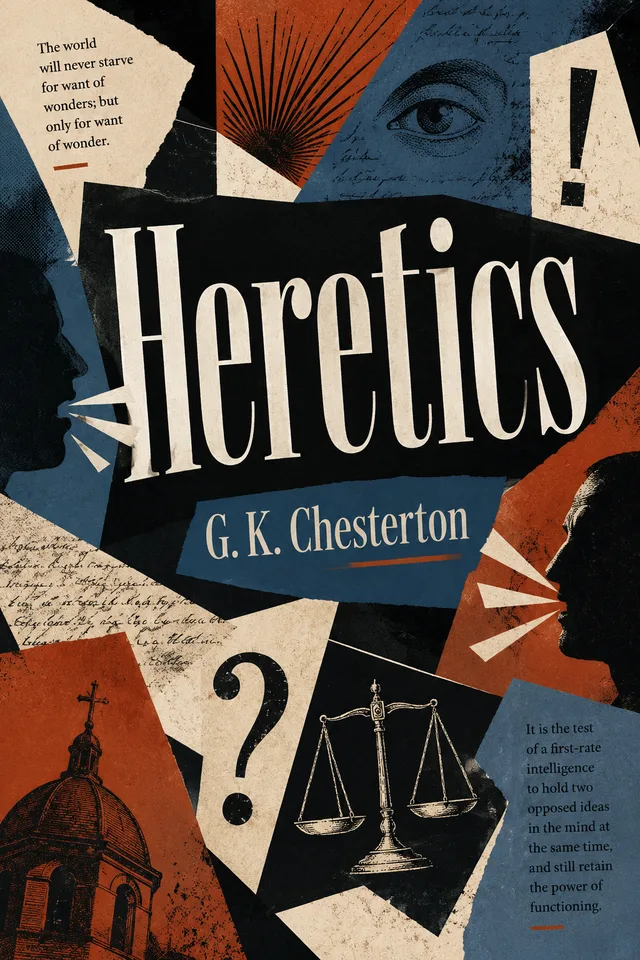
Heretics
English BooksWhale Edition by G. K. Chesterton
A witty essay collection attacking fashionable certainties in literature, politics, religion, and modern intellectual life.
- Preview
- A sample from the prepared text
- Formats
- Online reader, EPUB, PDF
- Access
- Library claim
Book introduction
Heretics
In Heretics, G. K. Chesterton argues with the leading ideas and writers of his age, from skepticism and progress to nationalism, art, and religion. The essays combine paradox, humor, and moral seriousness, asking what beliefs modern culture secretly depends on.
BooksWhale edition
How this edition was prepared
This edition is based on a public domain text and has been prepared for digital reading by BooksWhale.
Public domain basis
Why this edition can be shared
G. K. Chesterton died in 1936; the work was first published around 1905. These dates support the public-domain basis for this English edition.
Read preview
A sample from the prepared text
Preview selected from the prepared reader text.
Preview chapterFull textRead preview
Heretics
by
Gilbert K. Chesterton
“To My Father”
Preview chapterI. Introductory Remarks on the Importance of OrthodoxyPreview
Nothing more strangely indicates an enormous and silent evil of modern society than the extraordinary use which is made nowadays of the word “orthodox.” In former days the heretic was proud of not being a heretic. It was the kingdoms of the world and the police and the judges who were heretics. He was orthodox. He had no pride in having rebelled against them; they had rebelled against him. The armies with their cruel security, the kings with their cold faces, the decorous processes of State, the reasonable processes of law—all these like sheep had gone astray. The man was proud of being orthodox, was proud of being right. If he stood alone in a howling wilderness he was more than a man; he was a church. He was the centre of the universe; it was round him that the stars swung. All the tortures torn out of forgotten hells could not make him admit that he was heretical. But a few modern phrases have made him boast of it. He says, with a conscious laugh, “I suppose I am very heretical,” and looks round for applause. The word “heresy” not only means no longer being wrong; it practically means being clear-headed and courageous. The word “orthodoxy” not only no longer means being right; it practically means being wrong. All this can mean one thing, and one thing only. It means that people care less for whether they are philosophically right. For obviously a man ought to confess himself crazy before he confesses himself heretical. The Bohemian, with a red tie, ought to pique himself on his orthodoxy. The dynamiter, laying a bomb, ought to feel that, whatever else he is, at least he is orthodox.
It is foolish, generally speaking, for a philosopher to set fire to another philosopher in Smithfield Market because they do not agree in their theory of the universe. That was done very frequently in the last decadence of the Middle Ages, and it failed altogether in its object. But there is one thing that is infinitely more absurd and unpractical than burning a man for his philosophy. This is the habit of saying that his philosophy does not matter, and this is done universally in the twentieth century, in the decadence of the great revolutionary period. General theories are everywhere contemned; the doctrine of the Rights of Man is dismissed with the doctrine of the Fall of Man. Atheism itself is too theological for us to-day. Revolution itself is too much of a system; liberty itself is too much of a restraint. We will have no generalizations. Mr. Bernard Shaw has put the view in a perfect epigram: “The golden rule is that there is no golden rule.” We are more and more to discuss details in art, politics, literature. A man’s opinion on tramcars matters; his opinion on Botticelli matters; his opinion on all things does not matter. He may turn over and explore a million objects, but he must not find that strange object, the universe; for if he does he will have a religion, and be lost. Everything matters—except everything.
Examples are scarcely needed of this total levity on the subject of cosmic philosophy. Examples are scarcely needed to show that, whatever else we think of as affecting practical affairs, we do not think it matters whether a man is a pessimist or an optimist, a Cartesian or a Hegelian, a materialist or a spiritualist. Let me, however, take a random instance. At any innocent tea-table we may easily hear a man say, “Life is not worth living.” We regard it as we regard the statement that it is a fine day; nobody thinks that it can possibly have any serious effect on the man or on the world. And yet if that utterance were really believed, the world would stand on its head. Murderers would be given medals for saving men from life; firemen would be denounced for keeping men from death; poisons would be used as medicines; doctors would be called in when people were well; the Royal Humane Society would be rooted out like a horde of assassins. Yet we never speculate as to whether the conversational pessimist will strengthen or disorganize society; for we are convinced that theories do not matter.
Preview chapterII. On the negative spiritPreview
Much has been said, and said truly, of the monkish morbidity, of the hysteria which as often gone with the visions of hermits or nuns. But let us never forget that this visionary religion is, in one sense, necessarily more wholesome than our modern and reasonable morality. It is more wholesome for this reason, that it can contemplate the idea of success or triumph in the hopeless fight towards the ethical ideal, in what Stevenson called, with his usual startling felicity, “the lost fight of virtue.” A modern morality, on the other hand, can only point with absolute conviction to the horrors that follow breaches of law; its only certainty is a certainty of ill. It can only point to imperfection. It has no perfection to point to. But the monk meditating upon Christ or Buddha has in his mind an image of perfect health, a thing of clear colours and clean air. He may contemplate this ideal wholeness and happiness far more than he ought; he may contemplate it to the neglect of exclusion of essential THINGS; he may contemplate it until he has become a dreamer or a driveller; but still it is wholeness and happiness that he is contemplating. He may even go mad; but he is going mad for the love of sanity. But the modern student of ethics, even if he remains sane, remains sane from an insane dread of insanity.
The anchorite rolling on the stones in a frenzy of submission is a healthier person fundamentally than many a sober man in a silk hat who is walking down Cheapside. For many such are good only through a withering knowledge of evil. I am not at this moment claiming for the devotee anything more than this primary advantage, that though he may be making himself personally weak and miserable, he is still fixing his thoughts largely on gigantic strength and happiness, on a strength that has no limits, and a happiness that has no end. Doubtless there are other objections which can be urged without unreason against the influence of gods and visions in morality, whether in the cell or street. But this advantage the mystic morality must always have—it is always jollier. A young man may keep himself from vice by continually thinking of disease. He may keep himself from it also by continually thinking of the Virgin Mary. There may be question about which method is the more reasonable, or even about which is the more efficient. But surely there can be no question about which is the more wholesome.
I remember a pamphlet by that able and sincere secularist, Mr. G. W. Foote, which contained a phrase sharply symbolizing and dividing these two methods. The pamphlet was called BEER AND BIBLE, those two very noble things, all the nobler for a conjunction which Mr. Foote, in his stern old Puritan way, seemed to think sardonic, but which I confess to thinking appropriate and charming. I have not the work by me, but I remember that Mr. Foote dismissed very contemptuously any attempts to deal with the problem of strong drink by religious offices or intercessions, and said that a picture of a drunkard’s liver would be more efficacious in the matter of temperance than any prayer or praise. In that picturesque expression, it seems to me, is perfectly embodied the incurable morbidity of modern ethics. In that temple the lights are low, the crowds kneel, the solemn anthems are uplifted. But that upon the altar to which all men kneel is no longer the perfect flesh, the body and substance of the perfect man; it is still flesh, but it is diseased. It is the drunkard’s liver of the New Testament that is marred for us, which we take in remembrance of him.
Now, it is this great gap in modern ethics, the absence of vivid pictures of purity and spiritual triumph, which lies at the back of the real objection felt by so many sane men to the realistic literature of the nineteenth century. If any ordinary man ever said that he was horrified by the subjects discussed in Ibsen or Maupassant, or by the plain language in which they are spoken of, that ordinary man was lying. The average conversation of average men throughout the whole of modern civilization in every class or trade is such as Zola would never dream of printing. Nor is the habit of writing thus of these things a new habit. On the contrary, it is the Victorian prudery and silence which is new still, though it is already dying. The tradition of calling a spade a spade starts very early in our literature and comes down very late. But the truth is that the ordinary honest man, whatever vague account he may have given of his feelings, was not either disgusted or even annoyed at the candour of the moderns. What disgusted him, and very justly, was not the presence of a clear realism, but the absence of a clear idealism. Strong and genuine religious sentiment has never had any objection to realism; on the contrary, religion was the realistic thing, the brutal thing, the thing that called names. This is the great difference between some recent developments of Nonconformity and the great Puritanism of the seventeenth century. It was the whole point of the Puritans that they cared nothing for decency. Modern Nonconformist newspapers distinguish themselves by suppressing precisely those nouns and adjectives which the founders of Nonconformity distinguished themselves by flinging at kings and queens. But if it was a chief claim of religion that it spoke plainly about evil, it was the chief claim of all that it spoke plainly about good. The thing which is resented, and, as I think, rightly resented, in that great modern literature of which Ibsen is typical, is that while the eye that can perceive what are the wrong things increases in an uncanny and devouring clarity, the eye which sees what things are right is growing mistier and mistier every moment, till it goes almost blind with doubt. If we compare, let us say, the morality of the DIVINE COMEDY with the morality of Ibsen’s GHOSTS, we shall see all that modern ethics have really done. No one, I imagine, will accuse the author of the INFERNO of an Early Victorian prudishness or a Podsnapian optimism. But Dante describes three moral instruments—Heaven, Purgatory, and Hell, the vision of perfection, the vision of improvement, and the vision of failure. Ibsen has only one—Hell. It is often said, and with perfect truth, that no one could read a play like GHOSTS and remain indifferent to the necessity of an ethical self-command. That is quite true, and the same is to be said of the most monstrous and material descriptions of the eternal fire. It is quite certain the realists like Zola do in one sense promote morality—they promote it in the sense in which the hangman promotes it, in the sense in which the devil promotes it. But they only affect that small minority which will accept any virtue of courage. Most healthy people dismiss these moral dangers as they dismiss the possibility of bombs or microbes. Modern realists are indeed Terrorists, like the dynamiters; and they fail just as much in their effort to create a thrill. Both realists and dynamiters are well-meaning people engaged in the task, so obviously ultimately hopeless, of using science to promote morality.
Table of contents
Inside this edition
- 01Full text
- 02I. Introductory Remarks on the Importance of Orthodoxy
- 03II. On the negative spirit
- 04III. On Mr. Rudyard Kipling and Making the World Small
- 05IV. Mr. Bernard Shaw
- 06V. Mr. H. G. Wells and the Giants
- 07VI. Christmas and the Aesthetes
- 08VII. Omar and the Sacred Vine
- 09VIII. The Mildness of the Yellow Press
- 10IX. The Moods of Mr. George Moore
- 11X. On Sandals and Simplicity
- 12XI. Science and the Savages
- 13XII. Paganism and Mr. Lowes Dickinson
- 14XIII. Celts and Celtophiles
- 15XIV. On Certain Modern Writers and the Institution of the Family
- 16XV. On Smart Novelists and the Smart Set
- 17XVI. On Mr. McCabe and a Divine Frivolity
- 18XVII. On the Wit of Whistler
- 19XVIII. The Fallacy of the Young Nation
- 20XIX. Slum Novelists and the Slums
- 21XX. Concluding Remarks on the Importance of Orthodoxy
Language availability
Other languages
Additional language editions are not published yet. This section will link to other BooksWhale editions when they become available.
Request another language