English Edition
Literature
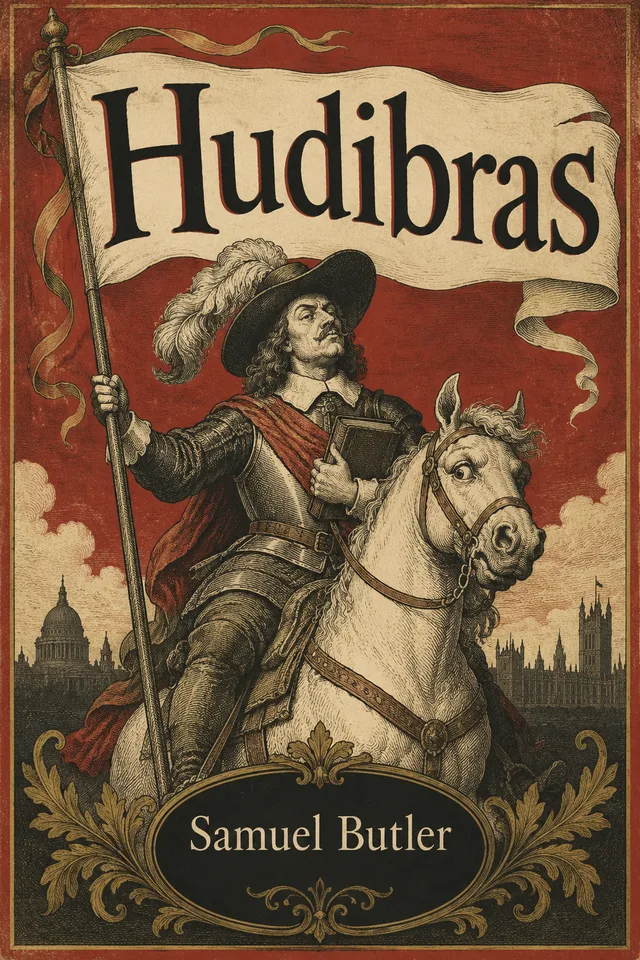
Hudibras
English BooksWhale Edition by Samuel Butler
A mock-heroic English satire of zeal, politics, argument, and Restoration wit.
- Preview
- A sample from the prepared text
- Formats
- Online reader, EPUB, PDF
- Access
- Library claim
Book introduction
Hudibras
Hudibras is a major Restoration satire, famous for rough couplets, comic logic, religious controversy, and political mockery. This edition is for readers of English satire, mock-epic poetry, and post-Civil-War literary wit.
BooksWhale edition
How this edition was prepared
This edition is based on a public domain text and has been prepared for digital reading by BooksWhale.
Public domain basis
Why this edition can be shared
Samuel Butler died in 1680, and Hudibras was first published in 1663. These dates support the public-domain basis for this original English edition.
Read preview
A sample from the prepared text
Preview selected from the prepared reader text.
Preview chapterFull textRead preview
Hudibras
Samuel Butler
Preview chapterTO THE READER.Preview
Poeta nascitur non fit, [poets are born, not made] is a sentence
of as great truth as antiquity; it being most certain, that all the
acquired learning imaginable is insufficient to compleat a poet,
without a natural genius and propensity to so noble and sublime
an art. And we may, without offence, observe, that many very
learned men, who have been ambitious to be thought poets,
have only rendered themselves obnoxious to that satyrical
inspiration our Author wittily invokes:
Which made them, though it were in spight
Of nature and their stars, to write.
On the one side some who have had very little human learning,
but were endued with a large share of natural wit and parts,
have become the most celebrated (Shakespear, D'Avenant, &c.)
poets of the age they lived in. But, as these last are, "Rarae aves
in terris," so, when the muses have not disdained the assistances
of other arts and sciences, we are then blessed with those lasting
monuments of wit and learning, which may justly claim a kind
of eternity upon earth. And our author, had his modesty
permitted him, might, with Horace, have said,
Exegi monumentum aere perennius:
[I have raised a memorial more lasting than bronze]
Or, with Ovid,
Jamque opus exegi, quod nec Jovis ira, nec ignis,
Nec poterit ferrum, nec edax abolere vetustas.
[For I have raised a work which neither the rage of Jupiter,
Nor fire, nor iron, nor consuming age can destroy.]
The Author of this celebrated Poem was of this his last
composition: for although he had not the happiness of an
academical education, as some affirm, if may be perceived,
throughout his whole Poem, that he had read much, and was
very well accomplished in the most useful parts of human
learning.
Rapin (in his reflections) speaking of the necessary qualities
belonging to a poet, tells us, he must have a genius
extraordinary; great natural gifts; a wit just, fruitful, piercing,
solid, and universal; an understanding clear and distinct; an
imagination neat and pleasant; an elevation of soul, that
depends not only on art or study, but is purely the gift of
heaven, which must be sustained by a lively sense and vivacity;
judgment to consider wisely of things, and vivacity for the
beautiful expression of them, &c.
Now, how justly this character is due to our Author, we leave to
the impartial reader, and those of nicer judgment, who had the
happiness to be more intimately acquainted with him.
The reputation of this incomparable Poem is so thoroughly
established in the world, that it would be superfluous, if not
impertinent, to endeavour any panegyric upon it. King Charles
II. whom the judicious part of mankind will readily
acknowledge to be a sovereign judge of wit, was so great an
admirer of it, that he would often pleasantly quote it in his
conversation. However, since most men have a curiosity to have
some account of such anonymous authors, whose compositions
have been eminent for wit or learning, we have, for their
information, subjoined a short Life of the Author.
THE AUTHOR'S LIFE.
Samuel Butler, the Author of this excellent Poem, was born in
the Parish of Strensham, in the county of Worcester, and
baptized there the 13th of Feb. 1612. His father, who was of the
same name, was an honest country farmer, who had some small
estate of his own, but rented a much greater of the Lord of the
Manor where he lived. However, perceiving in this son an early
inclination to learning, he made a shift to have him educated in
the free-school at Worcester, under Mr. Henry Bright; where
having passed the usual time, and being become an excellent
school-scholar, he went for some little time to Cambridge, but
was never matriculated into that University, his father's abilities
not being sufficient to be at the charge of an academical
education; so that our Author returned soon into his native
Preview chapterPART IPreview
PART I
Table of contents
Inside this edition
- 01Full text
- 02TO THE READER.
- 03PART I
- 04CANTO I
- 05PART I.
- 06CANTO II.
- 07PART I.
- 08CANTO III.
- 09PART II
- 10CANTO I
- 11CANTO II
- 12PART II
- 13CANTO III.
- 14PART III.
- 15CANTO I.
- 16PART III
- 17CANTO II.
- 18PART III
- 19CANTO III
Language availability
Other languages
Additional language editions are not published yet. This section will link to other BooksWhale editions when they become available.
Request another language