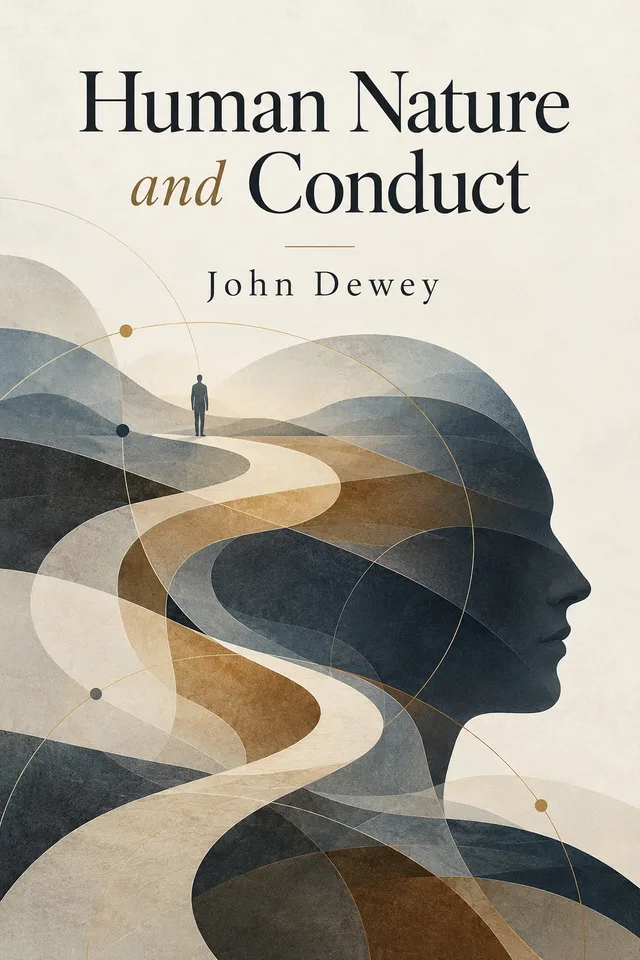
English Edition
Psychology
Human Nature and Conduct
English BooksWhale Edition by John Dewey
John Dewey examines how habits, impulses, intelligence, and social conditions shape conduct and the possibilities of moral change.
- Preview
- A sample from the prepared text
- Formats
- Online reader, EPUB, PDF
- Access
- Library claim
Book introduction
Human Nature and Conduct
Dewey approaches ethics through the everyday workings of human behavior rather than through fixed rules detached from experience. Four parts examine habit, impulse, reflective intelligence, and the consequences of this account for moral judgment. This English text explores education, institutions, responsibility, and freedom as problems within a shared and changing social environment.
BooksWhale edition
How this edition was prepared
This edition is based on a public domain text and has been prepared for digital reading by BooksWhale.
Public domain basis
Why this edition can be shared
John Dewey died in 1952. This edition uses the English original, first published in 1922, transcribed by Project Gutenberg; later introductions, notes, images and publishing matter are excluded.
Read preview
A sample from the prepared text
Preview selected from the prepared reader text.
Preview chapterFull textRead preview
Human Nature and Conduct
John Dewey
Preview chapterINTRODUCTIONPreview
"Give a dog a bad name and hang him." Human nature has been the dog of professional moralists, and consequences accord with the proverb. Man's nature has been regarded with suspicion, with fear, with sour looks, sometimes with enthusiasm for its possibilities but only when these were placed in contrast with its actualities. It has appeared to be so evilly disposed that the business of morality was to prune and curb it; it would be thought better of if it could be replaced by something else. It has been supposed that morality would be quite superfluous were it not for the inherent weakness, bordering on depravity, of human nature. Some writers with a more genial conception have attributed the current blackening to theologians who have thought to honor the divine by disparaging the human. Theologians have doubtless taken a gloomier view of man than have pagans and secularists. But this explanation doesn't take us far. For after all these theologians are themselves human, and they would have been without influence if the human audience had not somehow responded to them.
Morality is largely concerned with controlling human nature. When we are attempting to control anything we are acutely aware of what resists us. So moralists were led, perhaps, to think of human nature as evil because of its reluctance to yield to control, its rebelliousness under the yoke. But this explanation only raises another question. Why did morality set up rules so foreign to human nature? The ends it insisted upon, the regulations it imposed, were after all outgrowths of human nature. Why then was human nature so averse to them? Moreover rules can be obeyed and ideals realized only as they appeal to something in human nature and awaken in it an active response. Moral principles that exalt themselves by degrading human nature are in effect committing suicide. Or else they involve human nature in unending civil war, and treat it as a hopeless mess of contradictory forces.
We are forced therefore to consider the nature and origin of that control of human nature with which morals has been occupied. And the fact which is forced upon us when we raise this question is the existence of classes. Control has been vested in an oligarchy. Indifference to regulation has grown in the gap which separates the ruled from the rulers. Parents, priests, chiefs, social censors have supplied aims, aims which were foreign to those upon whom they were imposed, to the young, laymen, ordinary folk; a few have given and administered rule, and the mass have in a passable fashion and with reluctance obeyed. Everybody knows that good children are those who make as little trouble as possible for their elders, and since most of them cause a good deal of annoyance they must be naughty by nature. Generally speaking, good people have been those who did what they were told to do, and lack of eager compliance is a sign of something wrong in their nature.
But no matter how much men in authority have turned moral rules into an agency of class supremacy, any theory which attributes the origin of rule to deliberate design is false. To take advantage of conditions after they have come into existence is one thing; to create them for the sake of an advantage to accrue is quite another thing. We must go back to the bare fact of social division into superior and inferior. To say that accident produced social conditions is to perceive they were not produced by intelligence. Lack of understanding of human nature is the primary cause of disregard for it. Lack of insight always ends in despising or else unreasoned admiration. When men had no scientific knowledge of physical nature they either passively submitted to it or sought to control it magically. What cannot be understood cannot be managed intelligently. It has to be forced into subjection from without. The opaqueness of human nature to reason is equivalent to a belief in its intrinsic irregularity. Hence a decline in the authority of social oligarchy was accompanied by a rise of scientific interest in human nature. This means that the make-up and working of human forces afford a basis for moral ideas and ideals. Our science of human nature in comparison with physical sciences is rudimentary, and morals which are concerned with the health, efficiency and happiness of a development of human nature are correspondingly elementary. These pages are a discussion of some phases of the ethical change involved in positive respect for human nature when the latter is associated with scientific knowledge. We may anticipate the general nature of this change through considering the evils which have resulted from severing morals from the actualities of human physiology and psychology. There is a pathology of goodness as well as of evil; that is, of that sort of goodness which is nurtured by this separation. The badness of good people, for the most part recorded only in fiction, is the revenge taken by human nature for the injuries heaped upon it in the name of morality. In the first place, morals cut off from positive roots in man's nature is bound to be mainly negative. Practical emphasis falls upon avoidance, escape of evil, upon not doing things, observing prohibitions. Negative morals assume as many forms as there are types of temperament subject to it. Its commonest form is the protective coloration of a neutral respectability, an insipidity of character. For one man who thanks God that he is not as other men there are a thousand to offer thanks that they are as other men, sufficiently as others are to escape attention. Absence of social blame is the usual mark of goodness for it shows that evil has been avoided. Blame is most readily averted by being so much like everybody else that one passes unnoticed. Conventional morality is a drab morality, in which the only fatal thing is to be conspicuous. If there be flavor left in it, then some natural traits have somehow escaped being subdued. To be so good as to attract notice is to be priggish, too good for this world. The same psychology that brands the convicted criminal as forever a social outcast makes it the part of a gentleman not to obtrude virtues noticeably upon others.
Preview chapterPART ONE THE PLACE OF HABIT IN CONDUCTPreview
PART ONE THE PLACE OF HABIT IN CONDUCT
Table of contents
Inside this edition
- 01Full text
- 02INTRODUCTION
- 03PART ONE THE PLACE OF HABIT IN CONDUCT
- 04I
- 05II
- 06III
- 07IV
- 08V
- 09VI
- 10PART TWO THE PLACE OF IMPULSE IN CONDUCT
- 11I
- 12II
- 13III
- 14IV
- 15V
- 16VI
- 17VII
- 18PART THREE THE PLACE OF INTELLIGENCE IN CONDUCT
- 19I
- 20II
- 21III
- 22IV
- 23V
- 24VI
- 25VII
- 26VIII
- 27IX
- 28PART FOUR CONCLUSION
- 29I
- 30II
- 31III
- 32IV
Language availability
Other languages
Additional language editions are not published yet. This section will link to other BooksWhale editions when they become available.
Request another language