English Edition
Literature
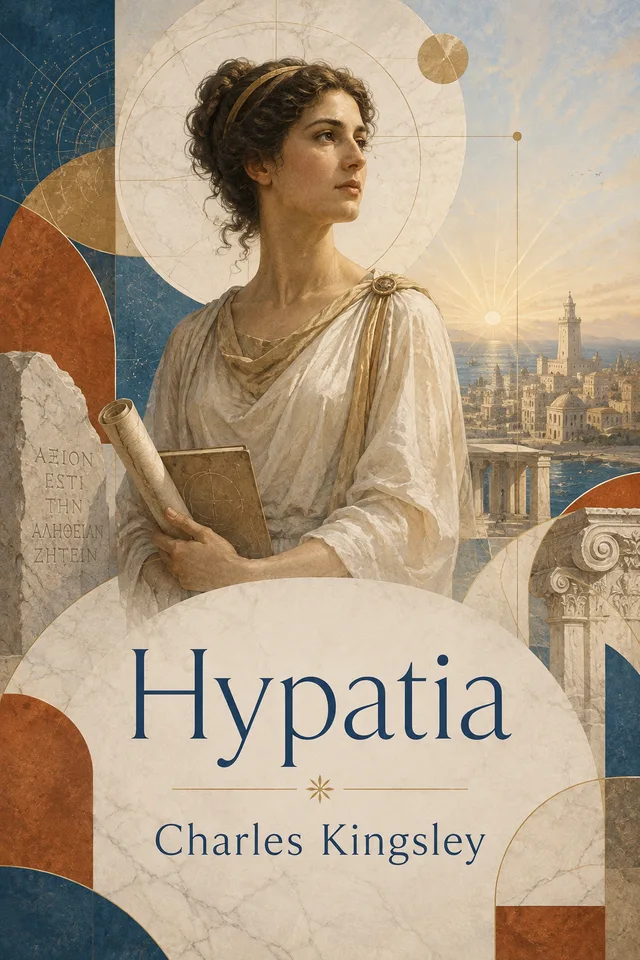
Hypatia
English BooksWhale Edition by Charles Kingsley
A historical novel of Alexandria, philosophy, faith, political conflict, and late antique crisis.
- Preview
- A sample from the prepared text
- Formats
- Online reader, EPUB, PDF
- Access
- Library claim
Book introduction
Hypatia
Hypatia follows the famous philosopher of Alexandria through a world of religious controversy, imperial politics, classical learning, and social upheaval. Charles Kingsley’s historical romance offers a dramatic nineteenth-century vision of late antiquity.
BooksWhale edition
How this edition was prepared
This edition is based on a public domain text and has been prepared for digital reading by BooksWhale.
Public domain basis
Why this edition can be shared
Hypatia was first published in 1853, and Charles Kingsley died in 1875. These dates support the public-domain basis for this English source text.
Read preview
A sample from the prepared text
Preview selected from the prepared reader text.
Preview chapterFull textRead preview
Hypatia
Charles Kingsley
or
Preview chapterNEW FOES WITH AN OLD FACEPreview
By Charles Kingsley
Preview chapterPREFACEPreview
A picture of life in the fifth century must needs contain much which will be painful to any reader, and which the young and innocent will do well to leave altogether unread. It has to represent a very hideous, though a very great, age; one of those critical and cardinal eras in the history of the human race, in which virtues and vices manifest themselves side by side--even, at times, in the same person--with the most startling openness and power. One who writes of such an era labours under a troublesome disadvantage. He dare not tell how evil people were; he will not be believed if he tells how good they were. In the present case that disadvantage is doubled; for while the sins of the Church, however heinous, were still such as admit of being expressed in words, the sins of the heathen world, against which she fought, were utterly indescribable; and the Christian apologist is thus compelled, for the sake of decency, to state the Church’s case far more weakly than the facts deserve.
Not, be it ever remembered, that the slightest suspicion of immorality attaches either to the heroine of this book, or to the leading philosophers of her school, for several centuries. Howsoever base and profligate their disciples, or the Manichees, may have been, the great Neo-Platonists were, as Manes himself was, persons of the most rigid and ascetic virtue.
For a time had arrived, in which no teacher who did not put forth the most lofty pretensions to righteousness could expect a hearing. That Divine Word, who is ‘The Light who lighteth every man which cometh into the world,’ had awakened in the heart of mankind a moral craving never before felt in any strength, except by a few isolated philosophers or prophets. The Spirit had been poured out on all flesh; and from one end of the Empire to the other, from the slave in the mill to the emperor on his throne, all hearts were either hungering and thirsting after righteousness, or learning to do homage to those who did so. And He who excited the craving, was also furnishing that which would satisfy it; and was teaching mankind, by a long and painful education, to distinguish the truth from its innumerable counterfeits, and to find, for the first time in the world’s life, a good news not merely for the select few, but for all mankind without respect of rank or race.
For somewhat more than four hundred years, the Roman Empire and the Christian Church, born into the world almost at the same moment, had been developing themselves side by side as two great rival powers, in deadly struggle for the possession of the human race. The weapons of the Empire had been not merely an overwhelming physical force, and a ruthless lust of aggressive conquest: but, even more powerful still, an unequalled genius for organisation, and an uniform system of external law and order. This was generally a real boon to conquered nations, because it substituted a fixed and regular spoliation for the fortuitous and arbitrary miseries of savage warfare: but it arrayed, meanwhile, on the side of the Empire the wealthier citizens of every province, by allowing them their share in the plunder of the labouring masses below them. These, in the country districts, were utterly enslaved; while in the cities, nominal freedom was of little use to masses kept from starvation by the alms of the government, and drugged into brutish good humour by a vast system of public spectacles, in which the realms of nature and of art were ransacked to glut the wonder, lust, and ferocity of a degraded populace.
Against this vast organisation the Church had been fighting for now four hundred years, armed only with its own mighty and all-embracing message, and with the manifestation of a spirit of purity and virtue, of love and self-sacrifice, which had proved itself mightier to melt and weld together the hearts of men, than all the force and terror, all the mechanical organisation, all the sensual baits with which the Empire had been contending against that Gospel in which it had recognised instinctively and at first sight, its internecine foe.
Table of contents
Inside this edition
- 01Full text
- 02NEW FOES WITH AN OLD FACE
- 03PREFACE
- 04CHAPTER I: THE LAURA
- 05CHAPTER II: THE DYING WORLD
- 06CHAPTER III: THE GOTHS
- 07CHAPTER IV: MIRIAM
- 08CHAPTER V: A DAY IN ALEXANDRIA
- 09CHAPTER VI: THE NEW DIOGENES
- 10CHAPTER VII: THOSE BY WHOM OFFENCES COME
- 11CHAPTER VIII: THE EAST WIND
- 12CHAPTER IX: THE SNAPPING OF THE BOW
- 13CHAPTER X: THE INTERVIEW
- 14CHAPTER XI: THE LAURA AGAIN
- 15CHAPTER XII: THE BOWER OF ACRASIA
- 16CHAPTER XIII: THE BOTTOM OF THE ABYSS
- 17CHAPTER XIV: THE ROCKS OF THE SIRENS
- 18CHAPTER XV: NEPHELOCOCCUGIA
- 19CHAPTER XVI: VENUS AND PALLAS
- 20CHAPTER XVII: A STRAY GLEAM
- 21CHAPTER XVIII: THE PREFECT TESTED
- 22CHAPTER XIX: JEWS AGAINST CHRISTIANS
- 23CHAPTER XX: SHE STOOPS TO CONQUER
- 24CHAPTER XXI: THE SQUIRE-BISHOP
- 25CHAPTER XXII: PANDEMONIUM
- 26CHAPTER XXIII: NEMESIS
- 27CHAPTER XXIV: LOST LAMBS
- 28CHAPTER XXV: SEEKING AFTER A SIGN
- 29CHAPTER XXVI: MIRIAM’S PLOT
- 30CHAPTER XXVII: THE PRODIGAL’S RETURN
- 31CHAPTER XXVIII: WOMAN’S LOVE
- 32CHAPTER XXIX: NEMESIS
- 33CHAPTER XXX: EVERY MAN TO HIS OWN PLACE
- 34THE END
Language availability
Other languages
Additional language editions are not published yet. This section will link to other BooksWhale editions when they become available.
Request another language