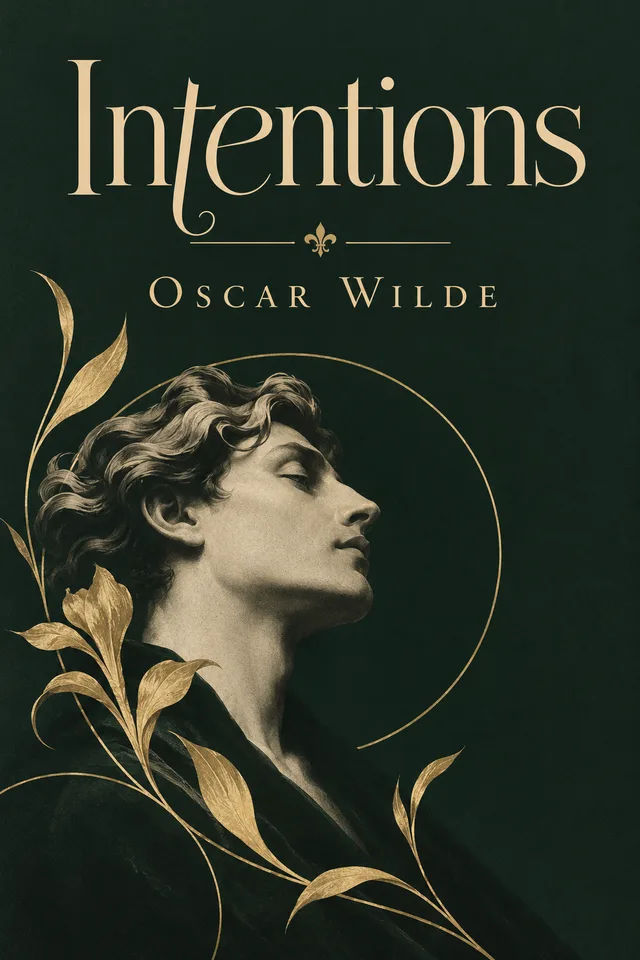
English Edition
Art
Intentions
English BooksWhale Edition by Oscar Wilde
Wilde’s essays defend artifice, criticism, and beauty with dazzling paradox and theatrical intelligence.
- Preview
- A sample from the prepared text
- Formats
- Online reader, EPUB, PDF
- Access
- Library claim
Book introduction
Intentions
Intentions gathers Oscar Wilde’s major aesthetic essays, including his arguments for criticism as creative art and for style as a form of truth. The volume is central to fin-de-siècle art, literature, and aesthetic theory.
BooksWhale edition
How this edition was prepared
This edition is based on a public domain text and has been prepared for digital reading by BooksWhale.
Public domain basis
Why this edition can be shared
Oscar Wilde died in 1900; the work was first published in 1891. These dates support the public-domain basis for this edition.
Read preview
A sample from the prepared text
Preview selected from the prepared reader text.
Preview chapterFull textRead preview
Intentions
Oscar Wilde
Preview chapterTHE DECAY OF LYING: AN OBSERVATIONPreview
_A DIALOGUE_. _Persons_: _Cyril and_ _Vivian_. _Scene_: _the Library of a country_ _house in Nottinghamshire_.
CYRIL (_coming in through the open window from the terrace_). My dear Vivian, don’t coop yourself up all day in the library. It is a perfectly lovely afternoon. The air is exquisite. There is a mist upon the woods, like the purple bloom upon a plum. Let us go and lie on the grass and smoke cigarettes and enjoy Nature.
VIVIAN. Enjoy Nature! I am glad to say that I have entirely lost that faculty. People tell us that Art makes us love Nature more than we loved her before; that it reveals her secrets to us; and that after a careful study of Corot and Constable we see things in her that had escaped our observation. My own experience is that the more we study Art, the less we care for Nature. What Art really reveals to us is Nature’s lack of design, her curious crudities, her extraordinary monotony, her absolutely unfinished condition. Nature has good intentions, of course, but, as Aristotle once said, she cannot carry them out. When I look at a landscape I cannot help seeing all its defects. It is fortunate for us, however, that Nature is so imperfect, as otherwise we should have no art at all. Art is our spirited protest, our gallant attempt to teach Nature her proper place. As for the infinite variety of Nature, that is a pure myth. It is not to be found in Nature herself. It resides in the imagination, or fancy, or cultivated blindness of the man who looks at her.
CYRIL. Well, you need not look at the landscape. You can lie on the grass and smoke and talk.
VIVIAN. But Nature is so uncomfortable. Grass is hard and lumpy and damp, and full of dreadful black insects. Why, even Morris’s poorest workman could make you a more comfortable seat than the whole of Nature can. Nature pales before the furniture of ‘the street which from Oxford has borrowed its name,’ as the poet you love so much once vilely phrased it. I don’t complain. If Nature had been comfortable, mankind would never have invented architecture, and I prefer houses to the open air. In a house we all feel of the proper proportions. Everything is subordinated to us, fashioned for our use and our pleasure. Egotism itself, which is so necessary to a proper sense of human dignity, is entirely the result of indoor life. Out of doors one becomes abstract and impersonal. One’s individuality absolutely leaves one. And then Nature is so indifferent, so unappreciative. Whenever I am walking in the park here, I always feel that I am no more to her than the cattle that browse on the slope, or the burdock that blooms in the ditch. Nothing is more evident than that Nature hates Mind. Thinking is the most unhealthy thing in the world, and people die of it just as they die of any other disease. Fortunately, in England at any rate, thought is not catching. Our splendid physique as a people is entirely due to our national stupidity. I only hope we shall be able to keep this great historic bulwark of our happiness for many years to come; but I am afraid that we are beginning to be over-educated; at least everybody who is incapable of learning has taken to teaching—that is really what our enthusiasm for education has come to. In the meantime, you had better go back to your wearisome uncomfortable Nature, and leave me to correct my proofs.
CYRIL. Writing an article! That is not very consistent after what you have just said.
VIVIAN. Who wants to be consistent? The dullard and the doctrinaire, the tedious people who carry out their principles to the bitter end of action, to the _reductio ad absurdum_ of practice. Not I. Like Emerson, I write over the door of my library the word ‘Whim.’ Besides, my article is really a most salutary and valuable warning. If it is attended to, there may be a new Renaissance of Art.
Preview chapterPEN, PENCIL AND POISON A STUDY IN GREENPreview
IT has constantly been made a subject of reproach against artists and men of letters that they are lacking in wholeness and completeness of nature. As a rule this must necessarily be so. That very concentration of vision and intensity of purpose which is the characteristic of the artistic temperament is in itself a mode of limitation. To those who are preoccupied with the beauty of form nothing else seems of much importance. Yet there are many exceptions to this rule. Rubens served as ambassador, and Goethe as state councillor, and Milton as Latin secretary to Cromwell. Sophocles held civic office in his own city; the humourists, essayists, and novelists of modern America seem to desire nothing better than to become the diplomatic representatives of their country; and Charles Lamb’s friend, Thomas Griffiths Wainewright, the subject of this brief memoir, though of an extremely artistic temperament, followed many masters other than art, being not merely a poet and a painter, an art-critic, an antiquarian, and a writer of prose, an amateur of beautiful things, and a dilettante of things delightful, but also a forger of no mean or ordinary capabilities, and as a subtle and secret poisoner almost without rival in this or any age.
This remarkable man, so powerful with ‘pen, pencil and poison,’ as a great poet of our own day has finely said of him, was born at Chiswick, in 1794. His father was the son of a distinguished solicitor of Gray’s Inn and Hatton Garden. His mother was the daughter of the celebrated Dr. Griffiths, the editor and founder of the _Monthly Review_, the partner in another literary speculation of Thomas Davis, that famous bookseller of whom Johnson said that he was not a bookseller, but ‘a gentleman who dealt in books,’ the friend of Goldsmith and Wedgwood, and one of the most well-known men of his day. Mrs. Wainewright died, in giving him birth, at the early age of twenty-one, and an obituary notice in the _Gentleman’s Magazine_ tells us of her ‘amiable disposition and numerous accomplishments,’ and adds somewhat quaintly that ‘she is supposed to have understood the writings of Mr. Locke as well as perhaps any person of either sex now living.’ His father did not long survive his young wife, and the little child seems to have been brought up by his grandfather, and, on the death of the latter in 1803, by his uncle George Edward Griffiths, whom he subsequently poisoned.
His boyhood was passed at Linden House, Turnham Green, one of those many fine Georgian mansions that have unfortunately disappeared before the inroads of the suburban builder, and to its lovely gardens and well-timbered park he owed that simple and impassioned love of nature which never left him all through his life, and which made him so peculiarly susceptible to the spiritual influences of Wordsworth’s poetry. He went to school at Charles Burney’s academy at Hammersmith. Mr. Burney was the son of the historian of music, and the near kinsman of the artistic lad who was destined to turn out his most remarkable pupil. He seems to have been a man of a good deal of culture, and in after years Mr. Wainewright often spoke of him with much affection as a philosopher, an archæologist, and an admirable teacher who, while he valued the intellectual side of education, did not forget the importance of early moral training. It was under Mr. Burney that he first developed his talent as an artist, and Mr. Hazlitt tells us that a drawing-book which he used at school is still extant, and displays great talent and natural feeling. Indeed, painting was the first art that fascinated him. It was not till much later that he sought to find expression by pen or poison.
Before this, however, he seems to have been carried away by boyish dreams of the romance and chivalry of a soldier’s life, and to have become a young guardsman. But the reckless dissipated life of his companions failed to satisfy the refined artistic temperament of one who was made for other things. In a short time he wearied of the service. ‘Art,’ he tells us, in words that still move many by their ardent sincerity and strange fervour, ‘Art touched her renegade; by her pure and high influence the noisome mists were purged; my feelings, parched, hot, and tarnished, were renovated with cool, fresh bloom, simple, beautiful to the simple-hearted.’ But Art was not the only cause of the change. ‘The writings of Wordsworth,’ he goes on to say, ‘did much towards calming the confusing whirl necessarily incident to sudden mutations. I wept over them tears of happiness and gratitude.’ He accordingly left the army, with its rough barrack-life and coarse mess-room tittle-tattle, and returned to Linden House, full of this new-born enthusiasm for culture. A severe illness, in which, to use his own words, he was ‘broken like a vessel of clay,’ prostrated him for a time. His delicately strung organisation, however indifferent it might have been to inflicting pain on others, was itself most keenly sensitive to pain.
Table of contents
Inside this edition
- 01Full text
- 02THE DECAY OF LYING: AN OBSERVATION
- 03PEN, PENCIL AND POISON A STUDY IN GREEN
- 04THE CRITIC AS ARTIST WITH SOME REMARKS UPON THE IMPORTANCE OF DOING NOTHING
- 05THE CRITIC AS ARTIST WITH SOME REMARKS UPON THE IMPORTANCE OF DISCUSSING EVERYTHING
- 06THE TRUTH OF MASKS A NOTE ON ILLUSION
Language availability
Other languages
Additional language editions are not published yet. This section will link to other BooksWhale editions when they become available.
Request another language