English Edition
Literature
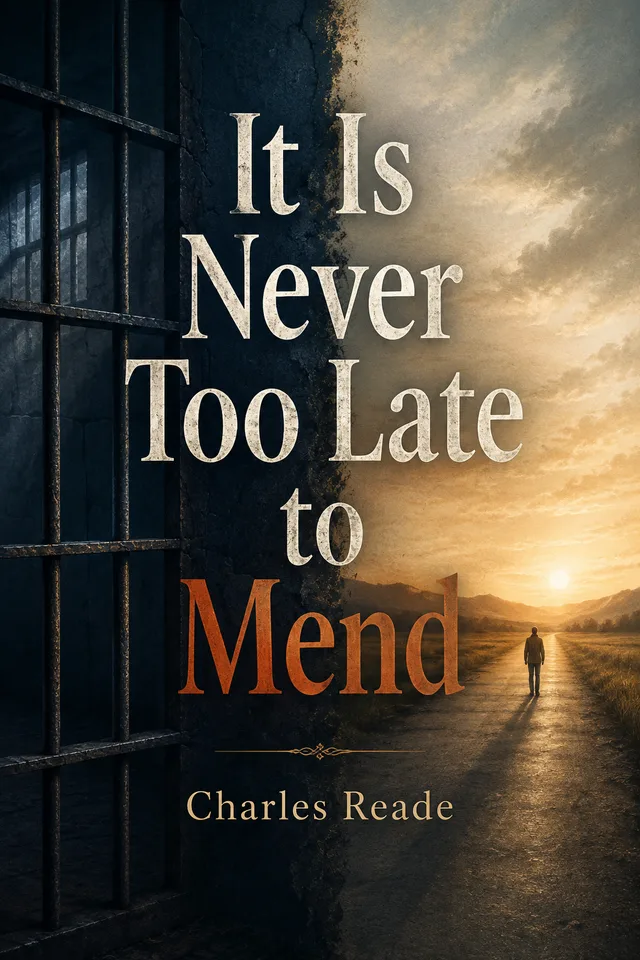
It Is Never Too Late to Mend
English BooksWhale Edition by Charles Reade
A reform-minded Victorian novel about prison abuse, emigration, injustice, and moral recovery.
- Preview
- A sample from the prepared text
- Formats
- Online reader, EPUB, PDF
- Access
- Library claim
Book introduction
It Is Never Too Late to Mend
It Is Never Too Late to Mend combines social-problem fiction with adventure, following characters through prison cruelty, rural hardship, Australian emigration, and the possibility of reform. This English edition keeps the full novel ready for BooksWhale reading.
BooksWhale edition
How this edition was prepared
This edition is based on a public domain text and has been prepared for digital reading by BooksWhale.
Public domain basis
Why this edition can be shared
It Is Never Too Late to Mend was first published in 1856, and Charles Reade died in 1884. These dates support the public-domain basis for this English source text.
Read preview
A sample from the prepared text
Preview selected from the prepared reader text.
Preview chapterFull textRead preview
It Is Never Too Late to Mend
Charles Reade
This attempt at a solid fiction is, with their permission, dedicated to the President, Fellows, and demies of St. Mary Magdalen College. Oxford, by a grateful son of that ancient, learned, and most charitable house.
Preview chapterCHAPTER I.Preview
George Fielding cultivated a small farm in Berkshire.
This position is not so enviable as it was. Years ago, the farmers of England, had they been as intelligent as other traders, could have purchased the English soil by means of the huge percentage it offered them.
But now, I grieve to say, a farmer must be as sharp as his neighbors, or like his neighbors he will break. What do I say? There are soils and situations where, in spite of intelligence and sobriety, he is almost sure to break; just as there are shops where the lively, the severe, the industrious, the lazy, are fractured alike.
This last fact I make mine by perambulating a certain great street every three months, and observing how name succeeds to name as wave to wave.
Readers hardened by the _Times_ will not perhaps go so far as to weep over a body of traders for being reduced to the average condition of all other traders. But the individual trader, who fights for existence against unfair odds, is to be pitied whether his shop has plate glass or a barn door to it; and he is the more to be pitied when he is sober, intelligent, proud, sensitive, and unlucky.
George Fielding was all these, who, a few years ago, assisted by his brother William, filled “The Grove”--as nasty a little farm as any in Berkshire.
Discontented as he was, the expression hereinbefore written would have seemed profane to young Fielding, for a farmer's farm and a sailor's ship have always something sacred in the sufferer's eyes, though one sends one to jail, and the other the other to Jones.
It was four hundred acres, all arable, and most of it poor sour land. George's father had one hundred acres grass with it, but this had been separated six years ago.
There was not a tree, nor even an old stump to show for this word “Grove.”
But in the country oral tradition still flourishes.
There had been trees in “The Grove,” only the title had outlived the timber a few centuries.
On the morning of our tale George Fielding might have been seen near his own homestead, conversing with the Honorable Frank Winchester.
This gentleman was a character that will be common some day, but was nearly unique at the date of our story.
He had not an extraordinary intellect, but he had great natural gayety, and under that he had enormous good sense; his good sense was really brilliant, he had a sort of universal healthy mind that I can't understand how people get.
He was deeply in love with a lady who returned his passion, but she was hopelessly out of his reach, because he had not much money or expectations; instead of sitting down railing, or sauntering about whining, what did me the Honorable Frank Winchester? He looked over England for the means of getting this money, and not finding it there, he surveyed the globe and selected Australia, where, they told him, a little money turns to a deal, instead of dissolving in the hand like a lozenge in the mouth, as it does in London.
So here was an earl's son (in this age of commonplace events) going to Australia with five thousand pounds, as sheep farmer and general speculator.
He was trying hard to persuade George Fielding to accompany him as bailiff or agricultural adviser and manager.
He knew the young man's value, but to do him justice his aim was not purely selfish; he was aware that Fielding had a bad bargain in “The Grove,” and the farmer had saved his life at great personal risk one day that he was seized with cramp bathing in the turbid waters of Cleve millpool, and he wanted to serve him in return. This was not his first attempt of the kind, and but for one reason perhaps he might have succeeded.
Preview chapterCHAPTER II.Preview
THE meal passed almost in silence; Robinson was too hungry to say a word, and a weight hung upon George and Susan.
As they were about to rise, William observed two men in the farmyard who were strangers to him--the men seemed to be inspecting the hogs. It struck him as rather cool; but apparently the pig is an animal which to be prized needs but to be known, for all connoisseurs of him are also enthusiastic amateurs.
When I say the pig I mean the four-legged one.
William Fielding, partly from curiosity to hear these strangers' remarks, partly hoping to find customers in them, strolled into the farmyard before his companions rose from the table.
The others, looking carelessly out of the window, saw William join the two men and enter into conversation with them; but their attention was almost immediately diverted from that group by the entrance of Meadows. He came in radiant; his face was a remarkable contrast to the rest of the party.
Susan could not help noticing it.
“Why, Mr. Meadows,” cried she, “you look as bright as a May morning; it is quite refreshing to see you; we are all rather down here this morning.”
Meadows said nothing, and did not seem at his ease under this remark.
George rose from the table; so did Susan; Robinson merely pushed back his chair and gave a comfortable little sigh, but the next moment he cried “Hallo!”
They looked up, and there was William's face close against the window.
William's face was remarkably pale, and first he tried to attract George's attention without speaking, but finding himself observed by the whole party, he spoke out.
“George, will you speak a word?” said he.
George rose and went out; but Susan's curiosity was wakened, and she followed him, accompanied by Meadows.
“None but you, George,” said William, with a voice half stern, half quivering.
George looked at his brother.
“Out with it,” cried he, “it is some deadly ill-luck; I have felt it coming all day, but out with it; what can't I bear after the words I have borne this morning?”
William hung his head.
“George, there is a distress upon the farm for the rent.”
George did not speak at first, he literally staggered under these words; his proud spirit writhed in his countenance, and with a groan, he turned his back abruptly upon them all and hid his face against the corner of his own house, the cold hard bricks.
Meadows, by strong self-command, contrived not to move a muscle of his face.
Up to this day and hour, Susan Merton had always seemed cool, compared with her lover; she used to treat him a little _de haut en bas_.
But when she saw his shame and despair, she was much distressed.
“George, George!” she cried, “don't do so. Can nothing be done? Where is my father?--they told me he was here. He is rich, he shall help you.” She darted from them in search of Merton; ere she could turn the angle of the house he met her.
“You had better go home, my girl,” said he gravely.
“Oh, no, no! I have been too unkind to George already,” and she turned toward him like a pitying angel with hands extended as if they would bring balm to a hurt soul.
Meadows left chuckling and was red and white by turns.
Merton was one of those friends one may make sure of finding in adversity.
“There,” cried he, “George, I told you how it would end.”
George wheeled round on him like lightning.
“What, do you come here to insult over me? I must be a long way lower than I am, before I shall be as low as you were when my mother took you up and made a man of you.”
“George, George!” cried Susan in dismay; “stop, for pity's sake, before you say words that will separate us forever. Father,” cried the peace-making angel, “how can you push poor George so hard and him in trouble! and we have all been too unkind to him to-day.”
Table of contents
Inside this edition
- 01Full text
- 02CHAPTER I.
- 03CHAPTER II.
- 04CHAPTER III.
- 05CHAPTER IV.
- 06CHAPTER V.
- 07CHAPTER VI.
- 08CHAPTER VII.
- 09CHAPTER VIII.
- 10CHAPTER IX.
- 11CHAPTER X.
- 12CHAPTER XI.
- 13CHAPTER XII.
- 14CHAPTER XIII.
- 15CHAPTER XIV.
- 16CHAPTER XV.
- 17SUNDAY.
- 18CHAPTER XVI.
- 19CHAPTER XVII.
- 20CHAPTER XVIII.
- 21CHAPTER XIX.
- 22CHAPTER XX.
- 23CHAPTER XXI.
- 24CHAPTER XXII.
- 25CHAPTER XXIII.
- 26CHAPTER XXIV.
- 27CHAPTER XXV.
- 28CHAPTER XXVI.
- 29CHAPTER XXVII.
- 30CHAPTER XXVIII.
- 31CHAPTER XXIX.
- 32CHAPTER XXX.
- 33CHAPTER XXXI.
- 34CHAPTER XXXII.
- 35CHAPTER XXXIII.
- 36CHAPTER XXXIV.
- 37CHAPTER XXXV.
- 38CHAPTER XXXVI.
- 39CHAPTER XXXVII.
- 40CHAPTER XXXVIII.
- 41CHAPTER XXXIX.
- 42CHAPTER XL.
- 43CHAPTER XLI.
- 44CHAPTER XLII.
- 45CHAPTER XLIII.
- 46CHAPTER XLIV
- 47CHAPTER XLV.
- 48CHAPTER XLVI.
- 49CHAPTER XLVII.
- 50CHAPTER XLVIII.
- 51THE DOOR WAS LOCKED.
- 52CHAPTER XLIX.
- 53CHAPTER L.
- 54CHAPTER LI.
- 55CHAPTER LII.
- 56CHAPTER LIII.
- 57CHAPTER LIV.
- 58CHAPTER LV.
- 59CHAPTER LVI.
- 60CHAPTER LVII.
- 61CHAPTER LVIII.
- 62CHAPTER LIX.
- 63CHAPTER LX.
- 64CHAPTER LXI.
- 65THIEF
- 66CHAPTER LXII.
- 67CHAPTER LXIII.
- 68SUNDAY.
- 69CHAPTER LXIV.
- 70CHAPTER LXV.
- 71CHAPTER LXVI.
- 72CHAPTER LXVII.
- 73CHAPTER LXVIII.
- 74CHAPTER LXIX.
- 75CHAPTER LXX.
- 76CHAPTER LXXI.
- 77CHAPTER LXXII.
- 78CHAPTER LXXIII.
- 79CHAPTER LXXIV.
- 80CHAPTER LXXV.
- 81CHAPTER LXXVI.
- 82CHAPTER LXXVII.
- 83CHAPTER LXXVIII.
- 84CHAPTER LXXIX.
- 85CHAPTER LXXX.
- 86CHAPTER LXXXI.
- 87CHAPTER LXXXII.
- 88CHAPTER LXXXIII.
- 89CHAPTER LXXXIV.
- 90CHAPTER LXXXV.
Language availability
Other languages
Additional language editions are not published yet. This section will link to other BooksWhale editions when they become available.
Request another language