English Edition
Literature
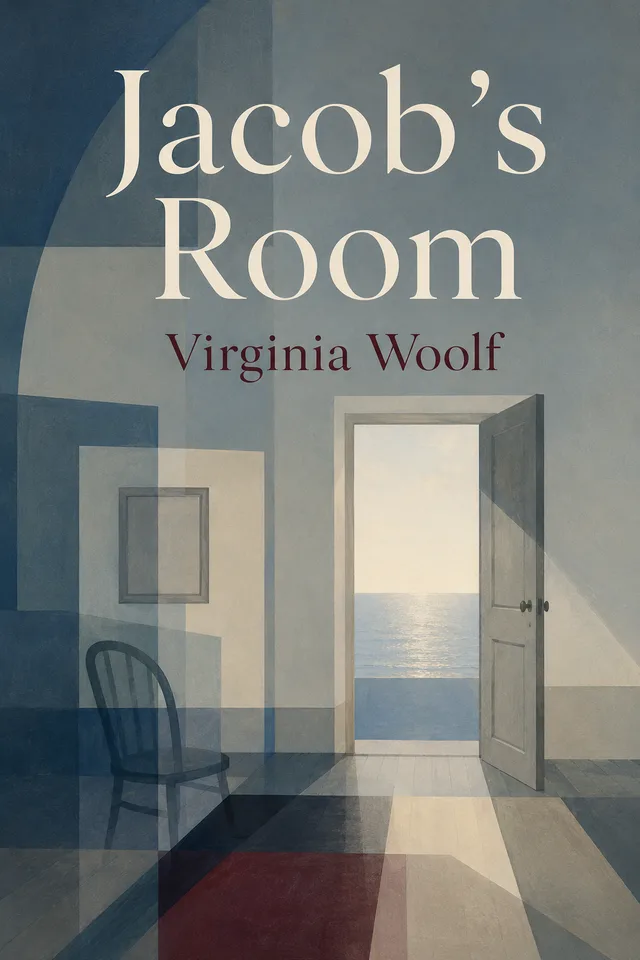
Jacob's Room
English BooksWhale Edition by Virginia Woolf
A public-domain original edition centered on Jacob Flanders, absence, memory, youth, rooms, letters, war, and Woolf’s early experimental modernism.
- Preview
- A sample from the prepared text
- Formats
- Online reader, EPUB, PDF
- Access
- Library claim
Book introduction
Jacob's Room
Jacob's Room by Virginia Woolf is presented here as a clean original-language edition. The work is especially valuable for readers interested in Jacob Flanders, absence, memory, youth, rooms, letters, war, and Woolf’s early experimental modernism. Its themes, historical context, and authorial style give this edition strong discovery value for classic literature and public-domain research.
BooksWhale edition
How this edition was prepared
This edition is based on a public domain text and has been prepared for digital reading by BooksWhale.
Public domain basis
Why this edition can be shared
Virginia Woolf died in 1941, and Jacob's Room was first published or composed in 1922. These dates support the public-domain basis for the original English source text used in this edition.
Read preview
A sample from the prepared text
Preview selected from the prepared reader text.
Preview chapterFull textRead preview
Jacob's Room
Preview chapterVIRGINIA WOOLFPreview
VIRGINIA WOOLF
Preview chapterCHAPTER ONEPreview
"So of course," wrote Betty Flanders, pressing her heels rather deeper in the sand, "there was nothing for it but to leave."
Slowly welling from the point of her gold nib, pale blue ink dissolved the full stop; for there her pen stuck; her eyes fixed, and tears slowly filled them. The entire bay quivered; the lighthouse wobbled; and she had the illusion that the mast of Mr. Connor's little yacht was bending like a wax candle in the sun. She winked quickly. Accidents were awful things. She winked again. The mast was straight; the waves were regular; the lighthouse was upright; but the blot had spread.
"... nothing for it but to leave," she read.
"Well, if Jacob doesn't want to play" (the shadow of Archer, her eldest son, fell across the notepaper and looked blue on the sand, and she felt chilly--it was the third of September already), "if Jacob doesn't want to play"--what a horrid blot! It must be getting late.
"Where IS that tiresome little boy?" she said. "I don't see him. Run and find him. Tell him to come at once." "... but mercifully," she scribbled, ignoring the full stop, "everything seems satisfactorily arranged, packed though we are like herrings in a barrel, and forced to stand the perambulator which the landlady quite naturally won't allow...."
Such were Betty Flanders's letters to Captain Barfoot--many-paged, tear-stained. Scarborough is seven hundred miles from Cornwall: Captain Barfoot is in Scarborough: Seabrook is dead. Tears made all the dahlias in her garden undulate in red waves and flashed the glass house in her eyes, and spangled the kitchen with bright knives, and made Mrs. Jarvis, the rector's wife, think at church, while the hymn-tune played and Mrs. Flanders bent low over her little boys' heads, that marriage is a fortress and widows stray solitary in the open fields, picking up stones, gleaning a few golden straws, lonely, unprotected, poor creatures. Mrs. Flanders had been a widow for these two years.
"Ja--cob! Ja--cob!" Archer shouted.
"Scarborough," Mrs. Flanders wrote on the envelope, and dashed a bold line beneath; it was her native town; the hub of the universe. But a stamp? She ferreted in her bag; then held it up mouth downwards; then fumbled in her lap, all so vigorously that Charles Steele in the Panama hat suspended his paint-brush.
Like the antennae of some irritable insect it positively trembled. Here was that woman moving--actually going to get up--confound her! He struck the canvas a hasty violet-black dab. For the landscape needed it. It was too pale--greys flowing into lavenders, and one star or a white gull suspended just so--too pale as usual. The critics would say it was too pale, for he was an unknown man exhibiting obscurely, a favourite with his landladies' children, wearing a cross on his watch chain, and much gratified if his landladies liked his pictures--which they often did.
"Ja--cob! Ja--cob!" Archer shouted.
Exasperated by the noise, yet loving children, Steele picked nervously at the dark little coils on his palette.
"I saw your brother--I saw your brother," he said, nodding his head, as Archer lagged past him, trailing his spade, and scowling at the old gentleman in spectacles.
"Over there--by the rock," Steele muttered, with his brush between his teeth, squeezing out raw sienna, and keeping his eyes fixed on Betty Flanders's back.
"Ja--cob! Ja--cob!" shouted Archer, lagging on after a second.
The voice had an extraordinary sadness. Pure from all body, pure from all passion, going out into the world, solitary, unanswered, breaking against rocks--so it sounded.
Steele frowned; but was pleased by the effect of the black--it was just THAT note which brought the rest together. "Ah, one may learn to paint at fifty! There's Titian..." and so, having found the right tint, up he looked and saw to his horror a cloud over the bay.
Table of contents
Inside this edition
- 01Full text
- 02VIRGINIA WOOLF
- 03CHAPTER ONE
- 04CHAPTER TWO
- 05CHAPTER THREE
- 06CHAPTER FOUR
- 07CHAPTER FIVE
- 08CHAPTER SIX
- 09CHAPTER SEVEN
- 10CHAPTER EIGHT
- 11CHAPTER NINE
- 12CHAPTER TEN
- 13CHAPTER ELEVEN
- 14CHAPTER TWELVE
- 15I like books whose virtue is all drawn together in a page or two. I like
- 16CHAPTER THIRTEEN
- 17CHAPTER FOURTEEN
Language availability
Other languages
Additional language editions are not published yet. This section will link to other BooksWhale editions when they become available.
Request another language