English Edition
Literature
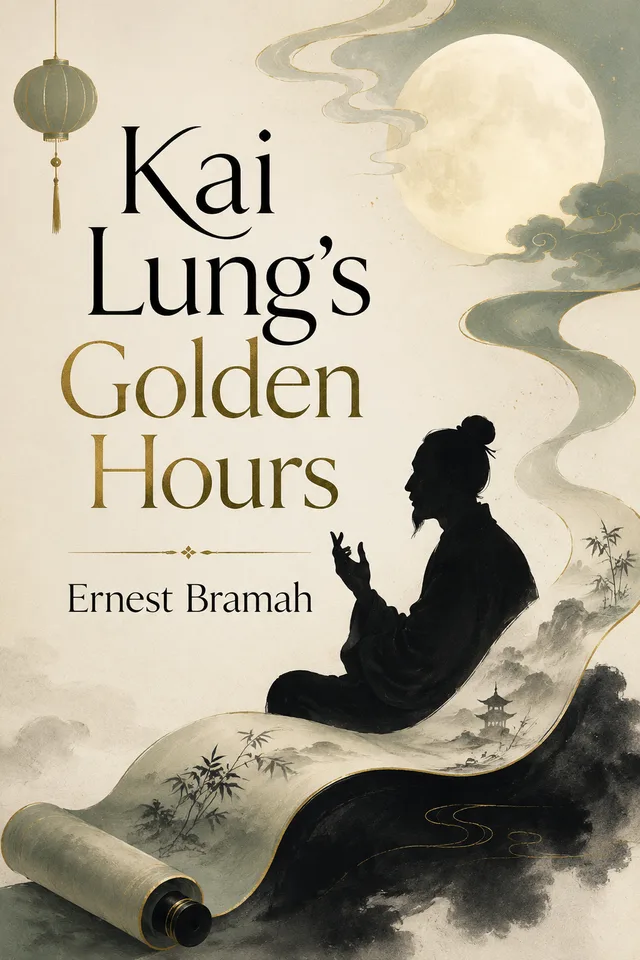
Kai Lung’s Golden Hours
English BooksWhale Edition by Ernest Bramah
A public-domain classic on comic storytelling, adventure, verbal wit, nested tales, and elegant fantasy.
- Preview
- A sample from the prepared text
- Formats
- Online reader, EPUB, PDF
- Access
- Library claim
Book introduction
Kai Lung’s Golden Hours
Kai Lung’s Golden Hours by Ernest Bramah remains a rewarding classic for readers interested in comic storytelling, adventure, verbal wit, nested tales, and elegant fantasy. This English edition presents the original public-domain text in a clean BooksWhale format for online reading, EPUB, and PDF, with the work’s historical context and literary value kept clear.
BooksWhale edition
How this edition was prepared
This edition is based on a public domain text and has been prepared for digital reading by BooksWhale.
Public domain basis
Why this edition can be shared
Kai Lung’s Golden Hours was first published in 1922. This edition uses the public-domain English original text, with publication date and rights status supporting public-domain use.
Read preview
A sample from the prepared text
Preview selected from the prepared reader text.
Preview chapterFull textRead preview
Kai Lung’s Golden Hours
Ernest Bramah
Preview chapterPart 1Preview
BY
ERNEST BRAMAH
With a Preface by Hilaire Belloc
LONDON
GRANT RICHARDS LTD.
ST MARTIN’S STREET
MDCCCCXXII
PREFACE
_Homo faber_. Man is born to make. His business is to construct: to plan: to carry out the plan: to fit together, and to produce a finished thing.
That human art in which it is most difficult to achieve this end (and in which it is far easier to neglect it than in any other) is the art of writing. Yet this much is certain, that unconstructed writing is at once worthless and ephemeral: and nearly the whole of our modern English writing is unconstructed.
The matter of survival is perhaps not the most important, though it is a test of a kind, and it is a test which every serious writer feels most intimately. The essential is the matter of excellence: that a piece of work should achieve its end. But in either character, the character of survival or the character of intrinsic excellence, construction deliberate and successful is the fundamental condition.
It may be objected that the mass of writing must in any age neglect construction. We write to establish a record for a few days: or to send a thousand unimportant messages: or to express for others or for ourselves something very vague and perhaps very weak in the way of emotion, which does not demand construction and at any rate cannot command it. No writer can be judged by the entirety of his writings, for these would include every note he ever sent round the corner; every memorandum he ever made upon his shirt cuff. But when a man sets out to write as a serious business, proclaiming that by the nature of his publication and presentment that he is doing something he thinks worthy of the time and place in which he lives and of the people to whom he belongs, then if he does not construct he is negligible.
Yet, I say, the great mass of men to-day do not attempt it in the English tongue, and the proof is that you can discover in their slipshod pages nothing of a seal or stamp. You do not, opening a book at random, say at once: “This is the voice of such and such a one.” It is no one’s manner or voice. It is part of a common babel.
Therefore in such a time as that of our decline, to come across work which is planned, executed and achieved has something of the effect like finding, as I once found, deep hidden in the tangled rank grass of autumn in Burgundy, on the edge of a wood not far from Dijon, a neglected statue of the eighteenth century. It is like coming round the corner of some wholly desolate upper valley in the mountains and seeing before one a well-cultivated close and a strong house in the midst.
It is now many years--I forget how many; it may be twenty or more, or it may be a little less--since _The Wallet of Kai Lung_ was sent me by a friend. The effect produced upon my mind at the first opening of its pages was in the same category as the effect produced by the discovery of that hidden statue in Burgundy, or the coming upon an unexpected house in the turn of a high Pyrenean gorge. Here was something worth doing and done. It was not a plan attempted and only part achieved (though even that would be rare enough to-day, and a memorable exception); it was a thing intended, wrought out, completed and established. Therefore it was destined to endure and, what is more important, it was a success.
The time in which we live affords very few of such moments of relief: here and there a good piece of verse, in _The New Age_ or in the now defunct _Westminster_: here and there a lapidary phrase such as a score or more of Blatchford’s which remain fixed in my memory. Here and there a letter written to the newspapers in a moment of indignation when the writer, not trained to the craft, strikes out the metal justly at white heat. But, I say, the thing is extremely rare, and in the shape of a complete book rarest of all.
Preview chapterPart 2Preview
The yard itself possessed no attraction for Kai Lung. Almost before Li-loe had disappeared he was at the shutter in the wall, had forced it open and was looking out. Thus long he waited, motionless, but observing every leaf that stirred among the trees and shrubs and neglected growth beyond. At last a figure passed across a distant glade and at the sight Kai Lung lifted up a restrained voice in song:
“At the foot of a bleak and inhospitable mountain An insignificant stream winds its uncared way; Although inferior to the Yangtze-kiang in every detail Yet fish glide to and fro among its crannies Nor would they change their home for the depths of the widest river.
The palace of the sublime Emperor is made rich with hanging curtains. While here rough stone walls forbid repose. Yet there is one who unhesitatingly prefers the latter; For from an open shutter here he can look forth, And perchance catch a glimpse of one who may pass by.
The occupation of the Imperial viceroy is both lucrative and noble; While that of a relater of imagined tales is by no means esteemed. But he who thus expressed himself would not exchange with the other; For around the identity of each heroine he can entwine the personality of one whom he has encountered. And thus she is ever by his side.”
“Your uplifted voice comes from an unexpected quarter, minstrel,” said a melodious voice, and the maiden whom he had encountered in the wood stood before him. “What crime have you now committed?”
“An ancient one. I presumed to raise my unworthy eyes--”
“Alas, story-teller,” interposed the maiden hastily, “it would seem that the star to which you chained _your_ wrist has not carried you into the assembly of the gods.”
“Yet already it has borne me half-way--into a company of malefactors. Doubtless on the morrow the obliging Mandarin Shan Tien will arrange for the journey to be complete.”
“Yet have you then no further wish to continue in an ordinary existence?” asked the maiden.
“To this person,” replied Kai Lung, with a deep-seated look, “existence can never again be ordinary. Admittedly it may be short.”
As they conversed together in this inoffensive manner she whom Li-loe had called the Golden Mouse held in her delicately-formed hands a priceless bowl filled with ripe fruit of the rarer kinds which she had gathered. These from time to time she threw up to the opening, rightly deciding that one in Kai Lung’s position would stand in need of sustenance, and he no less dexterously held and retained them. When the bowl was empty she continued for a space to regard it silently, as though exploring the many-sided recesses of her mind.
“You have claimed to be a story-teller and have indeed made a boast that there is no arising emergency for which you are unprepared,” she said at length. “It now befalls that you may be put to a speedy test. Is the nature of this imagined scene”--thus she indicated the embellishment of the bowl--“familiar to your eyes?”
“It is that known as ‘The Willow,’” replied Kai Lung. “There is a story--”
“There is a story!” exclaimed the maiden, loosening from her brow the overhanging look of care. “Thus and thus. Frequently have I importuned him before whom you will appear to explain to me the meaning of the scene. When you are called upon to plead your cause, see to it well that your knowledge of such a tale is clearly shown. He before whom you kneel, craftily plied meanwhile by my unceasing petulance, will then desire to hear it from your lips . . . At the striking of the fourth gong the day is done. What lies between rests with your discriminating wit.”
“You are deep in the subtler kinds of wisdom, such as the weak possess,” confessed Kai Lung. “Yet how will this avail to any length?”
Table of contents
Inside this edition
- 01Full text
- 02Part 1
- 03Part 2
- 04Part 3
- 05Part 4
- 06Part 5
- 07Part 6
- 08Part 7
- 09Part 8
- 10Part 9
- 11Part 10
- 12Part 11
- 13Part 12
- 14Part 13
- 15Part 14
- 16Part 15
- 17Part 16
Language availability
Other languages
Additional language editions are not published yet. This section will link to other BooksWhale editions when they become available.
Request another language