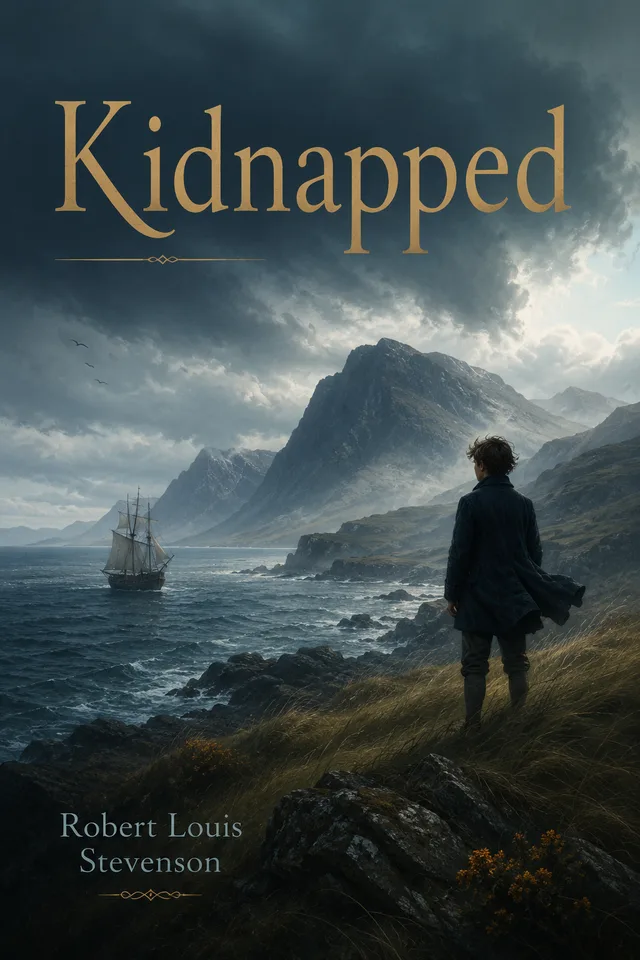
English Edition
Literature
Kidnapped
English BooksWhale Edition by Robert Louis Stevenson
A Scottish adventure of betrayal, flight, friendship, and Jacobite danger after a stolen inheritance.
- Preview
- A sample from the prepared text
- Formats
- Online reader, EPUB, PDF
- Access
- Library claim
Book introduction
Kidnapped
Kidnapped follows young David Balfour from a disputed inheritance into abduction, shipwreck, Highland pursuit, and an uneasy alliance with Alan Breck Stewart. Stevenson turns Scottish history into a fast-moving adventure about loyalty, courage, identity, and survival amid clan politics after the Jacobite rising.
BooksWhale edition
How this edition was prepared
This edition is based on a public domain text and has been prepared for digital reading by BooksWhale.
Public domain basis
Why this edition can be shared
Robert Louis Stevenson died in 1894, and Kidnapped was first published in 1886. These dates support the public-domain basis for the English source text used in this edition.
Read preview
A sample from the prepared text
Preview selected from the prepared reader text.
Preview chapterFull textRead preview
Kidnapped
KIDNAPPED
BEING
MEMOIRS OF THE ADVENTURES OF
DAVID BALFOUR
IN THE YEAR 1751
HOW HE WAS KIDNAPPED AND CAST AWAY; HIS SUFFERINGS IN
A DESERT ISLE; HIS JOURNEY IN THE WILD HIGHLANDS;
HIS ACQUAINTANCE WITH ALAN BRECK STEWART
AND OTHER NOTORIOUS HIGHLAND JACOBITES;
WITH ALL THAT HE SUFFERED AT THE
HANDS OF HIS UNCLE, EBENEZER
BALFOUR OF SHAWS, FALSELY
SO CALLED
WRITTEN BY HIMSELF AND NOW SET FORTH BY
ROBERT LOUIS STEVENSON
WITH A PREFACE BY MRS. STEVENSON
PREFACE TO THE BIOGRAPHICAL EDITION
While my husband and Mr. Henley were engaged in writing plays in Bournemouth they made a number of titles, hoping to use them in the future. Dramatic composition was not what my husband preferred, but the torrent of Mr. Henley’s enthusiasm swept him off his feet. However, after several plays had been finished, and his health seriously impaired by his endeavours to keep up with Mr. Henley, play writing was abandoned forever, and my husband returned to his legitimate vocation. Having added one of the titles, The Hanging Judge, to the list of projected plays, now thrown aside, and emboldened by my husband’s offer to give me any help needed, I concluded to try and write it myself.
As I wanted a trial scene in the Old Bailey, I chose the period of 1700 for my purpose; but being shamefully ignorant of my subject, and my husband confessing to little more knowledge than I possessed, a London bookseller was commissioned to send us everything he could procure bearing on Old Bailey trials. A great package came in response to our order, and very soon we were both absorbed, not so much in the trials as in following the brilliant career of a Mr. Garrow, who appeared as counsel in many of the cases. We sent for more books, and yet more, still intent on Mr. Garrow, whose subtle cross-examination of witnesses and masterly, if sometimes startling, methods of arriving at the truth seemed more thrilling to us than any novel.
Occasionally other trials than those of the Old Bailey would be included in the package of books we received from London; among these my husband found and read with avidity:--
THE
TRIAL
OF
JAMES STEWART
in Aucharn in Duror of Appin
FOR THE
Murder of COLIN CAMPBELL of Glenure, Efq;
Factor for His Majefty on the forfeited
Estate of Ardfhiel.
My husband was always interested in this period of his country’s
history, and had already the intention of writing a story that should
turn on the Appin murder. The tale was to be of a boy, David Balfour,
supposed to belong to my husband’s own family, who should travel in
Scotland as though it were a foreign country, meeting with various
adventures and misadventures by the way. From the trial of James Stewart
my husband gleaned much valuable material for his novel, the most
important being the character of Alan Breck. Aside from having described
him as “smallish in stature,” my husband seems to have taken Alan
Breck’s personal appearance, even to his clothing, from the book.
A letter from James Stewart to Mr. John Macfarlane, introduced as evidence in the trial, says: “There is one Alan Stewart, a distant friend of the late Ardshiel’s, who is in the French service, and came over in March last, as he said to some, in order to settle at home; to others, that he was to go soon back; and was, as I hear, the day that the murder was committed, seen not far from the place where it happened, and is not now to be seen; by which it is believed he was the actor. He is a desperate foolish fellow; and if he is guilty, came to the country for that very purpose. He is a tall, pock-pitted lad, very black hair, and wore a blue coat and metal buttons, an old red vest, and breeches of the same colour.” A second witness testified to having seen him wearing “a blue coat with silver buttons, a red waistcoat, black shag breeches, tartan hose, and a feathered hat, with a big coat, dun coloured,” a costume referred to by one of the counsel as “French cloathes which were remarkable.”
Preview chapterCHAPTER IPreview
CHAPTER I
Preview chapterI SET OFF UPON MY JOURNEY TO THE HOUSE OF SHAWSPreview
I will begin the story of my adventures with a certain morning early in
the month of June, the year of grace 1751, when I took the key for the last time out of the door of my father’s house. The sun began to shine upon the summit of the hills as I went down the road; and by the time
I had come as far as the manse, the blackbirds were whistling in the
garden lilacs, and the mist that hung around the valley in the time of the dawn was beginning to arise and die away.
Mr. Campbell, the minister of Essendean, was waiting for me by the
garden gate, good man! He asked me if I had breakfasted; and hearing
that I lacked for nothing, he took my hand in both of his and clapped it
kindly under his arm.
“Well, Davie, lad,” said he, “I will go with you as far as the ford, to set you on the way.” And we began to walk forward in silence.
“Are ye sorry to leave Essendean?” said he, after awhile.
“Why, sir,” said I, “if I knew where I was going, or what was likely
to become of me, I would tell you candidly. Essendean is a good place
indeed, and I have been very happy there; but then I have never been
anywhere else. My father and mother, since they are both dead, I shall
be no nearer to in Essendean than in the Kingdom of Hungary, and, to
speak truth, if I thought I had a chance to better myself where I was
going I would go with a good will.”
“Ay?” said Mr. Campbell. “Very well, Davie. Then it behoves me to tell your fortune; or so far as I may. When your mother was gone, and your father (the worthy, Christian man) began to sicken for his end, he gave me in charge a certain letter, which he said was your inheritance. ‘So soon,’ says he, ‘as I am gone, and the house is redd up and the gear disposed of’ (all which, Davie, hath been done), ‘give my boy this letter into his hand, and start him off to the house of Shaws, not far from Cramond. That is the place I came from,’ he said, ‘and it’s where it befits that my boy should return. He is a steady lad,’ your father said, ‘and a canny goer; and I doubt not he will come safe, and be well liked where he goes.’”
“The house of Shaws!” I cried. “What had my poor father to do with the house of Shaws?”
“Nay,” said Mr. Campbell, “who can tell that for a surety? But the name of that family, Davie, boy, is the name you bear--Balfours of Shaws: an ancient, honest, reputable house, peradventure in these latter days decayed. Your father, too, was a man of learning as befitted his position; no man more plausibly conducted school; nor had he the manner or the speech of a common dominie; but (as ye will yourself remember)
I took aye a pleasure to have him to the manse to meet the gentry; and
those of my own house, Campbell of Kilrennet, Campbell of Dunswire,
Campbell of Minch, and others, all well-kenned gentlemen, had pleasure
in his society. Lastly, to put all the elements of this affair before
you, here is the testamentary letter itself, superscrived by the own
hand of our departed brother.”
He gave me the letter, which was addressed in these words: “To the hands of Ebenezer Balfour, Esquire, of Shaws, in his house of Shaws, these will be delivered by my son, David Balfour.” My heart was beating hard at this great prospect now suddenly opening before a lad of seventeen years of age, the son of a poor country dominie in the Forest of Ettrick.
“Mr. Campbell,” I stammered, “and if you were in my shoes, would you go?”
Table of contents
Inside this edition
- 01Full text
- 02CHAPTER I
- 03I SET OFF UPON MY JOURNEY TO THE HOUSE OF SHAWS
- 04CHAPTER II
- 05I COME TO MY JOURNEY’S END
- 06CHAPTER III
- 07I MAKE ACQUAINTANCE OF MY UNCLE
- 08CHAPTER IV
- 09I RUN A GREAT DANGER IN THE HOUSE OF SHAWS
- 10CHAPTER V
- 11I GO TO THE QUEEN’S FERRY
- 12CHAPTER VI
- 13CHAPTER VII
- 14I GO TO SEA IN THE BRIG _COVENANT_ OF DYSART
- 15CHAPTER VIII
- 16CHAPTER IX
- 17CHAPTER X
- 18CHAPTER XI
- 19CHAPTER XII
- 20I HEAR OF THE “RED FOX”
- 21CHAPTER XIII
- 22CHAPTER XIV
- 23CHAPTER XV
- 24CHAPTER XVI
- 25CHAPTER XVII
- 26CHAPTER XVIII
- 27I TALK WITH ALAN IN THE WOOD OF LETTERMORE
- 28CHAPTER XIX
- 29CHAPTER XX
- 30CHAPTER XXI
- 31CHAPTER XXII
- 32CHAPTER XXIII
- 33CHAPTER XXIV
- 34CHAPTER XXV
- 35CHAPTER XXVI
- 36CHAPTER XXVII
- 37I COME TO MR. RANKEILLOR
- 38CHAPTER XXVIII
- 39I GO IN QUEST OF MY INHERITANCE
- 40CHAPTER XXIX
- 41I COME INTO MY KINGDOM
- 42CHAPTER XXX
Language availability
Other languages
Additional language editions are not published yet. This section will link to other BooksWhale editions when they become available.
Request another language