English Edition
Literature
Kim
English BooksWhale Edition by Rudyard Kipling
An orphan moves through British India between espionage, apprenticeship, friendship, and spiritual search.
- Preview
- A sample from the prepared text
- Formats
- Online reader, EPUB, PDF
- Access
- Library claim
Book introduction
Kim
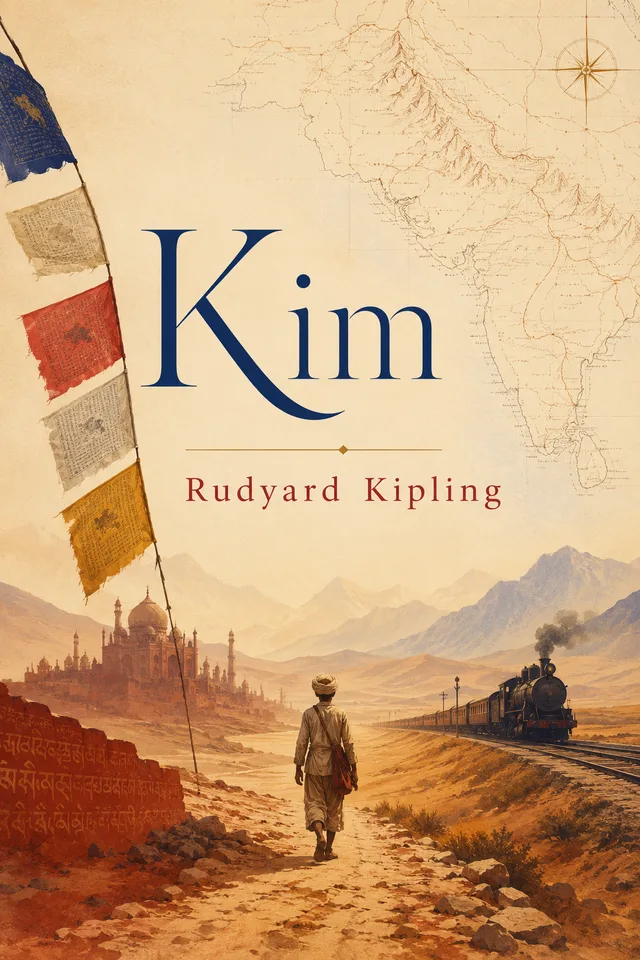
Kim follows Kimball O'Hara across roads, cities, schools, and secret missions in colonial India, pairing his life in the Great Game with the lama's pilgrimage toward liberation. Kipling combines adventure, surveillance, language, identity, and religious travel in one of his most expansive novels.
BooksWhale edition
How this edition was prepared
This edition is based on a public domain text and has been prepared for digital reading by BooksWhale.
Public domain basis
Why this edition can be shared
Rudyard Kipling died in 1936, and Kim was first published in 1901. These dates support the public-domain basis for the original English text used in this edition.
Read preview
A sample from the prepared text
Preview selected from the prepared reader text.
Preview chapterFull textRead preview
Kim
O ye who tread the Narrow Way By Tophet-flare to Judgment Day, Be gentle when “the heathen” pray To Buddha at Kamakura!
He sat, in defiance of municipal orders, astride the gun Zam Zammah on her brick platform opposite the old Ajaib-Gher—the Wonder House, as the natives call the Lahore Museum. Who hold Zam-Zammah, that “fire-breathing dragon”, hold the Punjab, for the great green-bronze piece is always first of the conqueror’s loot.
There was some justification for Kim—he had kicked Lala Dinanath’s boy off the trunnions—since the English held the Punjab and Kim was English. Though he was burned black as any native; though he spoke the vernacular by preference, and his mother-tongue in a clipped uncertain sing-song; though he consorted on terms of perfect equality with the small boys of the bazar; Kim was white—a poor white of the very poorest. The half-caste woman who looked after him (she smoked opium, and pretended to keep a second-hand furniture shop by the square where the cheap cabs wait) told the missionaries that she was Kim’s mother’s sister; but his mother had been nursemaid in a Colonel’s family and had married Kimball O’Hara, a young colour-sergeant of the Mavericks, an Irish regiment. He afterwards took a post on the Sind, Punjab, and Delhi Railway, and his Regiment went home without him. The wife died of cholera in Ferozepore, and O’Hara fell to drink and loafing up and down the line with the keen-eyed three-year-old baby. Societies and chaplains, anxious for the child, tried to catch him, but O’Hara drifted away, till he came across the woman who took opium and learned the taste from her, and died as poor whites die in India. His estate at death consisted of three papers—one he called his “_ne varietur_” because those words were written below his signature thereon, and another his “clearance-certificate”. The third was Kim’s birth-certificate. Those things, he was used to say, in his glorious opium-hours, would yet make little Kimball a man. On no account was Kim to part with them, for they belonged to a great piece of magic—such magic as men practised over yonder behind the Museum, in the big blue-and-white Jadoo-Gher—the Magic House, as we name the Masonic Lodge. It would, he said, all come right some day, and Kim’s horn would be exalted between pillars—monstrous pillars—of beauty and strength. The Colonel himself, riding on a horse, at the head of the finest Regiment in the world, would attend to Kim—little Kim that should have been better off than his father. Nine hundred first-class devils, whose God was a Red Bull on a green field, would attend to Kim, if they had not forgotten O’Hara—poor O’Hara that was gang-foreman on the Ferozepore line. Then he would weep bitterly in the broken rush chair on the veranda. So it came about after his death that the woman sewed parchment, paper, and birth-certificate into a leather amulet-case which she strung round Kim’s neck.
“And some day,” she said, confusedly remembering O’Hara’s prophecies, “there will come for you a great Red Bull on a green field, and the Colonel riding on his tall horse, yes, and” dropping into English—“nine hundred devils.”
“Ah,” said Kim, “I shall remember. A Red Bull and a Colonel on a horse will come, but first, my father said, will come the two men making ready the ground for these matters. That is how my father said they always did; and it is always so when men work magic.”
As he drummed his heels against Zam-Zammah he turned now and again from his king-of-the-castle game with little Chota Lal and Abdullah the sweetmeat-seller’s son, to make a rude remark to the native policeman on guard over rows of shoes at the Museum door. The big Punjabi grinned tolerantly: he knew Kim of old. So did the water-carrier, sluicing water on the dry road from his goat-skin bag. So did Jawahir Singh, the Museum carpenter, bent over new packing-cases. So did everybody in sight except the peasants from the country, hurrying up to the Wonder House to view the things that men made in their own province and elsewhere. The Museum was given up to Indian arts and manufactures, and anybody who sought wisdom could ask the Curator to explain.
Preview chapterCHAPTER IIPreview
And whoso will, from Pride released; Contemning neither creed nor priest, May feel the Soul of all the East. About him at Kamakura.
They entered the fort-like railway station, black in the end of night; the electrics sizzling over the goods-yard where they handle the heavy Northern grain-traffic.
“This is the work of devils!” said the lama, recoiling from the hollow echoing darkness, the glimmer of rails between the masonry platforms, and the maze of girders above. He stood in a gigantic stone hall paved, it seemed, with the sheeted dead third-class passengers who had taken their tickets overnight and were sleeping in the waiting-rooms. All hours of the twenty-four are alike to Orientals, and their passenger traffic is regulated accordingly.
“This is where the fire-carriages come. One stands behind that hole”—Kim pointed to the ticket-office—“who will give thee a paper to take thee to Umballa.”
“But we go to Benares,” he replied petulantly.
“All one. Benares then. Quick: she comes!”
“Take thou the purse.”
The lama, not so well used to trains as he had pretended, started as the 3.25 a.m. south-bound roared in. The sleepers sprang to life, and the station filled with clamour and shoutings, cries of water and sweetmeat vendors, shouts of native policemen, and shrill yells of women gathering up their baskets, their families, and their husbands.
“It is the train—only the _te-rain_. It will not come here. Wait!” Amazed at the lama’s immense simplicity (he had handed him a small bag full of rupees), Kim asked and paid for a ticket to Umballa. A sleepy clerk grunted and flung out a ticket to the next station, just six miles distant.
“Nay,” said Kim, scanning it with a grin. “This may serve for farmers, but I live in the city of Lahore. It was cleverly done, Babu. Now give the ticket to Umballa.”
The Babu scowled and dealt the proper ticket.
“Now another to Amritzar,” said Kim, who had no notion of spending Mahbub Ali’s money on anything so crude as a paid ride to Umballa. “The price is so much. The small money in return is just so much. I know the ways of the _te-rain_ ... Never did _yogi_ need _chela_ as thou dost,” he went on merrily to the bewildered lama. “They would have flung thee out at Mian Mir but for me. This way! Come!” He returned the money, keeping only one anna in each rupee of the price of the Umballa ticket as his commission—the immemorial commission of Asia.
The lama jibbed at the open door of a crowded third-class carriage. “Were it not better to walk?” said he weakly.
A burly Sikh artisan thrust forth his bearded head. “Is he afraid? Do not be afraid. I remember the time when I was afraid of the train. Enter! This thing is the work of the Government.”
“I do not fear,” said the lama. “Have ye room within for two?”
“There is no room even for a mouse,” shrilled the wife of a well-to-do cultivator—a Hindu Jat from the rich Jullundur, district. Our night trains are not as well looked after as the day ones, where the sexes are very strictly kept to separate carriages.
“Oh, mother of my son, we can make space,” said the blueturbaned husband. “Pick up the child. It is a holy man, see’st thou?”
“And my lap full of seventy times seven bundles! Why not bid him sit on my knee, Shameless? But men are ever thus!” She looked round for approval. An Amritzar courtesan near the window sniffed behind her head drapery.
“Enter! Enter!” cried a fat Hindu money-lender, his folded account-book in a cloth under his arm. With an oily smirk: “It is well to be kind to the poor.”
“Ay, at seven per cent a month with a mortgage on the unborn calf,” said a young Dogra soldier going south on leave; and they all laughed.
Preview chapterCHAPTER IIIPreview
Yea, voice of every Soul that clung To life that strove from rung to rung When Devadatta’s rule was young, The warm wind brings Kamakura.
Behind them an angry farmer brandished a bamboo pole. He was a market-gardener, Arain by caste, growing vegetables and flowers for Umballa city, and well Kim knew the breed.
“Such an one,” said the lama, disregarding the dogs, “is impolite to strangers, intemperate of speech and uncharitable. Be warned by his demeanour, my disciple.”
“Ho, shameless beggars!” shouted the farmer. “Begone! Get hence!”
“We go,” the lama returned, with quiet dignity. “We go from these unblessed fields.”
“Ah,” said Kim, sucking in his breath. “If the next crops fail, thou canst only blame thine own tongue.”
The man shuffled uneasily in his slippers. “The land is full of beggars,” he began, half apologetically.
“And by what sign didst thou know that we would beg from thee, O Mali?” said Kim tartly, using the name that a market-gardener least likes. “All we sought was to look at that river beyond the field there.”
“River, forsooth!” the man snorted. “What city do ye hail from not to know a canal-cut? It runs as straight as an arrow, and I pay for the water as though it were molten silver. There is a branch of a river beyond. But if ye need water I can give that—and milk.”
“Nay, we will go to the river,” said the lama, striding out.
“Milk and a meal.” the man stammered, as he looked at the strange tall figure. “I—I would not draw evil upon myself—or my crops. But beggars are so many in these hard days.”
“Take notice.” The lama turned to Kim. “He was led to speak harshly by the Red Mist of anger. That clearing from his eyes, he becomes courteous and of an affable heart. May his fields be blessed! Beware not to judge men too hastily, O farmer.”
“I have met holy ones who would have cursed thee from hearthstone to byre,” said Kim to the abashed man. “Is he not wise and holy? I am his disciple.”
He cocked his nose in the air loftily and stepped across the narrow field-borders with great dignity.
“There is no pride,” said the lama, after a pause, “there is no pride among such as follow the Middle Way.”
“But thou hast said he was low-caste and discourteous.”
“Low-caste I did not say, for how can that be which is not? Afterwards he amended his discourtesy, and I forgot the offence. Moreover, he is as we are, bound upon the Wheel of Things; but he does not tread the way of deliverance.” He halted at a little runlet among the fields, and considered the hoof-pitted bank.
“Now, how wilt thou know thy River?” said Kim, squatting in the shade of some tall sugar-cane.
“When I find it, an enlightenment will surely be given. This, I feel, is not the place. O littlest among the waters, if only thou couldst tell me where runs my River! But be thou blessed to make the fields bear!”
“Look! Look!” Kim sprang to his side and dragged him back. A yellow-and-brown streak glided from the purple rustling stems to the bank, stretched its neck to the water, drank, and lay still—a big cobra with fixed, lidless eyes.
“I have no stick—I have no stick,” said Kim. “I will get me one and break his back.”
“Why? He is upon the Wheel as we are—a life ascending or descending—very far from deliverance. Great evil must the soul have done that is cast into this shape.”
“I hate all snakes,” said Kim. No native training can quench the white man’s horror of the Serpent.
“Let him live out his life.” The coiled thing hissed and half opened its hood. “May thy release come soon, brother!” the lama continued placidly. “Hast _thou_ knowledge, by chance, of my River?”
Table of contents
Inside this edition
- 01Full text
- 02CHAPTER II
- 03CHAPTER III
- 04CHAPTER IV
- 05CHAPTER V
- 06CHAPTER VI
- 07CHAPTER VII
- 08CHAPTER VIII
- 09CHAPTER IX
- 10CHAPTER X
- 11book for kidnapping women within British territory. The Moslem
- 12CHAPTER XI
- 13“I—I—”
- 14CHAPTER XII
- 15CHAPTER XIII
- 16CHAPTER XIV
- 17KABIR.
- 18CHAPTER XV
Language availability
Other languages
Additional language editions are not published yet. This section will link to other BooksWhale editions when they become available.
Request another language