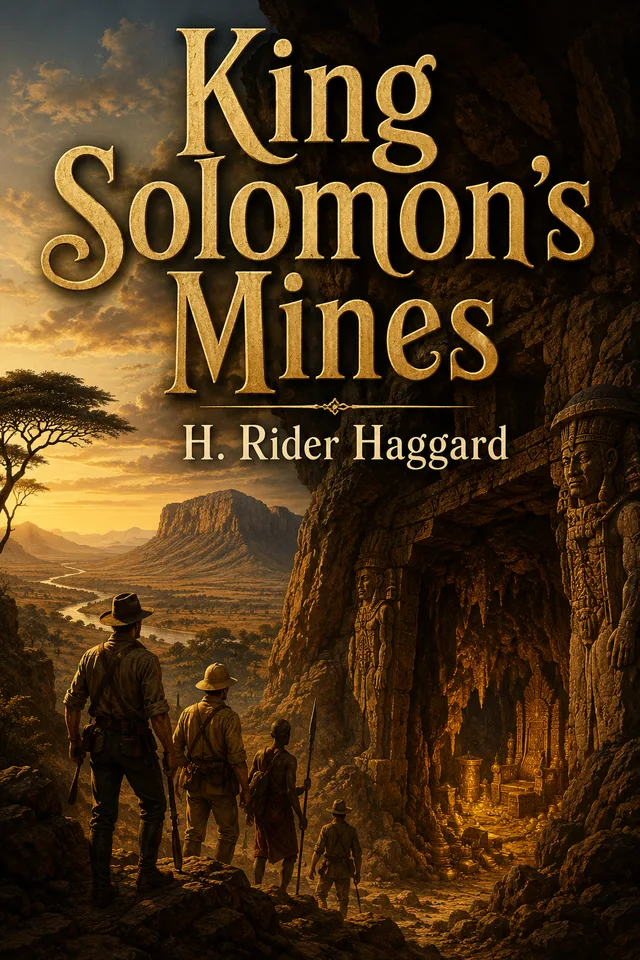
English Edition
Literature
King Solomon's Mines
English BooksWhale Edition by H. Rider Haggard
Allan Quatermain leads an expedition through peril, legend, and lost kingship in Haggard's adventure romance.
- Preview
- A sample from the prepared text
- Formats
- Online reader, EPUB, PDF
- Access
- Library claim
Book introduction
King Solomon's Mines
King Solomon's Mines sends Allan Quatermain, Sir Henry Curtis, and Captain Good into the interior of Africa in search of a missing man and a fabled treasure. H. Rider Haggard's novel helped define the lost-world adventure, combining dangerous travel, dynastic conflict, and Victorian romance of exploration.
BooksWhale edition
How this edition was prepared
This edition is based on a public domain text and has been prepared for digital reading by BooksWhale.
Public domain basis
Why this edition can be shared
H. Rider Haggard died in 1925, and King Solomon's Mines was first published in 1885. These dates support the public-domain basis for this English original-language edition.
Read preview
A sample from the prepared text
Preview selected from the prepared reader text.
Preview chapterFull textRead preview
King Solomon's Mines
Preview chapterINTRODUCTIONPreview
Now that this book is printed, and about to be given to the world, a sense of its shortcomings both in style and contents, weighs very heavily upon me. As regards the latter, I can only say that it does not pretend to be a full account of everything we did and saw. There are many things connected with our journey into Kukuanaland that I should have liked to dwell upon at length, which, as it is, have been scarcely alluded to. Amongst these are the curious legends which I collected about the chain armour that saved us from destruction in the great battle of Loo, and also about the “Silent Ones” or Colossi at the mouth of the stalactite cave. Again, if I had given way to my own impulses, I should have wished to go into the differences, some of which are to my mind very suggestive, between the Zulu and Kukuana dialects. Also a few pages might have been given up profitably to the consideration of the indigenous flora and fauna of Kukuanaland.[1] Then there remains the most interesting subject—that, as it is, has only been touched on incidentally—of the magnificent system of military organisation in force in that country, which, in my opinion, is much superior to that inaugurated by Chaka in Zululand, inasmuch as it permits of even more rapid mobilisation, and does not necessitate the employment of the pernicious system of enforced celibacy. Lastly, I have scarcely spoken of the domestic and family customs of the Kukuanas, many of which are exceedingly quaint, or of their proficiency in the art of smelting and welding metals. This science they carry to considerable perfection, of which a good example is to be seen in their “tollas,” or heavy throwing knives, the backs of these weapons being made of hammered iron, and the edges of beautiful steel welded with great skill on to the iron frames. The fact of the matter is, I thought, with Sir Henry Curtis and Captain Good, that the best plan would be to tell my story in a plain, straightforward manner, and to leave these matters to be dealt with subsequently in whatever way ultimately may appear to be desirable. In the meanwhile I shall, of course, be delighted to give all information in my power to anybody interested in such things.
And now it only remains for me to offer apologies for my blunt way of writing. I can but say in excuse of it that I am more accustomed to handle a rifle than a pen, and cannot make any pretence to the grand literary flights and flourishes which I see in novels—for sometimes I like to read a novel. I suppose they—the flights and flourishes—are desirable, and I regret not being able to supply them; but at the same time I cannot help thinking that simple things are always the most impressive, and that books are easier to understand when they are written in plain language, though perhaps I have no right to set up an opinion on such a matter. “A sharp spear,” runs the Kukuana saying, “needs no polish”; and on the same principle I venture to hope that a true story, however strange it may be, does not require to be decked out in fine words.
ALLAN QUATERMAIN.
KING SOLOMON’S MINES
Preview chapterCHAPTER I. I MEET SIR HENRY CURTISPreview
It is a curious thing that at my age—fifty-five last birthday—I should find myself taking up a pen to try to write a history. I wonder what sort of a history it will be when I have finished it, if ever I come to the end of the trip! I have done a good many things in my life, which seems a long one to me, owing to my having begun work so young, perhaps. At an age when other boys are at school I was earning my living as a trader in the old Colony. I have been trading, hunting, fighting, or mining ever since. And yet it is only eight months ago that I made my pile. It is a big pile now that I have got it—I don’t yet know how big—but I do not think I would go through the last fifteen or sixteen months again for it; no, not if I knew that I should come out safe at the end, pile and all. But then I am a timid man, and dislike violence; moreover, I am almost sick of adventure. I wonder why I am going to write this book: it is not in my line. I am not a literary man, though very devoted to the Old Testament and also to the “Ingoldsby Legends.” Let me try to set down my reasons, just to see if I have any.
First reason: Because Sir Henry Curtis and Captain John Good asked me.
Second reason: Because I am laid up here at Durban with the pain in my left leg. Ever since that confounded lion got hold of me I have been liable to this trouble, and being rather bad just now, it makes me limp more than ever. There must be some poison in a lion’s teeth, otherwise how is it that when your wounds are healed they break out again, generally, mark you, at the same time of year that you got your mauling? It is a hard thing when one has shot sixty-five lions or more, as I have in the course of my life, that the sixty-sixth should chew your leg like a quid of tobacco. It breaks the routine of the thing, and putting other considerations aside, I am an orderly man and don’t like that. This is by the way.
Third reason: Because I want my boy Harry, who is over there at the hospital in London studying to become a doctor, to have something to amuse him and keep him out of mischief for a week or so. Hospital work must sometimes pall and grow rather dull, for even of cutting up dead bodies there may come satiety, and as this history will not be dull, whatever else it may be, it will put a little life into things for a day or two while Harry is reading of our adventures.
Fourth reason and last: Because I am going to tell the strangest story that I remember. It may seem a queer thing to say, especially considering that there is no woman in it—except Foulata. Stop, though! there is Gagaoola, if she was a woman, and not a fiend. But she was a hundred at least, and therefore not marriageable, so I don’t count her. At any rate, I can safely say that there is not a _petticoat_ in the whole history.
Well, I had better come to the yoke. It is a stiff place, and I feel as though I were bogged up to the axle. But, “_sutjes, sutjes_,” as the Boers say—I am sure I don’t know how they spell it—softly does it. A strong team will come through at last, that is, if they are not too poor. You can never do anything with poor oxen. Now to make a start.
I, Allan Quatermain, of Durban, Natal, Gentleman, make oath and say—That’s how I headed my deposition before the magistrate about poor Khiva’s and Ventvögel’s sad deaths; but somehow it doesn’t seem quite the right way to begin a book. And, besides, am I a gentleman? What is a gentleman? I don’t quite know, and yet I have had to do with niggers—no, I will scratch out that word “niggers,” for I do not like it. I’ve known natives who _are_, and so you will say, Harry, my boy, before you have done with this tale, and I have known mean whites with lots of money and fresh out from home, too, who _are not_.
Table of contents
Inside this edition
- 01Full text
- 02INTRODUCTION
- 03CHAPTER I. I MEET SIR HENRY CURTIS
- 04CHAPTER II. THE LEGEND OF SOLOMON’S MINES
- 05CHAPTER III. UMBOPA ENTERS OUR SERVICE
- 06CHAPTER IV. AN ELEPHANT HUNT
- 07CHAPTER V. OUR MARCH INTO THE DESERT
- 08CHAPTER VI. WATER! WATER!
- 09CHAPTER VII. SOLOMON’S ROAD
- 10CHAPTER VIII. WE ENTER KUKUANALAND
- 11CHAPTER IX. TWALA THE KING
- 12CHAPTER X. THE WITCH-HUNT
- 13CHAPTER XI. WE GIVE A SIGN
- 14CHAPTER XII. BEFORE THE BATTLE
- 15CHAPTER XIII. THE ATTACK
- 16CHAPTER XIV. THE LAST STAND OF THE GREYS
- 17CHAPTER XV. GOOD FALLS SICK
- 18CHAPTER XVI. THE PLACE OF DEATH
- 19CHAPTER XVII. SOLOMON’S TREASURE CHAMBER
- 20CHAPTER XVIII. WE ABANDON HOPE
- 21CHAPTER XIX. IGNOSI’S FAREWELL
- 22CHAPTER XX. FOUND
Language availability
Other languages
Additional language editions are not published yet. This section will link to other BooksWhale editions when they become available.
Request another language