English Edition
Literature
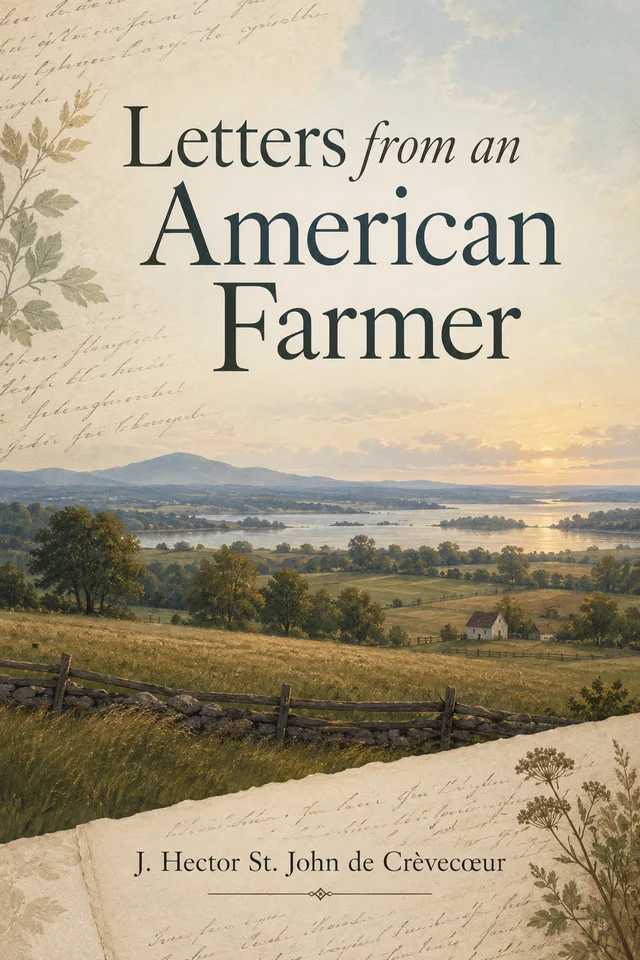
Letters from an American Farmer
English BooksWhale Edition by J. Hector St. John de Crèvecœur
A foundational portrait of early American identity, farming, immigration, slavery, and revolution.
- Preview
- A sample from the prepared text
- Formats
- Online reader, EPUB, PDF
- Access
- Library claim
Book introduction
Letters from an American Farmer
Letters from an American Farmer helped shape the question of American identity through essays on rural life, religious diversity, slavery, settlement, and revolutionary upheaval. This edition targets early American literature, Atlantic history, and Enlightenment travel prose.
BooksWhale edition
How this edition was prepared
This edition is based on a public domain text and has been prepared for digital reading by BooksWhale.
Public domain basis
Why this edition can be shared
J. Hector St. John de Crèvecœur died in 1813, and Letters from an American Farmer was first published in 1782. These dates support the public-domain basis for this original English edition.
Read preview
A sample from the prepared text
Preview selected from the prepared reader text.
Preview chapterFull textRead preview
Letters from an American Farmer
J. Hector St. John de Crèvecœur
Preview chapterLETTER I: INTRODUCTIONPreview
Who would have thought that because I received you with hospitality
and kindness, you should imagine me capable of writing with
propriety and perspicuity? Your gratitude misleads your judgment.
The knowledge which I acquired from your conversation has amply
repaid me for your five weeks' entertainment. I gave you nothing
more than what common hospitality dictated; but could any other
guest have instructed me as you did? You conducted me, on the map,
from one European country to another; told me many extraordinary
things of our famed mother-country, of which I knew very little; of
its internal navigation, agriculture, arts, manufactures, and trade:
you guided me through an extensive maze, and I abundantly profited
by the journey; the contrast therefore proves the debt of gratitude
to be on my side. The treatment you received at my house proceeded
from the warmth of my heart, and from the corresponding sensibility
of my wife; what you now desire must flow from a very limited power
of mind: the task requires recollection, and a variety of talents
which I do not possess. It is true I can describe our American modes
of farming, our manners, and peculiar customs, with some degree of
propriety, because I have ever attentively studied them; but my
knowledge extends no farther. And is this local and unadorned
information sufficient to answer all your expectations, and to
satisfy your curiosity? I am surprised that in the course of your
American travels you should not have found out persons more
enlightened and better educated than I am; your predilection excites
my wonder much more than my vanity; my share of the latter being
confined merely to the neatness of my rural operations.
My father left me a few musty books, which his father brought from
England with him; but what help can I draw from a library consisting
mostly of Scotch Divinity, the Navigation of Sir Francis Drake, the
History of Queen Elizabeth, and a few miscellaneous volumes? Our
minister often comes to see me, though he lives upwards of twenty
miles distant. I have shown him your letter, asked his advice, and
solicited his assistance; he tells me, that he hath no time to
spare, for that like the rest of us must till his farm, and is
moreover to study what he is to say on the sabbath. My wife (and I
never do anything without consulting her) laughs, and tells me that
you cannot be in earnest. What! says she, James, wouldst thee
pretend to send epistles to a great European man, who hath lived
abundance of time in that big house called Cambridge; where, they
say, that worldly learning is so abundant, that people gets it only
by breathing the air of the place? Wouldst not thee be ashamed to
write unto a man who has never in his life done a single day's work,
no, not even felled a tree; who hath expended the Lord knows how
many years in studying stars, geometry, stones, and flies, and in
reading folio books? Who hath travelled, as he told us, to the city
of Rome itself! Only think of a London man going to Rome! Where is
it that these English folks won't go? One who hath seen the factory
of brimstone at Suvius, and town of Pompey under ground! wouldst
thou pretend to letter it with a person who hath been to Paris, to
the Alps, to Petersburg, and who hath seen so many fine things up
and down the old countries; who hath come over the great sea unto
us, and hath journeyed from our New Hampshire in the East to our
Charles Town in the South; who hath visited all our great cities,
knows most of our famous lawyers and cunning folks; who hath
conversed with very many king's men, governors, and counsellors, and
yet pitches upon thee for his correspondent, as thee calls it?
Preview chapterLETTER II: ON THE SITUATION, FEELINGS, AND PLEASURES, OF AN AMERICAN FARMERPreview
As you are the first enlightened European I have ever had the
pleasure of being acquainted with, you will not be surprised that I
should, according to your earnest desire and my promise, appear
anxious of preserving your friendship and correspondence. By your
accounts, I observe a material difference subsists between your
husbandry, modes, and customs, and ours; everything is local; could
we enjoy the advantages of the English farmer, we should be much
happier, indeed, but this wish, like many others, implies a
contradiction; and could the English farmer have some of those
privileges we possess, they would be the first of their class in the
world. Good and evil I see is to be found in all societies, and it
is in vain to seek for any spot where those ingredients are not
mixed. I therefore rest satisfied, and thank God that my lot is to
be an American farmer, instead of a Russian boor, or an Hungarian
peasant. I thank you kindly for the idea, however dreadful, which
you have given me of their lot and condition; your observations have
confirmed me in the justness of my ideas, and I am happier now than
I thought myself before. It is strange that misery, when viewed in
others, should become to us a sort of real good, though I am far
from rejoicing to hear that there are in the world men so thoroughly
wretched; they are no doubt as harmless, industrious, and willing to
work as we are. Hard is their fate to be thus condemned to a slavery
worse than that of our negroes. Yet when young I entertained some
thoughts of selling my farm. I thought it afforded but a dull
repetition of the same labours and pleasures. I thought the former
tedious and heavy, the latter few and insipid; but when I came to
consider myself as divested of my farm, I then found the world so
wide, and every place so full, that I began to fear lest there would
be no room for me. My farm, my house, my barn, presented to my
imagination objects from which I adduced quite new ideas; they were
more forcible than before. Why should not I find myself happy, said
I, where my father was before? He left me no good books it is true,
he gave me no other education than the art of reading and writing;
but he left me a good farm, and his experience; he left me free from
debts, and no kind of difficulties to struggle with.--I married, and
this perfectly reconciled me to my situation; my wife rendered my
house all at once cheerful and pleasing; it no longer appeared
gloomy and solitary as before; when I went to work in my fields I
worked with more alacrity and sprightliness; I felt that I did not
work for myself alone, and this encouraged me much. My wife would
often come with her knitting in her hand, and sit under the shady
trees, praising the straightness of my furrows, and the docility of
my horses; this swelled my heart and made everything light and
pleasant, and I regretted that I had not married before.
I felt myself happy in my new situation, and where is that station
which can confer a more substantial system of felicity than that of
an American farmer, possessing freedom of action, freedom of
thoughts, ruled by a mode of government which requires but little
from us? I owe nothing, but a pepper corn to my country, a small
tribute to my king, with loyalty and due respect; I know no other
landlord than the lord of all land, to whom I owe the most sincere
gratitude. My father left me three hundred and seventy-one acres of
land, forty-seven of which are good timothy meadow, an excellent
orchard, a good house, and a substantial barn. It is my duty to
Table of contents
Inside this edition
- 01Full text
- 02LETTER I: INTRODUCTION
- 03LETTER II: ON THE SITUATION, FEELINGS, AND PLEASURES, OF AN AMERICAN FARMER
- 04LETTER III: WHAT IS AN AMERICAN
- 05LETTER IV: DESCRIPTION OF THE ISLAND OF NANTUCKET, WITH THE MANNERS, CUSTOMS, POLICY, AND TRADE OF THE INHABITANTS
- 06LETTER V: CUSTOMARY EDUCATION AND EMPLOYMENT OF THE INHABITANTS OF NANTUCKET
- 07LETTER VI: DESCRIPTION OF THE ISLAND OF MARTHA'S VINEYARD; AND OF THE WHALE FISHERY
- 08LETTER VII: MANNERS AND CUSTOMS AT NANTUCKET
- 09LETTER VIII: PECULIAR CUSTOMS AT NANTUCKET
- 10LETTER IX: DESCRIPTION OF CHARLES-TOWN; THOUGHTS ON SLAVERY; ON PHYSICAL EVIL; A MELANCHOLY SCENE
- 11LETTER X: ON SNAKES; AND ON THE HUMMING BIRD
- 12LETTER XI: FROM MR. IW--N AL--Z, A RUSSIAN GENTLEMAN; DESCRIBING THE VISIT HE PAID AT MY REQUEST TO MR. JOHN BERTRAM, THE CELEBRATED PENNSYLVANIAN BOTANIST
- 13LETTER XII: DISTRESSES OF A FRONTIER MAN
Language availability
Other languages
Additional language editions are not published yet. This section will link to other BooksWhale editions when they become available.
Request another language