English Edition
Literature
Lilith
English BooksWhale Edition by George MacDonald
A visionary fantasy novel of dreams, death, spiritual awakening, and mythic transformation.
- Preview
- A sample from the prepared text
- Formats
- Online reader, EPUB, PDF
- Access
- Library claim
Book introduction
Lilith
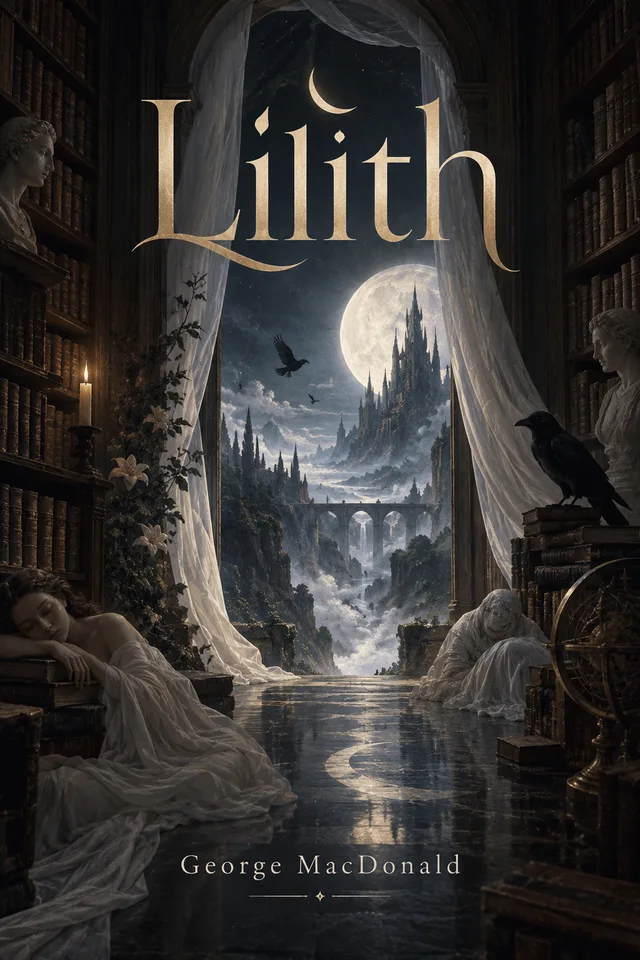
Lilith sends Mr. Vane through a mysterious library into a dreamlike world of ravens, sleepers, children, and spiritual trials. George MacDonald’s late masterpiece helped shape modern fantasy with its symbolic landscapes, Christian imagination, and strange inward adventure.
BooksWhale edition
How this edition was prepared
This edition is based on a public domain text and has been prepared for digital reading by BooksWhale.
Public domain basis
Why this edition can be shared
George MacDonald died in 1905, and Lilith was first published in 1895, supporting the public-domain basis for this English original edition.
Read preview
A sample from the prepared text
Preview selected from the prepared reader text.
Preview chapterFull textRead preview
Lilith
George MacDonald
I took a walk on Spaulding’s Farm the other afternoon. I saw the setting sun lighting up the opposite side of a stately pine wood. Its golden rays straggled into the aisles of the wood as into some noble hall. I was impressed as if some ancient and altogether admirable and shining family had settled there in that part of the land called Concord, unknown to me,--to whom the sun was servant,--who had not gone into society in the village,--who had not been called on. I saw their park, their pleasure-ground, beyond through the wood, in Spaulding’s cranberry-meadow. The pines furnished them with gables as they grew. Their house was not obvious to vision; their trees grew through it. I do not know whether I heard the sounds of a suppressed hilarity or not. They seemed to recline on the sunbeams. They have sons and daughters. They are quite well. The farmer’s cart-path, which leads directly through their hall, does not in the least put them out,--as the muddy bottom of a pool is sometimes seen through the reflected skies. They never heard of Spaulding, and do not know that he is their neighbor,--notwithstanding I heard him whistle as he drove his team through the house. Nothing can equal the serenity of their lives. Their coat of arms is simply a lichen. I saw it painted on the pines and oaks. Their attics were in the tops of the trees. They are of no politics.
There was no noise of labor. I did not perceive that they were weaving or spinning. Yet I did detect, when the wind lulled and hearing was done away, the finest imaginable sweet musical hum,--as of a distant hive in May, which perchance was the sound of their thinking. They had no idle thoughts, and no one without could see their work, for their industry was not as in knots and excrescences embayed.
But I find it difficult to remember them. They fade irrevocably out of my mind even now while I speak and endeavor to recall them, and recollect myself. It is only after a long and serious effort to recollect my best thoughts that I become again aware of their cohabitancy. If it were not for such families as this, I think I should move out of Concord.
Thoreau: “WALKING.”
Preview chapterCHAPTER I. THE LIBRARYPreview
I had just finished my studies at Oxford, and was taking a brief holiday from work before assuming definitely the management of the estate. My father died when I was yet a child; my mother followed him within a year; and I was nearly as much alone in the world as a man might find himself.
I had made little acquaintance with the history of my ancestors. Almost the only thing I knew concerning them was, that a notable number of them had been given to study. I had myself so far inherited the tendency as to devote a good deal of my time, though, I confess, after a somewhat desultory fashion, to the physical sciences. It was chiefly the wonder they woke that drew me. I was constantly seeing, and on the outlook to see, strange analogies, not only between the facts of different sciences of the same order, or between physical and metaphysical facts, but between physical hypotheses and suggestions glimmering out of the metaphysical dreams into which I was in the habit of falling. I was at the same time much given to a premature indulgence of the impulse to turn hypothesis into theory. Of my mental peculiarities there is no occasion to say more.
The house as well as the family was of some antiquity, but no description of it is necessary to the understanding of my narrative. It contained a fine library, whose growth began before the invention of printing, and had continued to my own time, greatly influenced, of course, by changes of taste and pursuit. Nothing surely can more impress upon a man the transitory nature of possession than his succeeding to an ancient property! Like a moving panorama mine has passed from before many eyes, and is now slowly flitting from before my own.
The library, although duly considered in many alterations of the house and additions to it, had nevertheless, like an encroaching state, absorbed one room after another until it occupied the greater part of the ground floor. Its chief room was large, and the walls of it were covered with books almost to the ceiling; the rooms into which it overflowed were of various sizes and shapes, and communicated in modes as various--by doors, by open arches, by short passages, by steps up and steps down.
In the great room I mainly spent my time, reading books of science, old as well as new; for the history of the human mind in relation to supposed knowledge was what most of all interested me. Ptolemy, Dante, the two Bacons, and Boyle were even more to me than Darwin or Maxwell, as so much nearer the vanished van breaking into the dark of ignorance.
In the evening of a gloomy day of August I was sitting in my usual place, my back to one of the windows, reading. It had rained the greater part of the morning and afternoon, but just as the sun was setting, the clouds parted in front of him, and he shone into the room. I rose and looked out of the window. In the centre of the great lawn the feathering top of the fountain column was filled with his red glory. I turned to resume my seat, when my eye was caught by the same glory on the one picture in the room--a portrait, in a sort of niche or little shrine sunk for it in the expanse of book-filled shelves. I knew it as the likeness of one of my ancestors, but had never even wondered why it hung there alone, and not in the gallery, or one of the great rooms, among the other family portraits. The direct sunlight brought out the painting wonderfully; for the first time I seemed to see it, and for the first time it seemed to respond to my look. With my eyes full of the light reflected from it, something, I cannot tell what, made me turn and cast a glance to the farther end of the room, when I saw, or seemed to see, a tall figure reaching up a hand to a bookshelf. The next instant, my vision apparently rectified by the comparative dusk, I saw no one, and concluded that my optic nerves had been momentarily affected from within.
Preview chapterCHAPTER II. THE MIRRORPreview
Nothing more happened for some days. I think it was about a week after, when what I have now to tell took place.
I had often thought of the manuscript fragment, and repeatedly tried to discover some way of releasing it, but in vain: I could not find out what held it fast.
But I had for some time intended a thorough overhauling of the books in the closet, its atmosphere causing me uneasiness as to their condition. One day the intention suddenly became a resolve, and I was in the act of rising from my chair to make a beginning, when I saw the old librarian moving from the door of the closet toward the farther end of the room. I ought rather to say only that I caught sight of something shadowy from which I received the impression of a slight, stooping man, in a shabby dress-coat reaching almost to his heels, the tails of which, disparting a little as he walked, revealed thin legs in black stockings, and large feet in wide, slipper-like shoes.
At once I followed him: I might be following a shadow, but I never doubted I was following something. He went out of the library into the hall, and across to the foot of the great staircase, then up the stairs to the first floor, where lay the chief rooms. Past these rooms, I following close, he continued his way, through a wide corridor, to the foot of a narrower stair leading to the second floor. Up that he went also, and when I reached the top, strange as it may seem, I found myself in a region almost unknown to me. I never had brother or sister to incite to such romps as make children familiar with nook and cranny; I was a mere child when my guardian took me away; and I had never seen the house again until, about a month before, I returned to take possession.
Through passage after passage we came to a door at the bottom of a winding wooden stair, which we ascended. Every step creaked under my foot, but I heard no sound from that of my guide. Somewhere in the middle of the stair I lost sight of him, and from the top of it the shadowy shape was nowhere visible. I could not even imagine I saw him. The place was full of shadows, but he was not one of them.
I was in the main garret, with huge beams and rafters over my head, great spaces around me, a door here and there in sight, and long vistas whose gloom was thinned by a few lurking cobwebbed windows and small dusky skylights. I gazed with a strange mingling of awe and pleasure: the wide expanse of garret was my own, and unexplored!
In the middle of it stood an unpainted inclosure of rough planks, the door of which was ajar. Thinking Mr. Raven might be there, I pushed the door, and entered.
The small chamber was full of light, but such as dwells in places deserted: it had a dull, disconsolate look, as if it found itself of no use, and regretted having come. A few rather dim sunrays, marking their track through the cloud of motes that had just been stirred up, fell upon a tall mirror with a dusty face, old-fashioned and rather narrow--in appearance an ordinary glass. It had an ebony frame, on the top of which stood a black eagle, with outstretched wings, in his beak a golden chain, from whose end hung a black ball.
I had been looking at rather than into the mirror, when suddenly I became aware that it reflected neither the chamber nor my own person. I have an impression of having seen the wall melt away, but what followed is enough to account for any uncertainty:--could I have mistaken for a mirror the glass that protected a wonderful picture?
Table of contents
Inside this edition
- 01Full text
- 02CHAPTER I. THE LIBRARY
- 03CHAPTER II. THE MIRROR
- 04CHAPTER III. THE RAVEN
- 05CHAPTER IV. SOMEWHERE OR NOWHERE?
- 06CHAPTER V. THE OLD CHURCH
- 07CHAPTER VI. THE SEXTON’S COTTAGE
- 08CHAPTER VII. THE CEMETERY
- 09CHAPTER VIII. MY FATHER’S MANUSCRIPT
- 10CHAPTER IX. I REPENT
- 11CHAPTER X. THE BAD BURROW
- 12CHAPTER XI. THE EVIL WOOD
- 13CHAPTER XII. FRIENDS AND FOES
- 14CHAPTER XIII. THE LITTLE ONES
- 15CHAPTER XIV. A CRISIS
- 16CHAPTER XV. A STRANGE HOSTESS
- 17CHAPTER XVI. A GRUESOME DANCE
- 18CHAPTER XVII. A GROTESQUE TRAGEDY
- 19CHAPTER XVIII. DEAD OR ALIVE?
- 20CHAPTER XIX. THE WHITE LEECH
- 21CHAPTER XX. GONE!--BUT HOW?
- 22CHAPTER XXI. THE FUGITIVE MOTHER
- 23CHAPTER XXII. BULIKA
- 24CHAPTER XXIII. A WOMAN OF BULIKA
- 25CHAPTER XXIV. THE WHITE LEOPARDESS
- 26CHAPTER XXV. THE PRINCESS
- 27CHAPTER XXVI. A BATTLE ROYAL
- 28CHAPTER XXVII. THE SILENT FOUNTAIN
- 29CHAPTER XXVIII. I AM SILENCED
- 30CHAPTER XXIX. THE PERSIAN CAT
- 31CHAPTER XXX. ADAM EXPLAINS
- 32CHAPTER XXXI. THE SEXTON’S OLD HORSE
- 33CHAPTER XXXII. THE LOVERS AND THE BAGS
- 34CHAPTER XXXIII. LONA’S NARRATIVE
- 35CHAPTER XXXIV. PREPARATION
- 36Chapter XXXV. THE LITTLE ONES IN BULIKA
- 37CHAPTER XXXVI. MOTHER AND DAUGHTER
- 38CHAPTER XXXVII. THE SHADOW
- 39CHAPTER XXXVIII. TO THE HOUSE OF BITTERNESS
- 40CHAPTER XXXIX. THAT NIGHT
- 41CHAPTER XL. THE HOUSE OF DEATH
- 42CHAPTER XLI. I AM SENT
- 43CHAPTER XLII. I SLEEP THE SLEEP
- 44CHAPTER XLIII. THE DREAMS THAT CAME
- 45CHAPTER XLIV. THE WAKING
- 46CHAPTER XLV. THE JOURNEY HOME
- 47CHAPTER XLVI. THE CITY
- 48CHAPTER XLVII. THE “ENDLESS ENDING”
Language availability
Other languages
Additional language editions are not published yet. This section will link to other BooksWhale editions when they become available.
Request another language