English Edition
Literature
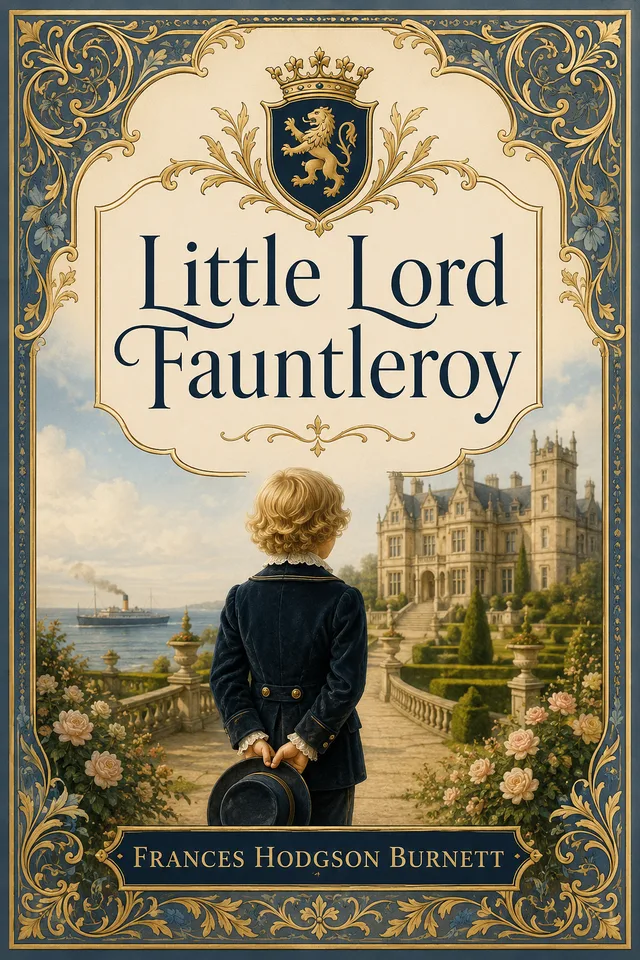
Little Lord Fauntleroy
English BooksWhale Edition by Frances Hodgson Burnett
A sentimental children’s classic about innocence, inheritance, class, and transatlantic family identity.
- Preview
- A sample from the prepared text
- Formats
- Online reader, EPUB, PDF
- Access
- Library claim
Book introduction
Little Lord Fauntleroy
“Little Lord Fauntleroy” follows young Cedric Errol from New York to an English aristocratic estate, where his kindness challenges pride and hierarchy. Burnett’s novel became a major children’s classic and a cultural emblem of childhood virtue.
BooksWhale edition
How this edition was prepared
This edition is based on a public domain text and has been prepared for digital reading by BooksWhale.
Public domain basis
Why this edition can be shared
Little Lord Fauntleroy is a public-domain work: the author died in 1924, and the text was first published in 1886. This edition uses the original English text.
Read preview
A sample from the prepared text
Preview selected from the prepared reader text.
Preview chapterFull textRead preview
Little Lord Fauntleroy
By Frances Hodgson Burnett
Cedric himself knew nothing whatever about it. It had never been even mentioned to him. He knew that his papa had been an Englishman, because his mamma had told him so; but then his papa had died when he was so little a boy that he could not remember very much about him, except that he was big, and had blue eyes and a long mustache, and that it was a splendid thing to be carried around the room on his shoulder. Since his papa's death, Cedric had found out that it was best not to talk to his mamma about him. When his father was ill, Cedric had been sent away, and when he had returned, everything was over; and his mother, who had been very ill, too, was only just beginning to sit in her chair by the window. She was pale and thin, and all the dimples had gone from her pretty face, and her eyes looked large and mournful, and she was dressed in black.
“Dearest,” said Cedric (his papa had called her that always, and so the little boy had learned to say it),--“dearest, is my papa better?”
He felt her arms tremble, and so he turned his curly head and looked in her face. There was something in it that made him feel that he was going to cry.
“Dearest,” he said, “is he well?”
Then suddenly his loving little heart told him that he'd better put both his arms around her neck and kiss her again and again, and keep his soft cheek close to hers; and he did so, and she laid her face on his shoulder and cried bitterly, holding him as if she could never let him go again.
“Yes, he is well,” she sobbed; “he is quite, quite well, but we--we have no one left but each other. No one at all.”
Then, little as he was, he understood that his big, handsome young papa would not come back any more; that he was dead, as he had heard of other people being, although he could not comprehend exactly what strange thing had brought all this sadness about. It was because his mamma always cried when he spoke of his papa that he secretly made up his mind it was better not to speak of him very often to her, and he found out, too, that it was better not to let her sit still and look into the fire or out of the window without moving or talking. He and his mamma knew very few people, and lived what might have been thought very lonely lives, although Cedric did not know it was lonely until he grew older and heard why it was they had no visitors. Then he was told that his mamma was an orphan, and quite alone in the world when his papa had married her. She was very pretty, and had been living as companion to a rich old lady who was not kind to her, and one day Captain Cedric Errol, who was calling at the house, saw her run up the stairs with tears on her eyelashes; and she looked so sweet and innocent and sorrowful that the Captain could not forget her. And after many strange things had happened, they knew each other well and loved each other dearly, and were married, although their marriage brought them the ill-will of several persons. The one who was most angry of all, however, was the Captain's father, who lived in England, and was a very rich and important old nobleman, with a very bad temper and a very violent dislike to America and Americans. He had two sons older than Captain Cedric; and it was the law that the elder of these sons should inherit the family title and estates, which were very rich and splendid; if the eldest son died, the next one would be heir; so, though he was a member of such a great family, there was little chance that Captain Cedric would be very rich himself.
Preview chapter“FAUNTLEROY.”Preview
“Mr. Hobbs always signed his letters that way,” said Fauntleroy; “and I thought I'd better say 'please.' Is that exactly the right way to spell 'interfered'?”
“It's not exactly the way it is spelled in the dictionary,” answered the Earl.
“I was afraid of that,” said Fauntleroy. “I ought to have asked. You see, that's the way with words of more than one syllable; you have to look in the dictionary. It's always safest. I'll write it over again.”
And write it over again he did, making quite an imposing copy, and taking precautions in the matter of spelling by consulting the Earl himself.
“Spelling is a curious thing,” he said. “It's so often different from what you expect it to be. I used to think 'please' was spelled p-l-e-e-s, but it isn't, you know; and you'd think 'dear' was spelled d-e-r-e, if you didn't inquire. Sometimes it almost discourages you.”
When Mr. Mordaunt went away, he took the letter with him, and he took something else with him also--namely, a pleasanter feeling and a more hopeful one than he had ever carried home with him down that avenue on any previous visit he had made at Dorincourt Castle.
When he was gone, Fauntleroy, who had accompanied him to the door, went back to his grandfather.
“May I go to Dearest now?” he asked. “I think she will be waiting for me.”
The Earl was silent a moment.
“There is something in the stable for you to see first,” he said. “Ring the bell.”
“If you please,” said Fauntleroy, with his quick little flush. “I'm very much obliged; but I think I'd better see it to-morrow. She will be expecting me all the time.”
“Very well,” answered the Earl. “We will order the carriage.” Then he added dryly, “It's a pony.”
Fauntleroy drew a long breath.
“A pony!” he exclaimed. “Whose pony is it?”
“Yours,” replied the Earl.
“Mine?” cried the little fellow. “Mine--like the things upstairs?”
“Yes,” said his grandfather. “Would you like to see it? Shall I order it to be brought around?”
Fauntleroy's cheeks grew redder and redder.
“I never thought I should have a pony!” he said. “I never thought that! How glad Dearest will be. You give me EVERYthing, don't you?”
“Do you wish to see it?” inquired the Earl.
Fauntleroy drew a long breath. “I WANT to see it,” he said. “I want to see it so much I can hardly wait. But I'm afraid there isn't time.”
“You MUST go and see your mother this afternoon?” asked the Earl. “You think you can't put it off?”
“Why,” said Fauntleroy, “she has been thinking about me all the morning, and I have been thinking about her!”
“Oh!” said the Earl. “You have, have you? Ring the bell.”
As they drove down the avenue, under the arching trees, he was rather silent. But Fauntleroy was not. He talked about the pony. What color was it? How big was it? What was its name? What did it like to eat best? How old was it? How early in the morning might he get up and see it?
“Dearest will be so glad!” he kept saying. “She will be so much obliged to you for being so kind to me! She knows I always liked ponies so much, but we never thought I should have one. There was a little boy on Fifth Avenue who had one, and he used to ride out every morning and we used to take a walk past his house to see him.”
He leaned back against the cushions and regarded the Earl with rapt interest for a few minutes and in entire silence.
“I think you must be the best person in the world,” he burst forth at last. “You are always doing good, aren't you?--and thinking about other people. Dearest says that is the best kind of goodness; not to think about yourself, but to think about other people. That is just the way you are, isn't it?”
Preview chapter“PROFESSOR DICK TIPTON CAN'T BE BEAT.”Preview
He stared at it so long that Dick began to take a lively interest in him, and when he had put the finishing touch to his customer's boots, he said:
“Want a shine, sir?”
The stout man came forward deliberately and put his foot on the rest.
“Yes,” he said.
Then when Dick fell to work, the stout man looked from Dick to the sign and from the sign to Dick.
“Where did you get that?” he asked.
“From a friend o' mine,” said Dick,--“a little feller. He guv' me the whole outfit. He was the best little feller ye ever saw. He's in England now. Gone to be one o' them lords.”
“Lord--Lord--” asked Mr. Hobbs, with ponderous slowness, “Lord Fauntleroy--Goin' to be Earl of Dorincourt?”
Dick almost dropped his brush.
“Why, boss!” he exclaimed, “d' ye know him yerself?”
“I've known him,” answered Mr. Hobbs, wiping his warm forehead, “ever since he was born. We was lifetime acquaintances--that's what WE was.”
It really made him feel quite agitated to speak of it. He pulled the splendid gold watch out of his pocket and opened it, and showed the inside of the case to Dick.
“'When this you see, remember me,'” he read. “That was his parting keepsake to me. 'I don't want you to forget me'--those was his words--I'd ha' remembered him,” he went on, shaking his head, “if he hadn't given me a thing an' I hadn't seen hide nor hair on him again. He was a companion as ANY man would remember.”
“He was the nicest little feller I ever see,” said Dick. “An' as to sand--I never seen so much sand to a little feller. I thought a heap o' him, I did,--an' we was friends, too--we was sort o' chums from the fust, that little young un an' me. I grabbed his ball from under a stage fur him, an' he never forgot it; an' he'd come down here, he would, with his mother or his nuss and he'd holler: 'Hello, Dick!' at me, as friendly as if he was six feet high, when he warn't knee high to a grasshopper, and was dressed in gal's clo'es. He was a gay little chap, and when you was down on your luck, it did you good to talk to him.”
“That's so,” said Mr. Hobbs. “It was a pity to make a earl out of HIM. He would have SHONE in the grocery business--or dry goods either; he would have SHONE!” And he shook his head with deeper regret than ever.
It proved that they had so much to say to each other that it was not possible to say it all at one time, and so it was agreed that the next night Dick should make a visit to the store and keep Mr. Hobbs company. The plan pleased Dick well enough. He had been a street waif nearly all his life, but he had never been a bad boy, and he had always had a private yearning for a more respectable kind of existence. Since he had been in business for himself, he had made enough money to enable him to sleep under a roof instead of out in the streets, and he had begun to hope he might reach even a higher plane, in time. So, to be invited to call on a stout, respectable man who owned a corner store, and even had a horse and wagon, seemed to him quite an event.
“Do you know anything about earls and castles?” Mr. Hobbs inquired. “I'd like to know more of the particklars.”
“There's a story about some on 'em in the Penny Story Gazette,” said Dick. “It's called the 'Crime of a Coronet; or, The Revenge of the Countess May.' It's a boss thing, too. Some of us boys 're takin' it to read.”
Table of contents
Inside this edition
- 01Full text
- 02“FAUNTLEROY.”
- 03“PROFESSOR DICK TIPTON CAN'T BE BEAT.”
- 04“DICK.”
- 05“SILAS HOBBS.”
Language availability
Other languages
Additional language editions are not published yet. This section will link to other BooksWhale editions when they become available.
Request another language