English Edition
Literature
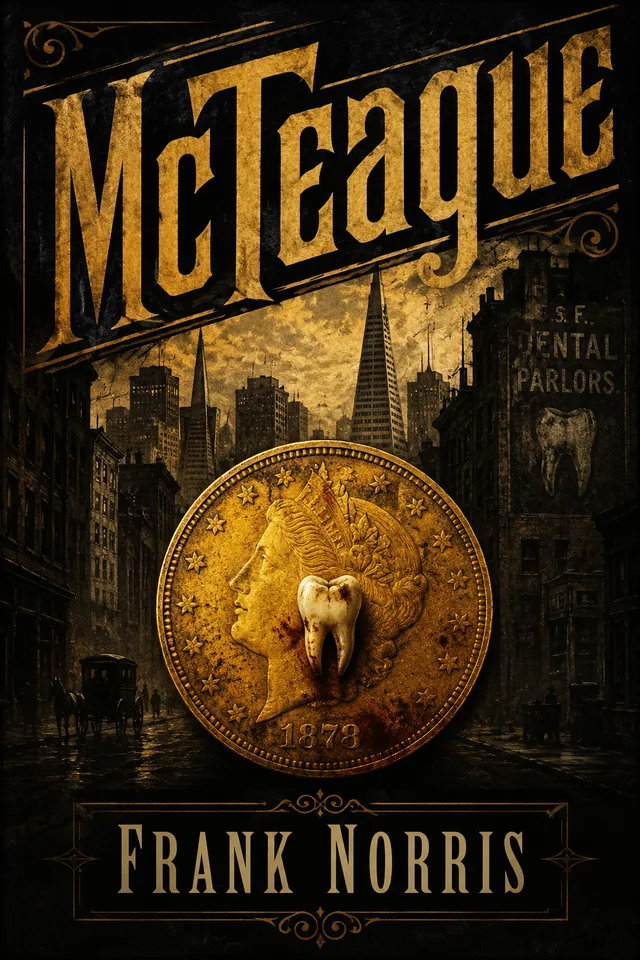
McTeague
English BooksWhale Edition by Frank Norris
A naturalist San Francisco novel of greed, marriage, obsession, money, violence, and decline.
- Preview
- A sample from the prepared text
- Formats
- Online reader, EPUB, PDF
- Access
- Library claim
Book introduction
McTeague
McTeague traces a dentist’s marriage to Trina, the lure of lottery wealth, and the slow hardening of desire into greed and violence. Frank Norris sets domestic realism against naturalist fatalism, using San Francisco streets, shops, rooms, and desert spaces to examine money, appetite, jealousy, social pressure, and moral collapse.
BooksWhale edition
How this edition was prepared
This edition is based on a public domain text and has been prepared for digital reading by BooksWhale.
Public domain basis
Why this edition can be shared
Frank Norris died in 1902, and McTeague was first published in 1899. These dates support the public-domain basis for this original-language edition.
Read preview
A sample from the prepared text
Preview selected from the prepared reader text.
Preview chapterFull textRead preview
McTeague
A Story of San Francisco
by Frank Norris
It was Sunday, and, according to his custom on that day, McTeague took his dinner at two in the afternoon at the car conductors' coffee-joint on Polk Street. He had a thick gray soup; heavy, underdone meat, very hot, on a cold plate; two kinds of vegetables; and a sort of suet pudding, full of strong butter and sugar. On his way back to his office, one block above, he stopped at Joe Frenna's saloon and bought a pitcher of steam beer. It was his habit to leave the pitcher there on his way to dinner.
Once in his office, or, as he called it on his signboard, “Dental Parlors,” he took off his coat and shoes, unbuttoned his vest, and, having crammed his little stove full of coke, lay back in his operating chair at the bay window, reading the paper, drinking his beer, and smoking his huge porcelain pipe while his food digested; crop-full, stupid, and warm. By and by, gorged with steam beer, and overcome by the heat of the room, the cheap tobacco, and the effects of his heavy meal, he dropped off to sleep. Late in the afternoon his canary bird, in its gilt cage just over his head, began to sing. He woke slowly, finished the rest of his beer--very flat and stale by this time--and taking down his concertina from the bookcase, where in week days it kept the company of seven volumes of “Allen's Practical Dentist,” played upon it some half-dozen very mournful airs.
McTeague looked forward to these Sunday afternoons as a period of relaxation and enjoyment. He invariably spent them in the same fashion. These were his only pleasures--to eat, to smoke, to sleep, and to play upon his concertina.
The six lugubrious airs that he knew, always carried him back to the time when he was a car-boy at the Big Dipper Mine in Placer County, ten years before. He remembered the years he had spent there trundling the heavy cars of ore in and out of the tunnel under the direction of his father. For thirteen days of each fortnight his father was a steady, hard-working shift-boss of the mine. Every other Sunday he became an irresponsible animal, a beast, a brute, crazy with alcohol.
McTeague remembered his mother, too, who, with the help of the Chinaman, cooked for forty miners. She was an overworked drudge, fiery and energetic for all that, filled with the one idea of having her son rise in life and enter a profession. The chance had come at last when the father died, corroded with alcohol, collapsing in a few hours. Two or three years later a travelling dentist visited the mine and put up his tent near the bunk-house. He was more or less of a charlatan, but he fired Mrs. McTeague's ambition, and young McTeague went away with him to learn his profession. He had learnt it after a fashion, mostly by watching the charlatan operate. He had read many of the necessary books, but he was too hopelessly stupid to get much benefit from them.
Then one day at San Francisco had come the news of his mother's death; she had left him some money--not much, but enough to set him up in business; so he had cut loose from the charlatan and had opened his “Dental Parlors” on Polk Street, an “accommodation street” of small shops in the residence quarter of the town. Here he had slowly collected a clientele of butcher boys, shop girls, drug clerks, and car conductors. He made but few acquaintances. Polk Street called him the “Doctor” and spoke of his enormous strength. For McTeague was a young giant, carrying his huge shock of blond hair six feet three inches from the ground; moving his immense limbs, heavy with ropes of muscle, slowly, ponderously. His hands were enormous, red, and covered with a fell of stiff yellow hair; they were hard as wooden mallets, strong as vises, the hands of the old-time car-boy. Often he dispensed with forceps and extracted a refractory tooth with his thumb and finger. His head was square-cut, angular; the jaw salient, like that of the carnivora.
Preview chapterCHAPTER 5Preview
Wednesday morning, Washington's Birthday, McTeague rose very early and shaved himself. Besides the six mournful concertina airs, the dentist knew one song. Whenever he shaved, he sung this song; never at any other time. His voice was a bellowing roar, enough to make the window sashes rattle. Just now he woke up all the lodgers in his hall with it. It was a lamentable wail:
“No one to love, none to caress, Left all alone in this world's wilderness.”
As he paused to strop his razor, Marcus came into his room, half-dressed, a startling phantom in red flannels.
Marcus often ran back and forth between his room and the dentist's “Parlors” in all sorts of undress. Old Miss Baker had seen him thus several times through her half-open door, as she sat in her room listening and waiting. The old dressmaker was shocked out of all expression. She was outraged, offended, pursing her lips, putting up her head. She talked of complaining to the landlady. “And Mr. Grannis right next door, too. You can understand how trying it is for both of us.” She would come out in the hall after one of these apparitions, her little false curls shaking, talking loud and shrill to any one in reach of her voice.
“Well,” Marcus would shout, “shut your door, then, if you don't want to see. Look out, now, here I come again. Not even a porous plaster on me this time.”
On this Wednesday morning Marcus called McTeague out into the hall, to the head of the stairs that led down to the street door.
“Come and listen to Maria, Mac,” said he.
Maria sat on the next to the lowest step, her chin propped by her two fists. The red-headed Polish Jew, the ragman Zerkow, stood in the doorway. He was talking eagerly.
“Now, just once more, Maria,” he was saying. “Tell it to us just once more.” Maria's voice came up the stairway in a monotone. Marcus and McTeague caught a phrase from time to time.
“There were more than a hundred pieces, and every one of them gold--just that punch-bowl was worth a fortune-thick, fat, red gold.”
“Get onto to that, will you?” observed Marcus. “The old skin has got her started on the plate. Ain't they a pair for you?”
“And it rang like bells, didn't it?” prompted Zerkow.
“Sweeter'n church bells, and clearer.”
“Ah, sweeter'n bells. Wasn't that punch-bowl awful heavy?”
“All you could do to lift it.”
“I know. Oh, I know,” answered Zerkow, clawing at his lips. “Where did it all go to? Where did it go?”
Maria shook her head.
“It's gone, anyhow.”
“Ah, gone, gone! Think of it! The punch-bowl gone, and the engraved ladle, and the plates and goblets. What a sight it must have been all heaped together!”
“It was a wonderful sight.”
“Yes, wonderful; it must have been.”
On the lower steps of that cheap flat, the Mexican woman and the red-haired Polish Jew mused long over that vanished, half-mythical gold plate.
Marcus and the dentist spent Washington's Birthday across the bay. The journey over was one long agony to McTeague. He shook with a formless, uncertain dread; a dozen times he would have turned back had not Marcus been with him. The stolid giant was as nervous as a schoolboy. He fancied that his call upon Miss Sieppe was an outrageous affront. She would freeze him with a stare; he would be shown the door, would be ejected, disgraced.
As they got off the local train at B Street station they suddenly collided with the whole tribe of Sieppes--the mother, father, three children, and Trina--equipped for one of their eternal picnics. They were to go to Schuetzen Park, within walking distance of the station. They were grouped about four lunch baskets. One of the children, a little boy, held a black greyhound by a rope around its neck. Trina wore a blue cloth skirt, a striped shirt waist, and a white sailor; about her round waist was a belt of imitation alligator skin.
Preview chapterCHAPTER 6Preview
No, Trina did not know. “Do I love him? Do I love him?” A thousand times she put the question to herself during the next two or three days. At night she hardly slept, but lay broad awake for hours in her little, gayly painted bed, with its white netting, torturing herself with doubts and questions. At times she remembered the scene in the station with a veritable agony of shame, and at other times she was ashamed to recall it with a thrill of joy. Nothing could have been more sudden, more unexpected, than that surrender of herself. For over a year she had thought that Marcus would some day be her husband. They would be married, she supposed, some time in the future, she did not know exactly when; the matter did not take definite shape in her mind. She liked Cousin Mark very well. And then suddenly this cross-current had set in; this blond giant had appeared, this huge, stolid fellow, with his immense, crude strength. She had not loved him at first, that was certain. The day he had spoken to her in his “Parlors” she had only been terrified. If he had confined himself to merely speaking, as did Marcus, to pleading with her, to wooing her at a distance, forestalling her wishes, showing her little attentions, sending her boxes of candy, she could have easily withstood him. But he had only to take her in his arms, to crush down her struggle with his enormous strength, to subdue her, conquer her by sheer brute force, and she gave up in an instant.
But why--why had she done so? Why did she feel the desire, the necessity of being conquered by a superior strength? Why did it please her? Why had it suddenly thrilled her from head to foot with a quick, terrifying gust of passion, the like of which she had never known? Never at his best had Marcus made her feel like that, and yet she had always thought she cared for Cousin Mark more than for any one else.
When McTeague had all at once caught her in his huge arms, something had leaped to life in her--something that had hitherto lain dormant, something strong and overpowering. It frightened her now as she thought of it, this second self that had wakened within her, and that shouted and clamored for recognition. And yet, was it to be feared? Was it something to be ashamed of? Was it not, after all, natural, clean, spontaneous? Trina knew that she was a pure girl; knew that this sudden commotion within her carried with it no suggestion of vice.
Dimly, as figures seen in a waking dream, these ideas floated through Trina's mind. It was quite beyond her to realize them clearly; she could not know what they meant. Until that rainy day by the shore of the bay Trina had lived her life with as little self-consciousness as a tree. She was frank, straightforward, a healthy, natural human being, without sex as yet. She was almost like a boy. At once there had been a mysterious disturbance. The woman within her suddenly awoke.
Did she love McTeague? Difficult question. Did she choose him for better or for worse, deliberately, of her own free will, or was Trina herself allowed even a choice in the taking of that step that was to make or mar her life? The Woman is awakened, and, starting from her sleep, catches blindly at what first her newly opened eyes light upon. It is a spell, a witchery, ruled by chance alone, inexplicable--a fairy queen enamored of a clown with ass's ears.
McTeague had awakened the Woman, and, whether she would or no, she was his now irrevocably; struggle against it as she would, she belonged to him, body and soul, for life or for death. She had not sought it, she had not desired it. The spell was laid upon her. Was it a blessing? Was it a curse? It was all one; she was his, indissolubly, for evil or for good.
Table of contents
Inside this edition
- 01Full text
- 02CHAPTER 5
- 03CHAPTER 6
- 04CHAPTER 7
- 05CHAPTER 8
- 06CHAPTER 9
- 07CHAPTER 10
- 08CHAPTER 11
- 09CHAPTER 12
- 10CHAPTER 13
- 11CHAPTER 14
- 12CHAPTER 15
- 13CHAPTER 16
- 14CHAPTER 17
- 15CHAPTER 18
- 16CHAPTER 19
- 17“NO.”
- 18CHAPTER 20
- 19CHAPTER 21
- 20CHAPTER 22
Language availability
Other languages
Additional language editions are not published yet. This section will link to other BooksWhale editions when they become available.
Request another language