English Edition
Literature
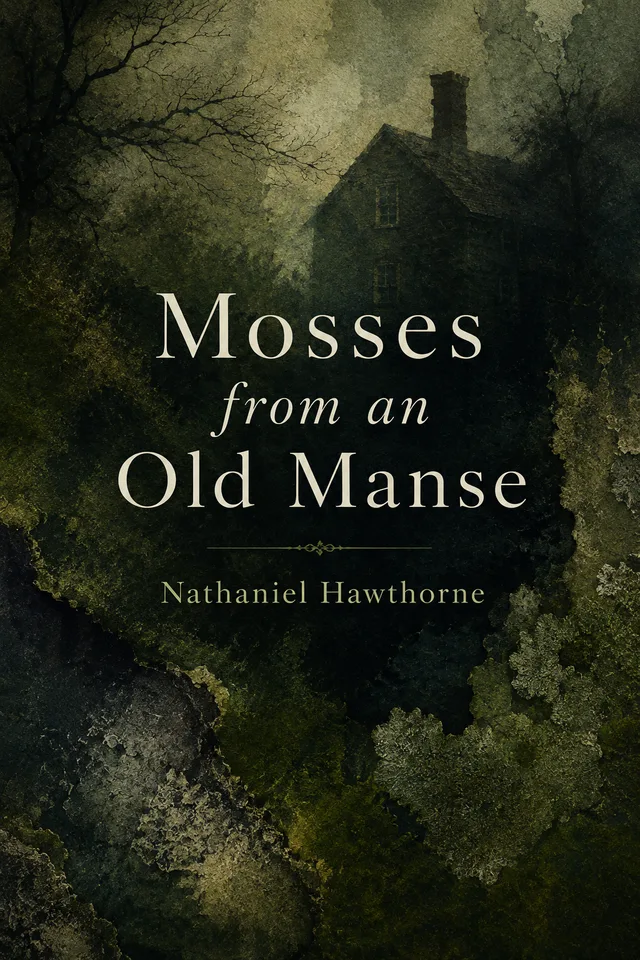
Mosses from an Old Manse
English BooksWhale Edition by Nathaniel Hawthorne
A major Hawthorne collection featuring allegorical tales, historical sketches, and psychological shadows.
- Preview
- A sample from the prepared text
- Formats
- Online reader, EPUB, PDF
- Access
- Library claim
Book introduction
Mosses from an Old Manse
“Mosses from an Old Manse” includes some of Hawthorne’s most powerful short works, blending romance, allegory, witchcraft memory, domestic unease, and moral ambiguity. It shows his mastery of symbolic American fiction.
BooksWhale edition
How this edition was prepared
This edition is based on a public domain text and has been prepared for digital reading by BooksWhale.
Public domain basis
Why this edition can be shared
Mosses from an Old Manse is a public-domain work: the author died in 1864, and the text was first published in 1846. This edition uses the original English text.
Read preview
A sample from the prepared text
Preview selected from the prepared reader text.
Preview chapterFull textRead preview
Mosses from an Old Manse
by Nathaniel Hawthorne
The Old Manse The Birthmark A Select Party Young Goodman Brown Rappaccini’s Daughter Mrs. Bullfrog Fire Worship Buds and Bird Voices Monsieur du Miroir The Hall of Fantasy The Celestial Railroad The Procession of Life Feathertop: A Moralized Legend The New Adam and Eve Egotism; or, The Bosom Serpent The Christmas Banquet Drowne’s Wooden Image The Intelligence Office Roger Malvin’s Burial P.’s Correspondence Earth’s Holocaust Passages from a Relinquished Work Sketches from Memory The Old Apple Dealer The Artist of the Beautiful A Virtuoso’s Collection
Preview chapterTHE OLD MANSEPreview
The Author makes the Reader acquainted with his Abode.
Between two tall gate-posts of rough-hewn stone (the gate itself having fallen from its hinges at some unknown epoch) we beheld the gray front of the old parsonage, terminating the vista of an avenue of black-ash trees. It was now a twelvemonth since the funeral procession of the venerable clergyman, its last inhabitant, had turned from that gateway towards the village burying-ground. The wheel-track leading to the door, as well as the whole breadth of the avenue, was almost overgrown with grass, affording dainty mouthfuls to two or three vagrant cows and an old white horse who had his own living to pick up along the roadside. The glimmering shadows that lay half asleep between the door of the house and the public highway were a kind of spiritual medium, seen through which the edifice had not quite the aspect of belonging to the material world. Certainly it had little in common with those ordinary abodes which stand so imminent upon the road that every passer-by can thrust his head, as it were, into the domestic circle. From these quiet windows the figures of passing travellers looked too remote and dim to disturb the sense of privacy. In its near retirement and accessible seclusion, it was the very spot for the residence of a clergyman,—a man not estranged from human life, yet enveloped, in the midst of it, with a veil woven of intermingled gloom and brightness. It was worthy to have been one of the time-honored parsonages of England, in which, through many generations, a succession of holy occupants pass from youth to age, and bequeath each an inheritance of sanctity to pervade the house and hover over it as with an atmosphere.
Nor, in truth, had the Old Manse ever been profaned by a lay occupant until that memorable summer afternoon when I entered it as my home. A priest had built it; a priest had succeeded to it; other priestly men from time to time had dwelt in it; and children born in its chambers had grown up to assume the priestly character. It was awful to reflect how many sermons must have been written there. The latest inhabitant alone—he by whose translation to paradise the dwelling was left vacant—had penned nearly three thousand discourses, besides the better, if not the greater, number that gushed living from his lips. How often, no doubt, had he paced to and fro along the avenue, attuning his meditations to the sighs and gentle murmurs and deep and solemn peals of the wind among the lofty tops of the trees! In that variety of natural utterances he could find something accordant with every passage of his sermon, were it of tenderness or reverential fear. The boughs over my head seemed shadowy with solemn thoughts, as well as with rustling leaves. I took shame to myself for having been so long a writer of idle stories, and ventured to hope that wisdom would descend upon me with the falling leaves of the avenue, and that I should light upon an intellectual treasure in the Old Manse well worth those hoards of long-hidden gold which people seek for in moss-grown houses. Profound treatises of morality; a layman’s unprofessional, and therefore unprejudiced, views of religion; histories (such as Bancroft might have written had he taken up his abode here, as he once purposed) bright with picture, gleaming over a depth of philosophic thought,—these were the works that might fitly have flowed from such a retirement. In the humblest event, I resolved at least to achieve a novel that should evolve some deep lesson, and should possess physical substance enough to stand alone.
In furtherance of my design, and as if to leave me no pretext for not fulfilling it, there was in the rear of the house the most delightful little nook of a study that ever afforded its snug seclusion to a scholar. It was here that Emerson wrote Nature; for he was then an inhabitant of the Manse, and used to watch the Assyrian dawn and Paphian sunset and moonrise from the summit of our eastern hill. When I first saw the room, its walls were blackened with the smoke of unnumbered years, and made still blacker by the grim prints of Puritan ministers that hung around. These worthies looked strangely like bad angels, or at least like men who had wrestled so continually and so sternly with the Devil that somewhat of his sooty fierceness had been imparted to their own visages. They had all vanished now; a cheerful coat of paint and golden-tinted paper-hangings lighted up the small apartment; while the shadow of a willow-tree that swept against the overhanging eaves atempered the cheery western sunshine. In place of the grim prints there was the sweet and lovely head of one of Raphael’s Madonnas, and two pleasant little pictures of the Lake of Como. The only other decorations were a purple vase of flowers, always fresh, and a bronze one containing graceful ferns. My books (few, and by no means choice; for they were chiefly such waifs as chance had thrown in my way) stood in order about the room, seldom to be disturbed.
Preview chapterTHE BIRTHMARKPreview
In the latter part of the last century there lived a man of science, an eminent proficient in every branch of natural philosophy, who not long before our story opens had made experience of a spiritual affinity more attractive than any chemical one. He had left his laboratory to the care of an assistant, cleared his fine countenance from the furnace smoke, washed the stain of acids from his fingers, and persuaded a beautiful woman to become his wife. In those days when the comparatively recent discovery of electricity and other kindred mysteries of Nature seemed to open paths into the region of miracle, it was not unusual for the love of science to rival the love of woman in its depth and absorbing energy. The higher intellect, the imagination, the spirit, and even the heart might all find their congenial aliment in pursuits which, as some of their ardent votaries believed, would ascend from one step of powerful intelligence to another, until the philosopher should lay his hand on the secret of creative force and perhaps make new worlds for himself. We know not whether Aylmer possessed this degree of faith in man’s ultimate control over Nature. He had devoted himself, however, too unreservedly to scientific studies ever to be weaned from them by any second passion. His love for his young wife might prove the stronger of the two; but it could only be by intertwining itself with his love of science, and uniting the strength of the latter to his own.
Such a union accordingly took place, and was attended with truly remarkable consequences and a deeply impressive moral. One day, very soon after their marriage, Aylmer sat gazing at his wife with a trouble in his countenance that grew stronger until he spoke.
“Georgiana,” said he, “has it never occurred to you that the mark upon your cheek might be removed?”
“No, indeed,” said she, smiling; but perceiving the seriousness of his manner, she blushed deeply. “To tell you the truth it has been so often called a charm that I was simple enough to imagine it might be so.”
“Ah, upon another face perhaps it might,” replied her husband; “but never on yours. No, dearest Georgiana, you came so nearly perfect from the hand of Nature that this slightest possible defect, which we hesitate whether to term a defect or a beauty, shocks me, as being the visible mark of earthly imperfection.”
“Shocks you, my husband!” cried Georgiana, deeply hurt; at first reddening with momentary anger, but then bursting into tears. “Then why did you take me from my mother’s side? You cannot love what shocks you!”
To explain this conversation it must be mentioned that in the centre of Georgiana’s left cheek there was a singular mark, deeply interwoven, as it were, with the texture and substance of her face. In the usual state of her complexion—a healthy though delicate bloom—the mark wore a tint of deeper crimson, which imperfectly defined its shape amid the surrounding rosiness. When she blushed it gradually became more indistinct, and finally vanished amid the triumphant rush of blood that bathed the whole cheek with its brilliant glow. But if any shifting motion caused her to turn pale there was the mark again, a crimson stain upon the snow, in what Aylmer sometimes deemed an almost fearful distinctness. Its shape bore not a little similarity to the human hand, though of the smallest pygmy size. Georgiana’s lovers were wont to say that some fairy at her birth hour had laid her tiny hand upon the infant’s cheek, and left this impress there in token of the magic endowments that were to give her such sway over all hearts. Many a desperate swain would have risked life for the privilege of pressing his lips to the mysterious hand. It must not be concealed, however, that the impression wrought by this fairy sign manual varied exceedingly, according to the difference of temperament in the beholders. Some fastidious persons—but they were exclusively of her own sex—affirmed that the bloody hand, as they chose to call it, quite destroyed the effect of Georgiana’s beauty, and rendered her countenance even hideous. But it would be as reasonable to say that one of those small blue stains which sometimes occur in the purest statuary marble would convert the Eve of Powers to a monster. Masculine observers, if the birthmark did not heighten their admiration, contented themselves with wishing it away, that the world might possess one living specimen of ideal loveliness without the semblance of a flaw. After his marriage,—for he thought little or nothing of the matter before,—Aylmer discovered that this was the case with himself.
Table of contents
Inside this edition
- 01Full text
- 02THE OLD MANSE
- 03THE BIRTHMARK
- 04A SELECT PARTY
- 05YOUNG GOODMAN BROWN
- 06RAPPACCINI’S DAUGHTER
- 07MRS. BULLFROG
- 08FIRE WORSHIP
- 09BUDS AND BIRD VOICES
- 10MONSIEUR DU MIROIR
- 11THE HALL OF FANTASY
- 12THE CELESTIAL RAILROAD
- 13THE PROCESSION OF LIFE
- 14FEATHERTOP: A MORALIZED LEGEND
- 15THE NEW ADAM AND EVE
- 16EGOTISM; OR, THE BOSOM SERPENT
- 17THE CHRISTMAS BANQUET
- 18FROM THE UNPUBLISHED “ALLEGORIES OF THE HEART.”
- 19DROWNE’S WOODEN IMAGE
- 20THE INTELLIGENCE OFFICE
- 21ROGER MALVIN’S BURIAL
- 22P.’S CORRESPONDENCE
- 23EARTH’S HOLOCAUST
- 24PASSAGES FROM A RELINQUISHED WORK
- 25AT HOME
- 26A FLIGHT IN THE FOG.
- 27A FELLOW-TRAVELLER.
- 28THE VILLAGE THEATRE
- 29SKETCHES FROM MEMORY
- 30THE NOTCH OF THE WHITE MOUNTAINS
- 31OUR EVENING PARTY AMONG THE MOUNTAINS
- 32THE CANAL-BOAT
- 33THE OLD APPLE DEALER
- 34THE ARTIST OF THE BEAUTIFUL
- 35A VIRTUOSO’S COLLECTION
Language availability
Other languages
Additional language editions are not published yet. This section will link to other BooksWhale editions when they become available.
Request another language