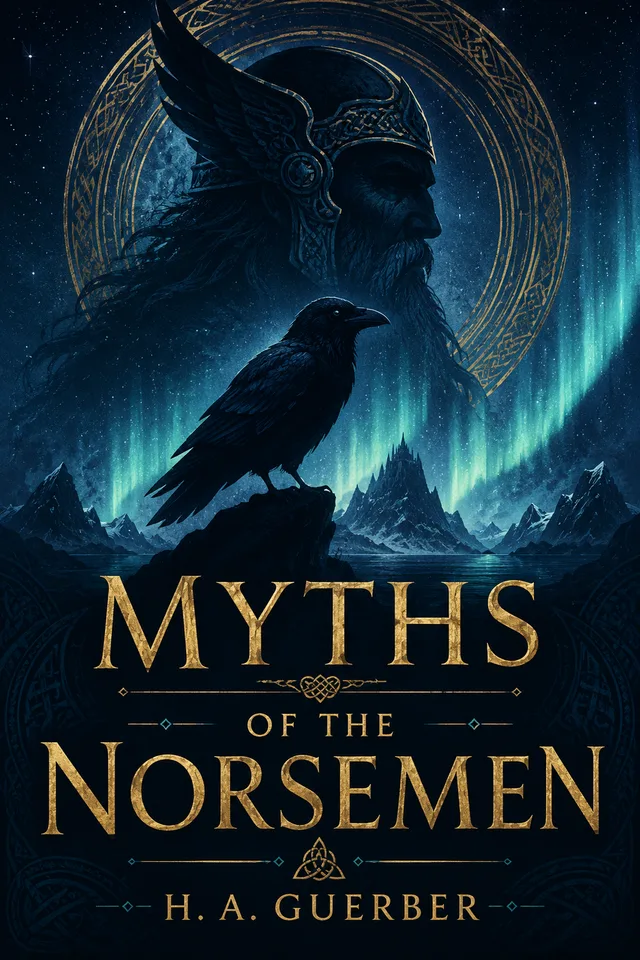
English Edition
Religion
Myths of the Norsemen
English BooksWhale Edition by H. A. Guerber
A public-domain classic on Norse gods, heroes, sagas, Valhalla, Ragnarok, folklore, and mythology.
- Preview
- A sample from the prepared text
- Formats
- Online reader, EPUB, PDF
- Access
- Library claim
Book introduction
Myths of the Norsemen
Myths of the Norsemen by H. A. Guerber remains a rewarding classic for readers interested in Norse gods, heroes, sagas, Valhalla, Ragnarok, folklore, and mythology. This English edition presents the original public-domain text in a clean BooksWhale format for online reading, EPUB, and PDF, with the work’s historical context and literary value kept clear.
BooksWhale edition
How this edition was prepared
This edition is based on a public domain text and has been prepared for digital reading by BooksWhale.
Public domain basis
Why this edition can be shared
Myths of the Norsemen was first published in 1909. This edition uses the public-domain English original text, with publication date and rights status supporting public-domain use.
Read preview
A sample from the prepared text
Preview selected from the prepared reader text.
Preview chapterFull textRead preview
Myths of the Norsemen
H. A. Guerber
Preview chapterPart 1Preview
From the Eddas and Sagas
By
H. A. Guerber
Author of "The Myths of Greece and Rome" etc.
London
George G. Harrap & Company
15 York Street Covent Garden
1909
Printed by Ballantyne & Co. Limited Tavistock Street, Covent Garden, London
CHAPTER I: THE BEGINNING
Myths of Creation
Although the Aryan inhabitants of Northern Europe are supposed by some authorities to have come originally from the plateau of Iran, in the heart of Asia, the climate and scenery of the countries where they finally settled had great influence in shaping their early religious beliefs, as well as in ordering their mode of living.
The grand and rugged landscapes of Northern Europe, the midnight sun, the flashing rays of the aurora borealis, the ocean continually lashing itself into fury against the great cliffs and icebergs of the Arctic Circle, could not but impress the people as vividly as the almost miraculous vegetation, the perpetual light, and the blue seas and skies of their brief summer season. It is no great wonder, therefore, that the Icelanders, for instance, to whom we owe the most perfect records of this belief, fancied in looking about them that the world was originally created from a strange mixture of fire and ice.
Northern mythology is grand and tragical. Its principal theme is the perpetual struggle of the beneficent forces of Nature against the injurious, and hence it is not graceful and idyllic in character, like the religion of the sunny South, where the people could bask in perpetual sunshine, and the fruits of the earth grew ready to their hand.
It was very natural that the dangers incurred in hunting and fishing under these inclement skies, and the suffering entailed by the long cold winters when the sun never shines, made our ancestors contemplate cold and ice as malevolent spirits; and it was with equal reason that they invoked with special fervour the beneficent influences of heat and light.
When questioned concerning the creation of the world, the Northern scalds, or poets, whose songs are preserved in the Eddas and Sagas, declared that in the beginning, when there was as yet no earth, nor sea, nor air, when darkness rested over all, there existed a powerful being called Allfather, whom they dimly conceived as uncreated as well as unseen, and that whatever he willed came to pass.
In the centre of space there was, in the morning of time, a great abyss called Ginnunga-gap, the cleft of clefts, the yawning gulf, whose depths no eye could fathom, as it was enveloped in perpetual twilight. North of this abode was a space or world known as Nifl-heim, the home of mist and darkness, in the centre of which bubbled the exhaustless spring Hvergelmir, the seething cauldron, whose waters supplied twelve great streams known as the Elivagar. As the water of these streams flowed swiftly away from its source and encountered the cold blasts from the yawning gulf, it soon hardened into huge blocks of ice, which rolled downward into the immeasurable depths of the great abyss with a continual roar like thunder.
South of this dark chasm, and directly opposite Nifl-heim, the realm of mist, was another world called Muspells-heim, the home of elemental fire, where all was warmth and brightness, and whose frontiers were continually guarded by Surtr, the flame giant. This giant fiercely brandished his flashing sword, and continually sent forth great showers of sparks, which fell with a hissing sound upon the ice-blocks in the bottom of the abyss, and partly melted them by their heat.
"Great Surtur, with his burning sword, Southward at Muspel's gate kept ward, And flashes of celestial flame, Life-giving, from the fire-world came."
Valhalla (J. C. Jones).
Ymir and Audhumla
As the steam rose in clouds it again encountered the prevailing cold, and was changed into rime or hoarfrost, which, layer by layer, filled up the great central space. Thus by the continual action of cold and heat, and also probably by the will of the uncreated and unseen, a gigantic creature called Ymir or Orgelmir (seething clay), the personification of the frozen ocean, came to life amid the ice-blocks in the abyss, and as he was born of rime he was called a Hrim-thurs, or ice-giant.
Preview chapterPart 2Preview
The Vanas
Now although the original inhabitants of heaven were the Æsir, they were not the sole divinities of the Northern races, who also recognised the power of the sea- and wind-gods, the Vanas, dwelling in Vana-heim and ruling their realms as they pleased. In early times, before the golden palaces in Asgard were built, a dispute arose between the Æsir and Vanas, and they resorted to arms, using rocks, mountains, and icebergs as missiles in the fray. But discovering ere long that in unity alone lay strength, they composed their differences and made peace, and to ratify the treaty they exchanged hostages.
It was thus that the Van, Niörd, came to dwell in Asgard with his two children, Frey and Freya, while the Asa, Hoenir, Odin's own brother, took up his abode in Vana-heim.
CHAPTER II: ODIN
The Father of Gods and Men
Odin, Wuotan, or Woden was the highest and holiest god of the Northern races. He was the all-pervading spirit of the universe, the personification of the air, the god of universal wisdom and victory, and the leader and protector of princes and heroes. As all the gods were supposed to be descended from him, he was surnamed Allfather, and as eldest and chief among them he occupied the highest seat in Asgard. Known by the name of Hlidskialf, this chair was not only an exalted throne, but also a mighty watch-tower, from whence he could overlook the whole world and see at a glance all that was happening among gods, giants, elves, dwarfs, and men.
"From the hall of Heaven he rode away To Lidskialf, and sate upon his throne, The mount, from whence his eye surveys the world. And far from Heaven he turned his shining orbs To look on Midgard, and the earth, and men."
Balder Dead (Matthew Arnold).
Odin's Personal Appearance
None but Odin and his wife and queen Frigga were privileged to use this seat, and when they occupied it they generally gazed towards the south and west, the goal of all the hopes and excursions of the Northern nations. Odin was generally represented as a tall, vigorous man, about fifty years of age, either with dark curling hair or with a long grey beard and bald head. He was clad in a suit of grey, with a blue hood, and his muscular body was enveloped in a wide blue mantle flecked with grey--an emblem of the sky with its fleecy clouds. In his hand Odin generally carried the infallible spear Gungnir, which was so sacred that an oath sworn upon its point could never be broken, and on his finger or arm he wore the marvellous ring, Draupnir, the emblem of fruitfulness, precious beyond compare. When seated upon his throne or armed for the fray, to mingle in which he would often descend to earth, Odin wore his eagle helmet; but when he wandered peacefully about the earth in human guise, to see what men were doing, he generally donned a broad-brimmed hat, drawn low over his forehead to conceal the fact that he possessed but one eye.
Two ravens, Hugin (thought) and Munin (memory), perched upon his shoulders as he sat upon his throne, and these he sent out into the wide world every morning, anxiously watching for their return at nightfall, when they whispered into his ears news of all they had seen and heard. Thus he was kept well informed about everything that was happening on earth.
"Hugin and Munin Fly each day Over the spacious earth. I fear for Hugin That he come not back, Yet more anxious am I for Munin."
Norse Mythology (R. B. Anderson).
At his feet crouched two wolves or hunting hounds, Geri and Freki, animals which were therefore considered sacred to him, and of good omen if met by the way. Odin always fed these wolves with his own hands from meat set before him. He required no food at all for himself, and seldom tasted anything except the sacred mead.
Table of contents
Inside this edition
- 01Full text
- 02Part 1
- 03Part 2
- 04Part 3
- 05Part 4
- 06Part 5
- 07Part 6
- 08Part 7
- 09Part 8
- 10Part 9
- 11Part 10
- 12Part 11
- 13Part 12
- 14Part 13
- 15Part 14
- 16Part 15
- 17Part 16
- 18Part 17
- 19Part 18
- 20Part 19
- 21Part 20
Language availability
Other languages
Additional language editions are not published yet. This section will link to other BooksWhale editions when they become available.
Request another language