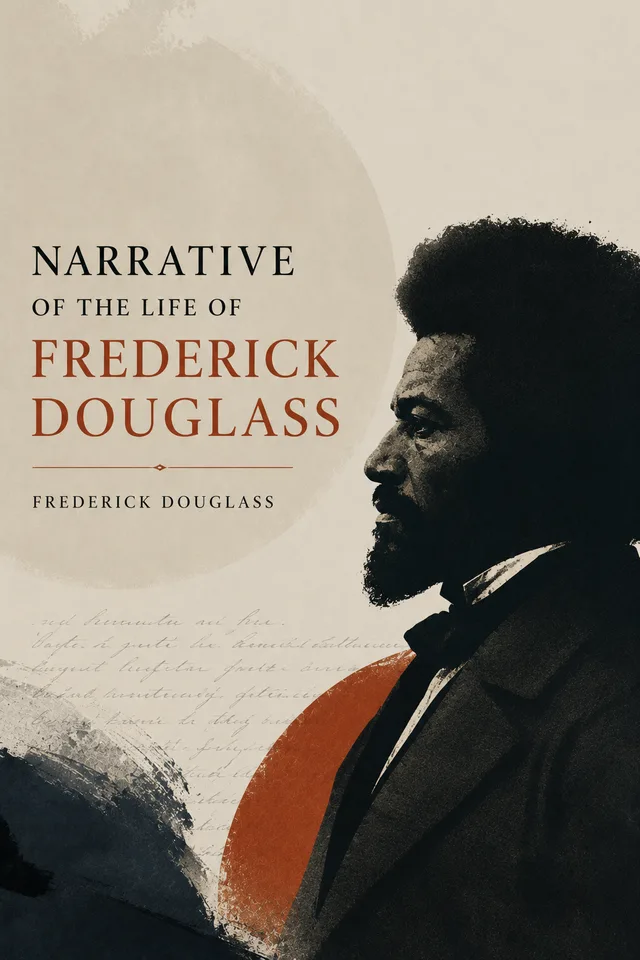
English Edition
History
Narrative of the Life of Frederick Douglass
English BooksWhale Edition by Frederick Douglass
Original title: Narrative of the Life of Frederick Douglass, an American Slave
A powerful autobiographical account of slavery, literacy, resistance, and the struggle for freedom.
- Preview
- A sample from the prepared text
- Formats
- Online reader, EPUB, PDF
- Access
- Library claim
Book introduction
Narrative of the Life of Frederick Douglass
Narrative of the Life of Frederick Douglass recounts Douglass’s experience of enslavement, his pursuit of literacy, his escape, and his emergence as a voice for abolition and human dignity.
BooksWhale edition
How this edition was prepared
This edition is based on a public domain text and has been prepared for digital reading by BooksWhale.
Public domain basis
Why this edition can be shared
Frederick Douglass died in 1895, and Narrative of the Life of Frederick Douglass was first published in 1845; these dates support the public-domain basis for this English edition.
Read preview
A sample from the prepared text
Preview selected from the prepared reader text.
Preview chapterFull textRead preview
Narrative of the Life of Frederick Douglass, an American Slave
Frederick Douglass
Preview chapterPREFACEPreview
In the month of August, 1841, I attended an anti-slavery convention in Nantucket, at which it was my happiness to become acquainted with Frederick Douglass, the writer of the following Narrative. He was a stranger to nearly every member of that body; but, having recently made his escape from the southern prison-house of bondage, and feeling his curiosity excited to ascertain the principles and measures of the abolitionists,—of whom he had heard a somewhat vague description while he was a slave,—he was induced to give his attendance, on the occasion alluded to, though at that time a resident in New Bedford.
Fortunate, most fortunate occurrence!—fortunate for the millions of his manacled brethren, yet panting for deliverance from their awful thraldom!—fortunate for the cause of negro emancipation, and of universal liberty!—fortunate for the land of his birth, which he has already done so much to save and bless!—fortunate for a large circle of friends and acquaintances, whose sympathy and affection he has strongly secured by the many sufferings he has endured, by his virtuous traits of character, by his ever-abiding remembrance of those who are in bonds, as being bound with them!—fortunate for the multitudes, in various parts of our republic, whose minds he has enlightened on the subject of slavery, and who have been melted to tears by his pathos, or roused to virtuous indignation by his stirring eloquence against the enslavers of men!—fortunate for himself, as it at once brought him into the field of public usefulness, “gave the world assurance of a MAN,” quickened the slumbering energies of his soul, and consecrated him to the great work of breaking the rod of the oppressor, and letting the oppressed go free!
I shall never forget his first speech at the convention—the extraordinary emotion it excited in my own mind—the powerful impression it created upon a crowded auditory, completely taken by surprise—the applause which followed from the beginning to the end of his felicitous remarks. I think I never hated slavery so intensely as at that moment; certainly, my perception of the enormous outrage which is inflicted by it, on the godlike nature of its victims, was rendered far more clear than ever. There stood one, in physical proportion and stature commanding and exact—in intellect richly endowed—in natural eloquence a prodigy—in soul manifestly “created but a little lower than the angels”—yet a slave, ay, a fugitive slave,—trembling for his safety, hardly daring to believe that on the American soil, a single white person could be found who would befriend him at all hazards, for the love of God and humanity! Capable of high attainments as an intellectual and moral being—needing nothing but a comparatively small amount of cultivation to make him an ornament to society and a blessing to his race—by the law of the land, by the voice of the people, by the terms of the slave code, he was only a piece of property, a beast of burden, a chattel personal, nevertheless!
A beloved friend from New Bedford prevailed on Mr. DOUGLASS to address the convention. He came forward to the platform with a hesitancy and embarrassment, necessarily the attendants of a sensitive mind in such a novel position. After apologizing for his ignorance, and reminding the audience that slavery was a poor school for the human intellect and heart, he proceeded to narrate some of the facts in his own history as a slave, and in the course of his speech gave utterance to many noble thoughts and thrilling reflections. As soon as he had taken his seat, filled with hope and admiration, I rose, and declared that PATRICK HENRY, of revolutionary fame, never made a speech more eloquent in the cause of liberty, than the one we had just listened to from the lips of that hunted fugitive. So I believed at that time—such is my belief now. I reminded the audience of the peril which surrounded this self-emancipated young man at the North,—even in Massachusetts, on the soil of the Pilgrim Fathers, among the descendants of revolutionary sires; and I appealed to them, whether they would ever allow him to be carried back into slavery,—law or no law, constitution or no constitution. The response was unanimous and in thunder-tones—“NO!” “Will you succor and protect him as a brother-man—a resident of the old Bay State?” “YES!” shouted the whole mass, with an energy so startling, that the ruthless tyrants south of Mason and Dixon’s line might almost have heard the mighty burst of feeling, and recognized it as the pledge of an invincible determination, on the part of those who gave it, never to betray him that wanders, but to hide the outcast, and firmly to abide the consequences.
Preview chapterWM. LLOYD GARRISON BOSTON,Preview
May 1, 1845.
Table of contents
Inside this edition
- 01Full text
- 02PREFACE
- 03WM. LLOYD GARRISON BOSTON,
- 04LETTER FROM WENDELL PHILLIPS, ESQ.
- 05WENDELL PHILLIPS
- 06CHAPTER II
- 07CHAPTER III
- 08CHAPTER IV
- 09CHAPTER V
- 10CHAPTER VI
- 11CHAPTER VII
- 12CHAPTER VIII
- 13CHAPTER IX
- 14CHAPTER X
- 15CHAPTER XI
- 16APPENDIX
- 17A PARODY
- 18FREDERICK DOUGLASS.
- 19THE END
Language availability
Other languages
Additional language editions are not published yet. This section will link to other BooksWhale editions when they become available.
Request another language