English Edition
Politics
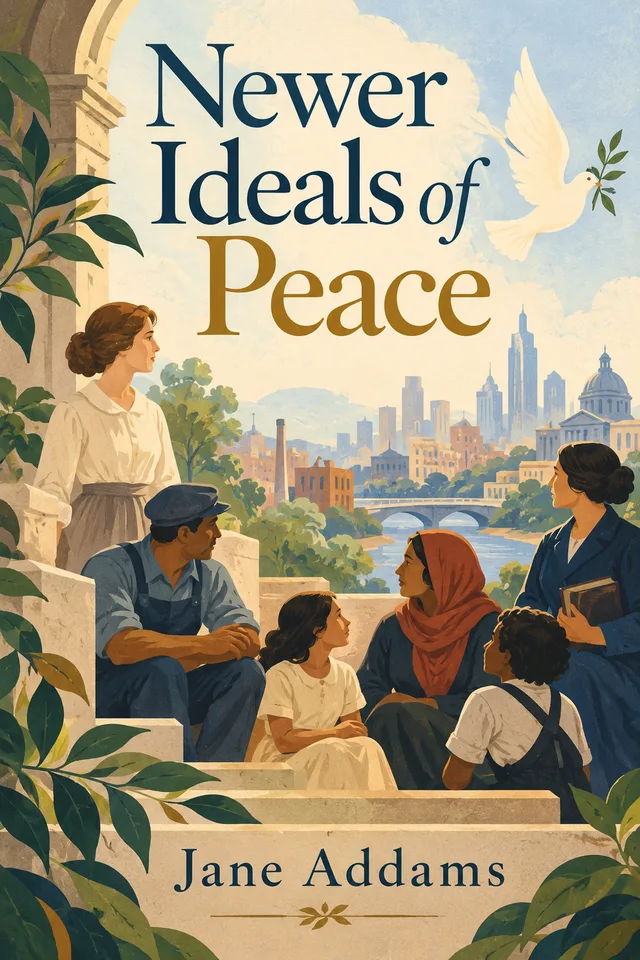
Newer Ideals of Peace
English BooksWhale Edition by Jane Addams
Jane Addams relates the pursuit of peace to city government, industrial relations, immigrant life, women’s participation, and the protection of children.
- Preview
- A sample from the prepared text
- Formats
- Online reader, EPUB, PDF
- Access
- Library claim
Book introduction
Newer Ideals of Peace
Addams asks how a modern industrial city might replace inherited military ideals with habits of cooperation. Eight chapters connect peace to municipal administration, immigration, labor organization, legislation, children’s welfare, and women’s public activity. Drawing on urban experience, the English work treats democratic participation and social responsibility as practical conditions for a less coercive public life.
BooksWhale edition
How this edition was prepared
This edition is based on a public domain text and has been prepared for digital reading by BooksWhale.
Public domain basis
Why this edition can be shared
Jane Addams died in 1935. This edition uses the English original, first published in 1906, transcribed by Project Gutenberg; later introductions, notes, images and publishing matter are excluded.
Read preview
A sample from the prepared text
Preview selected from the prepared reader text.
Preview chapterFull textRead preview
Newer Ideals of Peace
Jane Addams
Preview chapterPREFATORY NOTEPreview
These studies in the gradual development of the moral substitutes for war have been made in the industrial quarter of a cosmopolitan city where the morality exhibits marked social and international aspects.
Parts of two chapters have been published before in the form of addresses, and two others as articles in the North American Review and in the American Journal of Sociology. All of them however are held together by a conviction that has been maturing through many years.
Hull-House, Chicago.
Preview chapterCHAPTER I INTRODUCTIONPreview
The following pages present the claims of the newer, more aggressive ideals of peace, as over against the older dovelike ideal. These newer ideals are active and dynamic, and it is believed that if their forces were made really operative upon society, they would, in the end, quite as a natural process, do away with war. The older ideals have required fostering and recruiting, and have been held and promulgated on the basis of a creed. Their propaganda has been carried forward during the last century in nearly all civilized countries by a small body of men who have never ceased to cry out against war and its iniquities and who have preached the doctrines of peace along two great lines. The first has been the appeal to the higher imaginative pity, as it is found in the modern, moralized man. This line has been most effectively followed by two Russians, Count Tolstoy in his earlier writings and Verestchagin in his paintings. With his relentless power of reducing all life to personal experience Count Tolstoy drags us through the campaign of the common soldier in its sordidness and meanness and constant sense of perplexity. We see nothing of the glories we have associated with warfare, but learn of it as it appears to the untutored peasant who goes forth at the mandate of his superior to suffer hunger, cold, and death for issues which he does not understand, which, indeed, can have no moral significance to him. Verestchagin covers his canvas with thousands of wretched wounded and neglected dead, with the waste, cruelty, and squalor of war, until he forces us to question whether a moral issue can ever be subserved by such brutal methods.
High and searching as is the preaching of these two great Russians who hold their art of no account save as it serves moral ends, it is still the appeal of dogma, and may be reduced to a command to cease from evil. And when this same line of appeal is presented by less gifted men, it often results in mere sentimentality, totally unenforced by a call to righteousness.
The second line followed by the advocates of peace in all countries has been the appeal to the sense of prudence, and this again has found its ablest exponent in a Russian subject, the economist and banker, Jean de Bloch. He sets forth the cost of warfare with pitiless accuracy, and demonstrates that even the present armed peace is so costly that the burdens of it threaten social revolution in almost every country in Europe. Long before the reader comes to the end of de Bloch’s elaborate computation he is ready to cry out on the inanity of the proposition that the only way to secure eternal peace is to waste so much valuable energy and treasure in preparing for war that war becomes impossible. Certainly no theory could be devised which is more cumbersome, more roundabout, more extravagant, than the reductio ad absurdum of the peace-secured-by-the-preparation-for-war theory. This appeal to prudence was constantly emphasized at the first Hague Conference and was shortly afterward demonstrated by Great Britain when she went to war in South Africa, where she was fined one hundred million pounds and lost ten thousand lives. The fact that Russia also, and the very Czar who invited the Conference, disregarded the conclusions of the Hague Tribunal makes this line of appeal at least for the moment seem impotent to influence empires which command enormous resources and which lodge the power of expenditure in officials who have nothing to do with accumulating the treasure they vote to expend.
It would, however, be the height of folly for responsible statesmen to ignore the sane methods of international discussion and concession which have been evolved largely as a result of these appeals. The Interparliamentary Union for International Arbitration and the Institute of International Law represent the untiring efforts of the advocates of peace through many years. Nevertheless universal peace, viewed from the point of the World’s Sovereignty or of the Counsel of Nations, is discouraging even when stated by the most ardent promoters of the peace society. Here it is quite possible that the mistake is being repeated which the old annalists of history made when they never failed to chronicle the wars and calamities which harassed their contemporaries, although, while the few indulged in fighting, the mass of them peacefully prosecuted their daily toil and followed their own conceptions of kindliness and equity. An English writer has recently bidden us to look at the actual state of affairs existing at the present moment. He says, “Universal and permanent peace may be a vision; but the gradual change whereby war, as a normal state of international relations, has given place to peace as the normal state, is no vision, but an actual process of history palpably forwarded in our own day by the development of international law and of morals, and voluntary arbitration based thereon.” He insists that it is the function of international lawyers merely to give coherent expression to the best principles which the common moral sense of civilized Governments recognizes; in other words, that international law should be like primitive law within the nation, a formal expression of custom resting on the sense of a reciprocal restraint which has been found to be necessary for the common good.
Table of contents
Inside this edition
- 01Full text
- 02PREFATORY NOTE
- 03CHAPTER I INTRODUCTION
- 04CHAPTER II SURVIVALS OF MILITARISM IN CIVIL GOVERNMENT
- 05CHAPTER III FAILURE TO UTILIZE IMMIGRANTS IN CITY GOVERNMENT
- 06CHAPTER IV MILITARISM AND INDUSTRIAL LEGISLATION
- 07CHAPTER V GROUP MORALITY IN THE LABOR MOVEMENT
- 08CHAPTER VI PROTECTION OF CHILDREN FOR INDUSTRIAL EFFICIENCY
- 09CHAPTER VII UTILIZATION OF WOMEN IN CITY GOVERNMENT
- 10CHAPTER VIII PASSING OF THE WAR VIRTUES
Language availability
Other languages
Additional language editions are not published yet. This section will link to other BooksWhale editions when they become available.
Request another language