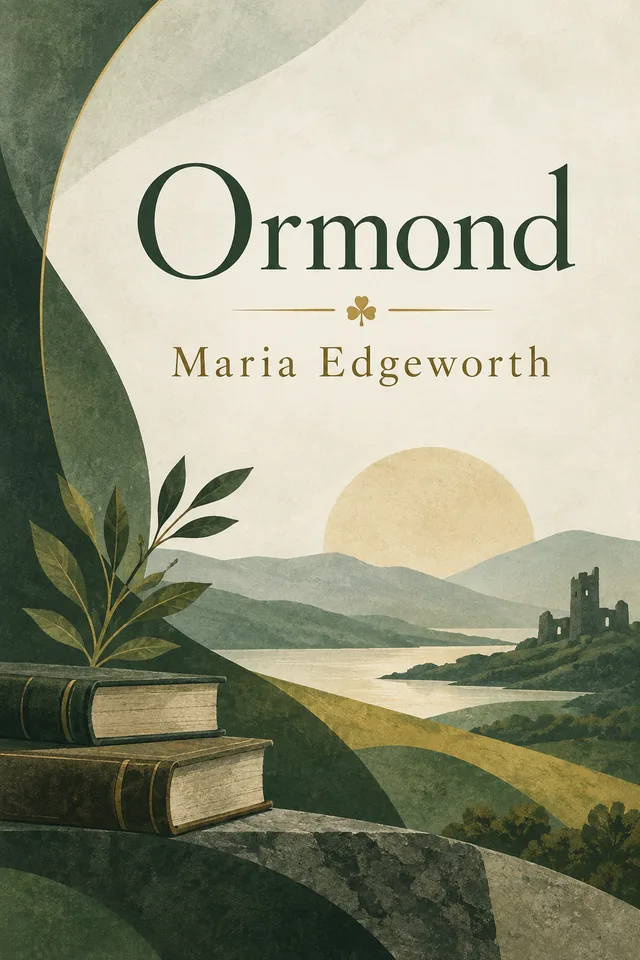
English Edition
Literature
Ormond
English BooksWhale Edition by Maria Edgeworth
An Irish realist novel about education, character, inheritance, and moral independence.
- Preview
- A sample from the prepared text
- Formats
- Online reader, EPUB, PDF
- Access
- Library claim
Book introduction
Ormond
Ormond follows a young man’s formation through family expectations, Irish society, personal discipline, and ethical choice. This edition highlights Maria Edgeworth’s role in the development of Irish fiction and the nineteenth-century novel of manners.
BooksWhale edition
How this edition was prepared
This edition is based on a public domain text and has been prepared for digital reading by BooksWhale.
Public domain basis
Why this edition can be shared
Maria Edgeworth died in 1849, and Ormond was first published in 1817. These dates support the public-domain basis for this original English edition.
Read preview
A sample from the prepared text
Preview selected from the prepared reader text.
Preview chapterFull textRead preview
Ormond
Maria Edgeworth
Preview chapterCHAPTER I.Preview
“What! no music, no dancing at Castle Hermitage to-night; and all the ladies sitting in a formal circle, petrifying into perfect statues?” cried Sir Ulick O’Shane as he entered the drawing-room, between ten and eleven o’clock at night, accompanied by what he called his _rear-guard_, veterans of the old school of good fellows, who at those times in Ireland--times long since past--deemed it essential to health, happiness, and manly character, to swallow, and show themselves able to stand after swallowing, a certain number of bottles of claret per day or night.
“Now, then,” continued Sir Ulick, “of all the figures in nature or art, the formal circle is universally the most obnoxious to conversation, and, to me, the most formidable; all my faculties are spell-bound--here I am like a bird in a circle of chalk, that dare not move so much as its head or its eyes, and can’t, for the life of it, take to its legs.”
A titter ran round that part of the circle where the young ladies sat--Sir Ulick was a favourite, and they rejoiced when he came among them; because, as they observed, “he always said something pleasant, or set something pleasant a-going.”
“Lady O’Shane, for mercy’s sake let us have no more of these permanent circle sittings at Castle Hermitage, my dear!”
“Sir Ulick, I am sure I should be very glad if it were possible,” replied Lady O’Shane, “to have no more _permanent sittings_ at Castle Hermitage; but when gentlemen are at their bottle, I really don’t know what the ladies can do but sit in a circle.”
“Can’t they dance in a circle, or any way? or have not they an elegant resource in their music? There’s many here who, to my knowledge, can caper as well as they modulate,” said Sir Ulick, “to say nothing of cards for those that like them.”
“Lady Annaly does not like cards,” said Lady O’Shane, “and I could not ask any of these young ladies to waste their breath and their execution, singing and playing before the gentlemen came out.”
“These young ladies would not, I’m sure, do us old fellows the honour of waiting for us; and the young beaux deserted to your tea-table a long hour ago--so why you have not been dancing is a mystery beyond my comprehension.”
“Tea or coffee, Sir Ulick O’Shane, for the third time of asking?” cried a sharp female voice from the remote tea-table.
“Wouldn’t you swear to that being the voice of a presbyterian?” whispered Sir Ulick, over his shoulder to the curate: then aloud he replied to the lady, “Miss Black, you are three times too obliging. Neither tea nor coffee I’ll take from you to-night, I thank you kindly.”
“Fortunate for yourself, sir--for both are as cold as stones--and no wonder!” said Miss Black.
“No wonder!” echoed Lady O’Shane, looking at her watch, and sending forth an ostentatious sigh.
“What o’clock is it by your ladyship?” asked Miss Black. “I have a notion it’s tremendously late.”
“No matter--we are not pinned to hours in this house, Miss Black,” said Sir Ulick, walking up to the tea-table, and giving her a look, which said as plainly as look could say, “You had better be quiet.”
Lady O’Shane followed her husband, and putting her arm within his, began to say something in a fondling tone; and in a most conciliatory manner she went on talking to him for some moments. He looked absent, and replied coldly.
“I’ll take a cup of coffee from you now, Miss Black,” said he, drawing away his arm from his wife, who looked much mortified.
“We are too long, Lady O’Shane,” added he, “standing here like lovers, talking to no one but ourselves--awkward in company.”
Preview chapterCHAPTER II.Preview
Lady O’Shane, extremely terrified, had scarcely power to rise. She opened the drawer of the table, and thrust her trembling hand down to the bottom of the silk bag, into which the keys had fallen. Impatient of delay, Ormond pushed open the door, snatched the keys, and disappeared. The whole passed in a few seconds. The music drowned the noise of the opening door, and of the two chairs, which Ormond had thrown down: those who sat near, thought a servant had pushed in and gone out; but, however rapid the movement, the full view of the figure had been seen by Miss Annaly, who was sitting on the opposite side of the room; Sir Ulick was sitting beside her, talking earnestly. Lady Annaly had just retired. “For Heaven’s sake, what’s the matter?” cried he, stopping in the middle of a sentence, on seeing Miss Annaly grow suddenly pale as death. Her eyes were fixed on the door of the green-house; his followed that direction. “Yes,” said he, “we can get out into the air that way--lean on me.” She did so--he pushed his way through the crowd at the bottom of the country dance; and, as he passed, was met by Lady O’Shane and Miss Black, both with faces of horror.
“Sir Ulick, did you see,” pointing to the door, “did you see Mr. Ormond?--There’s blood!”
“There’s mischief, certainly,” said Miss Black. “A quarrel--Mr. Marcus, perhaps.”
“Nonsense! No such thing, you’ll find,” said Sir Ulick, pushing on, and purposely jostling the arm of a servant who was holding a salver of ices, overturning them all; and whilst the surrounding company were fully occupied about their clothes, and their fears, and apologies, he made his way onwards to the green-house--Lady O’Shane clinging to one arm--Miss Annaly supported by the other--Miss Black following, repeating, “Mischief! mischief! you’ll see, sir.”
“Miss Black, open the door, and not another word.”
He edged Miss Annaly on, the moment the door opened, dragged Lady O’Shane after him, pushed Miss Black back as she attempted to follow: but, recollecting that she might spread the report of mischief, if he left her behind, drew her into the green-house, locked the door, and led Miss Annaly out into the air.
“Bring salts! water! something, Miss Black--follow me, Lady O’Shane.”
“When I’m hardly able--your wife! Sir Ulick, you might,” said Lady O’Shane, as she tottered on, “you might, I should have _thought_--”
“No time for such thoughts, my dear,” interrupted he. “Sit down on the steps--there, she is better now--now what is all this?”
“I am not to speak,” said Miss Black.
Lady O’Shane began to say how Mr. Ormond had burst in, covered with blood, and seized the keys of the gates.
“The keys!” But he had no time for _that_ thought. “Which way did he go?”
“I don’t know; I gave him the keys of both gates.”
The two entrances were a mile asunder. Sir Ulick looked for footsteps on the grass. It was a fine moonlight night. He saw footsteps on the path leading to the gardener’s house. “Stay here, ladies, and I will bring you intelligence as soon as possible.”
“This way, Sir Ulick--they are coming,” said Miss Annaly, who had now recovered her presence of mind.
Several persons appeared from a turn in the shrubbery, carrying some one on a hand-barrow--a gentleman on horseback, with a servant and many persons walking. Sir Ulick hastened towards them; the gentleman on horseback spurred his horse and met him.
“Marcus!--is it you?--thank God! But Ormond--where is he, and what has happened?”
The first sound of Marcus’s voice, when he attempted to answer, showed that he was not in a condition to give a rational account of any thing. His servant followed, also much intoxicated. While Sir Ulick had been stopped by their ineffectual attempts to explain, the people who were carrying the man on the hand-barrow came up. Ormond appeared from the midst of them. “Carry him on to the gardener’s house,” cried he, pointing the way, and coming forward to Sir Ulick. “If he dies, I am a murderer!” cried he.
Table of contents
Inside this edition
- 01Full text
- 02CHAPTER I.
- 03CHAPTER II.
- 04CHAPTER III.
- 05CHAPTER IV.
- 06HARRY OSMOND’S GOOD RESOLUTIONS.
- 07CHAPTER V.
- 08CHAPTER VI.
- 09CHAPTER VII.
- 10CHAPTER VIII.
- 11CHAPTER IX.
- 12CHAPTER X.
- 13CHAPTER XI.
- 14CHAPTER XII.
- 15CHAPTER XIII.
- 16CHAPTER XIV
- 17CHAPTER XV.
- 18CHAPTER XVI.
- 19CHAPTER XVII.
- 20“LONG LIVE KING CORNY.”
- 21CHAPTER XVIII.
- 22“DEAR HARRY,
- 23“U. O’SHANE.”
- 24introduction you did me just now the favour to give me to Lady Norton;
- 25CHAPTER XIX.
- 26CHAPTER XX.
- 27CHAPTER XXI.
- 28CHAPTER XXII.
- 29CHAPTER XXIII.
- 30CHAPTER XXIV.
- 31CHAPTER XXV.
- 32CHAPTER XXVI.
- 33CHAPTER XXVII.
- 34CHAPTER XXVIII.
- 35CHAPTER XXIX.
- 36CHAPTER XXX.
- 37CHAPTER XXXI.
- 38“ORMOND,
- 39“ULICK O’SHANE.”
- 40CHAPTER XXXII.
- 41note paid in gold, and went away blessing Master Harry. Happy for all
Language availability
Other languages
Additional language editions are not published yet. This section will link to other BooksWhale editions when they become available.
Request another language