English Edition
Literature
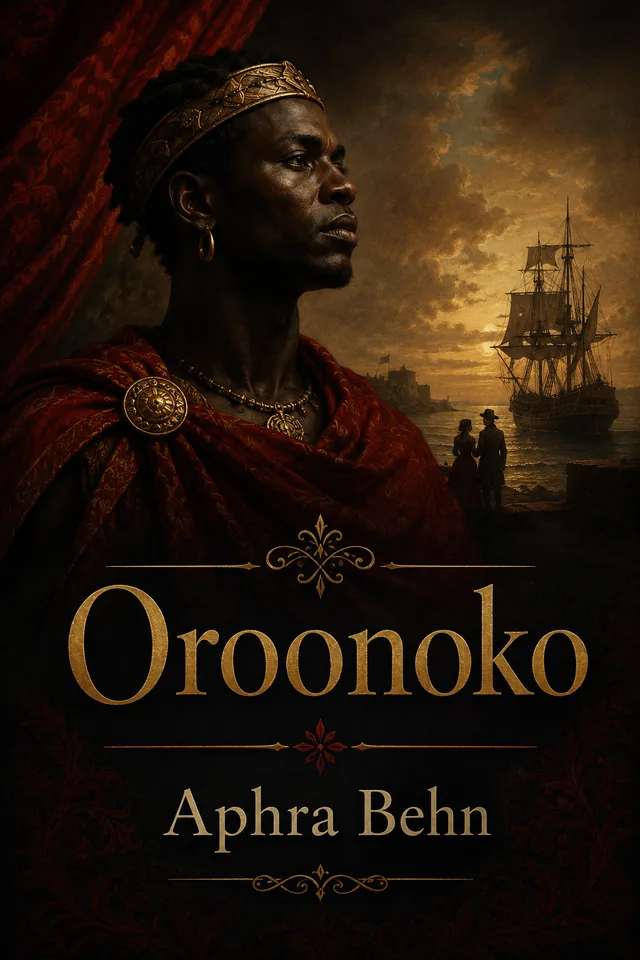
Oroonoko
English BooksWhale Edition by Aphra Behn
Aphra Behn’s influential novella of slavery, colonial violence, honor, love, betrayal, and royal identity.
- Preview
- A sample from the prepared text
- Formats
- Online reader, EPUB, PDF
- Access
- Library claim
Book introduction
Oroonoko
Oroonoko follows an African prince drawn into enslavement and colonial power in Surinam. Aphra Behn’s compact English narrative remains central to early novel history, Atlantic slavery studies, women’s writing, and debates over race, monarchy, and moral authority.
BooksWhale edition
How this edition was prepared
This edition is based on a public domain text and has been prepared for digital reading by BooksWhale.
Public domain basis
Why this edition can be shared
Aphra Behn died in 1689, and Oroonoko was first published in 1688. These dates support the public-domain basis for this English original edition.
Read preview
A sample from the prepared text
Preview selected from the prepared reader text.
Preview chapterFull textRead preview
Oroonoko
Aphra Behn
By Aphra Behn
Preview chapterOROONOKO; OR THE ROYAL SLAVE.Preview
OROONOKO; OR THE ROYAL SLAVE.
Preview chapterINTRODUCTION.Preview
The tale of Oroonoko, the Royal Slave is indisputedly Mrs. Behn's masterpiece in prose. Its originality and power have singled it out for a permanence and popularity none of her other works attained. It is vivid, realistic, pregnant with pathos, beauty, and truth, and not only has it so impressed itself upon the readers of more than two centuries, but further, it surely struck a new note in English literature and one which was re-echoed far and wide. It has been said that 'Oroonoko is the first emancipation novel', and there is no little acumen in this remark. Certainly we may absolve Mrs. Behn from having directly written with a purpose such as animated Mrs. Harriet Beecher Stowe's Uncle Tom's Cabin; but none the less her sympathy with the oppressed blacks, her deep emotions of pity for outraged humanity, her anger at the cruelties of the slave-driver aye ready with knout or knife, are manifest in every line. Beyond the intense interest of the pure narrative we have passages of a rhythm that is lyric, exquisitely descriptive of the picturesque tropical scenery and exotic vegetations, fragrant and luxuriant; there are intimate accounts of adventuring and primitive life; there are personal touches which lend a colour only personal touches can, as Aphara tells her prose-epic of her Superman, Caesar the slave, Oroonoko the prince.
It is not difficult to trace the influence of Oroonoko. We can see it in many an English author; in Bernardin de Saint-Pierre, in
Chateaubriand. Her idyllic romance has inspired writers who perhaps but dimly remember even her name and her genius.
It was often reprinted separately from the rest. There is a little 12mo Oroonoko, 'the ninth edition corrected', published at Doncaster, 1759, 'for C. Plummer', which is rarely seen save in a torn and well-thumbed state.[1]
In 1777 the sentimental and highly proper Mrs. Elizabeth Griffith included Oroonoko in her three volume Collection of Novels selected and revised. Oroonoko, 'written originally by Mrs. Behn and revised by Mrs. Griffith'[2], was also issued separately, 'price sixpence'[3], in 1800, frontispieced by a very crude picture of a black-a-moor about to attack a tiger.
As early as 1709 we find _Lebens und Liebes-Geschichte des Koeniglichen
Sclaven Oroonoko in West-Indien_, a German translation published at
Hamburg, with a portrait of 'Die Sinnreiche Engellaenderin Mrs. Afra
Behn.'
In 1745 Oroonoko was 'traduit de l'Anglois de Madame Behn,' with the motto from Lucan 'Quo fata trahunt virtus secura sequetur.' There is a rhymed dedication 'A Madame La M. P. D'l...' (35 lines), signed D. L.****, i.e., Pierre-Antoine de la Place, a fecund but mediocre writer of the eighteenth century (1707-93), who also translated, Venice Preserv'd, The Fatal Marriage, Tom Jones, and other English masterpieces. There is another edition of de la Place's version with fine plates engraved by C. Baron after Marillier, Londres, 1769.
In 1696 Southerne's great tragedy, founded upon Mrs. Behn's novel, was produced at Drury Lane. Oroonoko was created by Verbruggen, Powell acted Aboan, and the beautiful Mrs. Rogers Imoinda. The play has some magnificent passages, and long kept the stage. Southerne had further added an excellent comic underplot, full of humour and the truest vis comica. It is perhaps worth noting that the intrigues of Lucy and Charlotte and the Lackitt menage were dished up as a short slap-bang farce by themselves with, curiously enough, two or three scenes in extenso from Fletcher's Monsieur Thomas (III, iii, and V, ii). This hotch potch entitled The Sexes Mis-match'd; or, A New Way to get a Husband is printed in The Strollers' Pacquet open'd. (12mo, 1741.) On 1 December, 1759, there was brought out at Drury Lane a most insipid alteration of Oroonoko by Dr. Hawkesworth, who omitted all Southerne's lighter fare and inserted serious nonsense of his own. Garrick was the Oroonoko and Mrs. Cibber Imoinda. Although Hawkesworth's version was not tolerated, the underplot was none the less pruned in later productions to such an extent that it perforce lost nearly all its pristine wit and fun. There is another adaption of Southerne: 'Oroonoko altered from the original play... to which the editor has added near six hundred lines in place of the comic scenes, together with an addition of two new characters, intended for one of the theatres.' (8vo, 1760.) The two new characters are Maria, sister to the Lieutenant-Governor and contracted to Blandford, and one Heartwell; both thoroughly tiresome individuals. In the same year Frank Gentleman, a provincial actor, produced his idea of Oroonoko 'as it was acted at Edinburgh.' (12mo, 1760.) There is yet a fourth bastard: The Prince of Angola, by one J. Ferriar, 'a tragedy altered from the play of Oroonoko and adapted to the circumstances of the present times.'[4] (Manchester, 1788.) It must be confessed that all this tinkering with an original, which does not require from any point of view the slightest alteration or omission, is most uncalled for, crude, and unsuccessful.
Table of contents
Inside this edition
- 01Full text
- 02OROONOKO; OR THE ROYAL SLAVE.
- 03INTRODUCTION.
- 04TO THE RIGHT HONOURABLE THE LORD MAITLAND.
- 05THE HISTORY OF THE ROYAL SLAVE.
Language availability
Other languages
Additional language editions are not published yet. This section will link to other BooksWhale editions when they become available.
Request another language