English Edition
History
Past and Present
English BooksWhale Edition by Thomas Carlyle
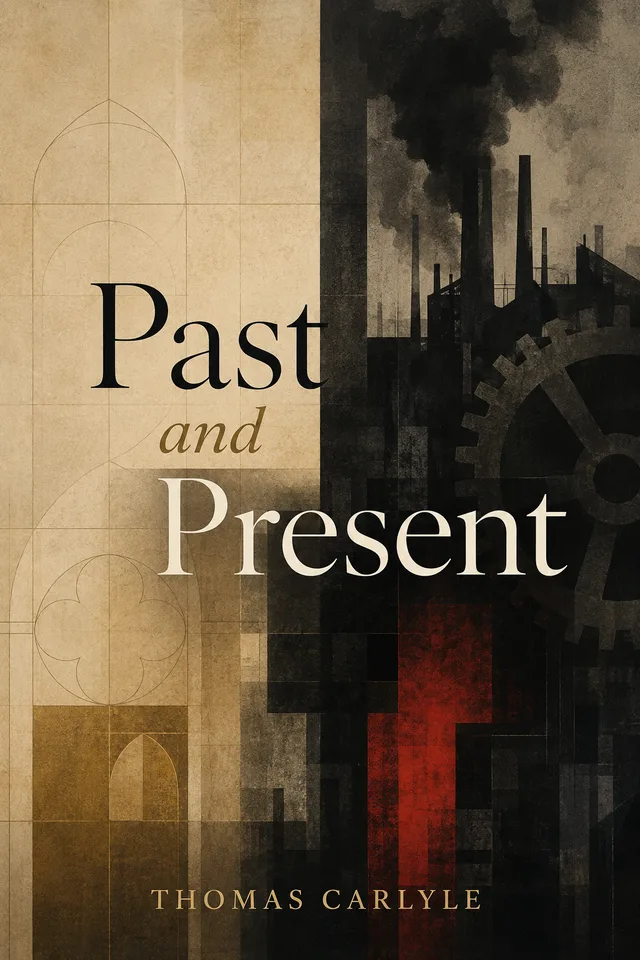
Carlyle contrasts medieval monastic order with modern industrial unrest and social responsibility.
- Preview
- A sample from the prepared text
- Formats
- Online reader, EPUB, PDF
- Access
- Library claim
Book introduction
Past and Present
“Past and Present” moves between the medieval world of Abbot Samson and the industrial crisis of nineteenth-century England. Carlyle attacks laissez-faire complacency and asks what leadership, labor, duty, and community should mean in modern society.
BooksWhale edition
How this edition was prepared
This edition is based on a public domain text and has been prepared for digital reading by BooksWhale.
Public domain basis
Why this edition can be shared
Past and Present is a public-domain work: the author died in 1881, and the text was first published in 1843. This edition uses the original English text.
Read preview
A sample from the prepared text
Preview selected from the prepared reader text.
Preview chapterFull textRead preview
Past and Present
PAST AND PRESENT By Thomas Carlyle
Appreciation by Ralph Waldo Emerson
First published 1843
THOMAS CARLYLE, born in 1795 at Ecclefechan, the son of a stonemason. Educated at Edinburgh University. Schoolmaster for a short time, but decided on a literary career, visiting Paris and London. Retired in 1828 to Dumfriesshire to write. In 1834 moved to Cheyne Row, Chelsea, and died there in 1881.
INTRODUCTION Being an appreciation from "The Dial" (July 1843) by Ralph Waldo Emerson
Though no theocrat, and more than most philosophers, a believer in political systems, Mr. Carlyle very fairly finds the calamity of the times, not in bad bills of Parliament, nor the remedy in good bills, but the vice in false and superficial aims of the people, and the remedy in honesty and insight. Like every work of genius, its great value is in telling such simple truths. As we recall the topics, we are struck with force given to the plain truths; the picture of the English nation all sitting enchanted, the poor, enchanted so that they cannot work, the rich, enchanted so that they cannot enjoy, and are rich in vain; the exposure of the progress of fraud into all arts and social activities; the proposition that the labourer must have a greater share in his earnings; that the principle of permanence shall be admitted into all contracts of mutual service; that the state shall provide at least schoolmaster's education for all the citizens; the exhortation to the workman that he shall respect the work and not the wages; to the scholar that he shall be there for light; to the idle, that no man shall sit idle; the picture of Abbot Samson, the true governor, who "is not there to expect reason and nobleness of others, he is there to give them of his own reason and nobleness;" the assumption throughout the book, that a new chivalry and nobility, namely the dynasty of labour, is replacing the old nobilities. These things strike us with a force which reminds us of the morals of the Oriental or early Greek masters, and of no modern book. Truly in these things is great reward. It is not by sitting so at a grand distance and calling the human race _larvae,_ that men are to be helped, nor by helping the depraved after their own foolish fashion; but by doing unweariedly the particular work we were born to do. Let no man think himself absolved because he does a generous action and befriends the poor, but let him see whether he so holds his property that a benefit goes from it to all. A man's diet should be what is simplest and readiest to be had, because it is so private a good. His house should be better, because that is for the use of hundreds, perhaps of thousands, and is the property of the traveler. But his speech is a perpetual and public instrument; let that always side with the race and yield neither a lie nor a sneer. His manners,--let them be hospitable and civilising, so that no Phidias or Raphael shall have taught anything better in canvas or stone; and his acts should be representative of the human race, as one who makes them rich in his having, and poor in his want.
It requires great courage in a man of letters to handle the contemporary practical questions; not because he then has all men for his rivals, but because of the infinite entanglements of the problem, and the waste of strength in gathering unripe fruits. The task is superhuman; and the poet knows well that a little time will do more than the most puissant genius. Time stills the loud noise of opinions, sinks the small, raises the great, so that the true emerges without effort and in perfect harmony to all eyes; but the truth of the present hour, except in particulars and single relations, is unattainable. Each man can very well know his own part of duty, if he will; but to bring out the truth for beauty, and as literature, surmounts the powers of art. The most elaborate history of today will have the oddest dislocated look in the next generation. The historian of today is yet three ages off. The poet cannot descend into the turbid present without injury to his rarest gifts. Hence that necessity of isolation which genius has always felt. He must stand on his glass tripod, if he would keep his electricity.
Preview chapterBIBLIOGRAPHYPreview
Life of Schiller (Lond. Mag., 1823-4), 1825, 1845. (Supplement published in the People's Edition, 1873) Wilhelm Meister's Apprenticeship, 1824. Elements of Geometry and Trigonometry (from the French of Legendre), 1824. German Romance, 1827. Sartor Resartus (Fraser's Mag., 1833-4), 1835 (Boston) 1838. French Revolution, 1837,1839. Critical and Miscellaneous Essays, 1839, 1840, 1847, 1857. (In these were reprinted Articles from Edinburgh Review, Foreign Review, Foreign Quarterly Review, Fraser's Magazine, Westminster Review, New Monthly Magazine, London and Westminster Review, Keepsake, Proceedings of the Society of Antiquaries of Scotland, Times.) Chartism, 1840. Heroes, Hero-worship, and the Heroic in History, 1841. Past and Present, 1843. Oliver Cromwell's Letters and Speeches; with Elucidations, 1845. Thirty-five Unpublished Letters of Oliver Cromwell, 1847 (Fraser). Original Discourses on the Negro Question (Fraser, 1849), 1853. Latter-day Pamphlets, 1850. Life of John Sterling, 1851. History of Friedrich II. of Prussia, 1858-65. Inaugural Address at Edinburgh, 1866. Shooting Niagara; and After? 1867 (from Macmillan). The Early Kings of Norway; also an Essay on the Portraits of John Knox, 1875.
There were also contributions to Brewster's Edinburgh Encyclopaedia, vols. xiv. xv., and xvi.; to New Edinburgh Review, 1821, 1822; Fraser's Magazine, 1830, 1831; The Times, 19 June, 1844 (Mazzini); 28 November, 1876; 5 May, 1877; Examiner, 1848; Spectator 1848.
First Collected Edition of Works, 1857-58 (16 vols.)
Reminiscences (ed. J.A. Froude), 1881; (ed. C.E. Norton, 1887, and preprinted in Everyman's Library; 1932, with an added article on Professor John Wilson--"Christopher North") Reminiscences of my Irish journey in 1849, 1882. Last Words of Thomas Carlyle, 1882 (ed. by J.C.A.) Last Words of Thomas Carlyle, 1892. Rescued Essays (ed. P. Newberry) 1892. Historical Sketches of Notable Persons and Events in the Reign of James I. and Charles I. (ed. A. Carlyle), 1898.
Sir Leslie Stephen's article on Carlyle in the Dictionary of National Biography gives a list of his occasional writings which have never been collected or reprinted.
Preview chapterBook I--ProemPreview
I. Midas. II. The Sphinx III. Manchester Insurrection IV. Morrison's Pill V. Aristocracy of Talent VI. Hero-Worship
Table of contents
Inside this edition
- 01Full text
- 02BIBLIOGRAPHY
- 03Book I--Proem
- 04Book II--The Ancient Monk
- 05Book III--The Modern Worker
- 06Book IV--Horoscope
- 07Book I--Proem
- 08Chapter I
- 09Chapter II
- 10Chapter III
- 11Chapter IV
- 12Chapter V
- 13Chapter VI
- 14Book II--The Ancient Monk
- 15Chapter I
- 16Chapter II
- 17Chapter III
- 18Chapter IV
- 19Chapter V
- 20Chapter VI
- 21Chapter VII
- 22Chapter VIII
- 23Chapter IX
- 24Chapter X
- 25Chapter XI
- 26Chapter XII
- 27Chapter XIII
- 28Chapter XIV
- 29Chapter XV
- 30Chapter XVI
- 31Chapter XVII
- 32Book III--The Modern Worker
- 33Chapter I
- 34Chapter II
- 35Chapter III
- 36Chapter IV
- 37Chapter V
- 38Chapter VI
- 39Chapter VII
- 40Chapter VIII
- 41Chapter IX
- 42Chapter X
- 43Chapter XI
- 44Chapter XII
- 45Chapter XIII
- 46Chapter XIV
- 47Chapter XV
- 48Book IV--Horoscope
- 49Chapter I
- 50Chapter II
- 51Chapter III
- 52Chapter IV
- 53Chapter V
- 54Chapter VI
- 55Chapter VII
- 56Chapter VIII
- 57THE END
- 58Book I--Proem
- 59Book II--The Ancient Monk
- 60Book III.--The Modern Worker
- 61Book IV.--Horoscope
Language availability
Other languages
Additional language editions are not published yet. This section will link to other BooksWhale editions when they become available.
Request another language