English Edition
Economics
Protection or Free Trade
English BooksWhale Edition by Henry George
Henry George examines tariffs, wages, production, and landownership to ask what genuine freedom of trade requires.
- Preview
- A sample from the prepared text
- Formats
- Online reader, EPUB, PDF
- Access
- Library claim
Book introduction
Protection or Free Trade
Protection or Free Trade tests the arguments for tariffs against the interests of workers and producers. Henry George moves from trade, money, and industrial development to wages, the ownership of land, and the distribution of wealth. Thirty chapters connect the tariff controversy to a broader inquiry into economic privilege, arguing that removing customs barriers alone does not establish genuine economic freedom.
BooksWhale edition
How this edition was prepared
This edition is based on a public domain text and has been prepared for digital reading by BooksWhale.
Public domain basis
Why this edition can be shared
Henry George died in 1897. The work was first published in 1886. This edition uses the historical English original from Online Library of Liberty, excluding later editorial matter.
Read preview
A sample from the prepared text
Preview selected from the prepared reader text.
Preview chapterFull textRead preview
To the Memory of those Illustrious Frenchman of a Century Ago, QUESNAY, TURGOT, MIRABEAU, CONDORCET, DUPONT and their Fellows, Who in the Night of Despotism Foresaw the Glories of the Coming Day
Preview chapterPREFACE.Preview
IN this book I have endeavored to determine whether protection or free trade better accords with the interests of labor, and to bring to a common conclusion on this subject those who really desire to raise wages.
I have not only gone over the ground generally traversed, and examined the arguments commonly used, but, carrying the inquiry further than the controversialists on either side have yet ventured to go, I have sought to discover why protection retains such popular strength in spite of all exposures of its fallacies; to trace the connection between the tariff question and those still more important social questions, now rapidly becoming the "burning questions" of our times; and to show to what radical measures the principle of free trade logically leads. While pointing out the falsity of the belief that tariffs can protect labor, I have not failed to recognize the facts which give this belief vitality, and, by an examination of these facts, have shown, not only how little the working classes can hope from that mere "revenue reform" which is miscalled "free trade," but how much they have to hope from real free trade. By thus harmonizing the truths which free traders perceive with the facts that to protectionists make their own theory plausible, I believe I have opened ground upon which those separated by seemingly irreconcilable differences of opinion may unite for that full application of the free-trade principle which would secure both the largest production and the fairest distribution of wealth.
By thus carrying the inquiry beyond the point where Adam Smith and the writers who have followed him have stopped, I believe I have stripped the vexed tariff question of its greatest difficulties, and have cleared the way for the settlement of a dispute which otherwise might go on interminably. The conclusions thus reached raise the doctrine of free trade from the emasculated form in which it has been taught by the English economists to the fullness in which it was held by the predecessors of Adam Smith, those illustrious Frenchmen, with whom originated the motto Laissez faire, and who, whatever may have been the confusions of their terminology or the faults of their method, grasped a central truth which free traders since their time have ignored.
My effort, in short, has been to make such a candid and thorough examination of the tariff question, in all its phases, as would aid men to whom the subject is now a perplexing maze to reach clear and firm conclusions. In this I trust I have done something to inspire a movement now faint-hearted with the earnestness and strength of radical conviction, to prevent the division into hostile camps of those whom a common purpose ought to unite, to give to efforts for the emancipation of labor greater definiteness of purpose, and to eradicate that belief in the opposition of national interests which leads peoples, even of the same blood and tongue, to regard each other as natural antagonists.
To avoid any appearance of culling absurdities, I have, in referring to the protectionist position, quoted mainly from the latest writer who seems to be regarded by American protectionists as an authoritative exponent of their views—Professor Thompson, of the University of Pennsylvania.
Preview chapterChapter I INTRODUCTORY.Preview
NEAR the window by which I write, a great bull is tethered by a ring in his nose. Grazing round and round he has wound his rope about the stake until now he stands a close prisoner, tantalized by rich grass he cannot reach, unable even to toss his head to rid him of the flies that cluster on his shoulders. Now and again he struggles vainly, and then, after pitiful bellowings, relapses into silent misery.
This bull, a very type of massive strength, who, because he has not wit enough to see how he might be free, suffers want in sight of plenty, and is helplessly preyed upon by weaker creatures, seems to me no unfit emblem of the working masses.
In all lands, men whose toil creates abounding wealth are pinched with poverty, and, while advancing civilization opens wider vistas and awakens new desires. are held down to brutish levels by animal needs. Bitterly conscious of injustice, feeling in their inmost souls that they were made for more than so narrow a life, they, too, spasmodically struggle and cry out. But until they trace effect to cause, until they see how they are fettered and how they may be freed, their struggles and outcries are as vain as those of the bull. Nay, they are vainer. I shall go out and drive the bull in the way that will untwist his rope. But who shall drive men into freedom? Till they use the reason with which they have been gifted, nothing can avail. For them there is no special providence.
Under all forms of government the ultimate power lies with the masses. It is not kings nor aristocracies, nor land-owners nor capitalists, that anywhere really enslave the people. It is their own ignorance. Most clear is this where governments rest on universal suffrage. The workingmen of the United States may mould to their will legislatures, courts and constitutions. Politicians strive for their favor and political parties bid against one another for their vote. But what avails this? The little finger of aggregated capital must be thicker than the loins of the working masses so long as they do not know how to use their power. And how far from any agreement as to practical reform are even those who most feel the injustice of existing conditions may be seen in the labor organizations. Though beginning to realize the wastefulness of strikes and to feel the necessity of acting on general conditions through legislation, these organizations when they come to formulate political demands seem unable to unite upon any measures capable of large results.
This political impotency must continue until the masses, or at least that sprinkling of more thoughtful men who are the file leaders of popular opinion, shall give such head to larger questions as will enable them to agree on the path reform should take.
It is with the hope of promoting such agreement that I propose in these pages to examine a vexed question which must be settled before there can be any efficient union in political action for social reform—the question whether protective tariffs are or are not helpful to those who get their living by their labor.
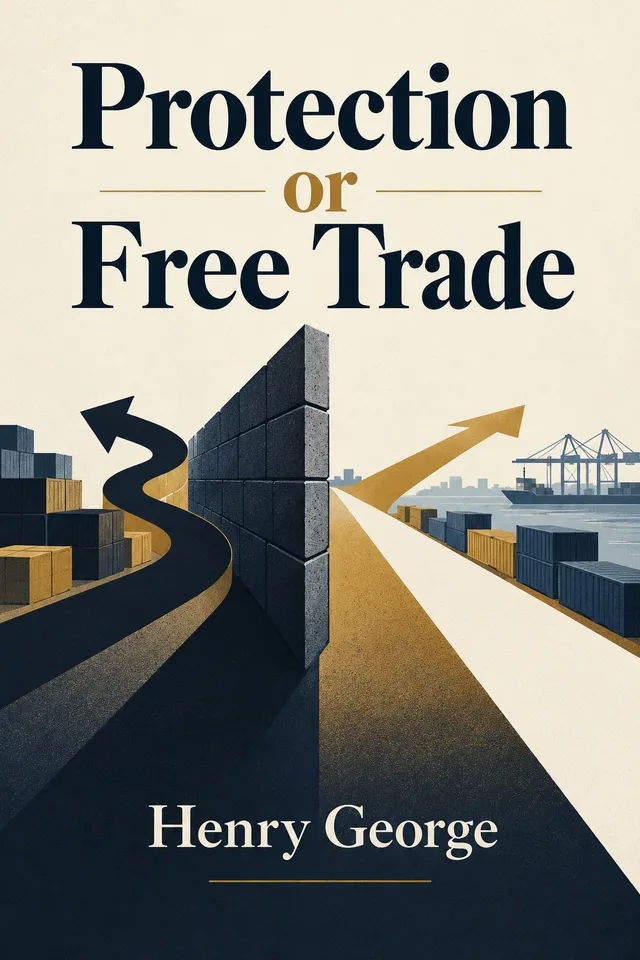
This is a question important in itself, yet far more important in what it involves. Not only is it true that its examination cannot fail to throw light upon other social-economic questions, but it leads directly to that great "Labor Question" which every day as it passes brings more and more to the foreground in every country of the civilized world. For it is a question of direction—a question which of two divergent roads shall be taken. Whether labor is to be benefited by governmental restrictions or by the abolition of such restrictions is, in short, the question of how the bull shall go to untwist his rope.
In one way or another, we must act upon the tariff question. Throughout the civilized world it everywhere lies within the range of practical politics. Even when protection is most thoroughly accepted there not only exists a more or less active minority who seek its overthrow, but the constant modifications that are being made or proposed in existing tariffs are as constantly bringing the subject into the sphere of political action, while even in that country in which free trade has seemed to be most strongly rooted, the policy of protection is again raising its head. Here it is evident that the tariff question is the great political question of the immediate future. For more than a generation the slavery agitation, the war to which it led and the problems growing out of that war have absorbed political attention in the United States. That era has passed, and a new one is beginning, in which economic questions must force themselves to the front. First among these questions, upon which party lines must soon be drawn and political discussion must rage, is the tariff question.
Table of contents
Inside this edition
- 01Full text
- 02PREFACE.
- 03Chapter I INTRODUCTORY.
- 04Chapter II CLEARING GROUND.
- 05Chapter III OF METHOD.
- 06Chapter IV PROTECTION AS A UNIVERSAL NEED.
- 07Chapter V THE PROTECTIVE UNIT.
- 08Chapter VI TRADE.
- 09Chapter VII PRODUCTION AND PRODUCERS.
- 10Chapter VIII TARIFFS FOR REVENUE.
- 11Chapter IX TARIFFS FOR PROTECTION
- 12Chapter X THE ENCOURAGEMENT OF INDUSTRY.
- 13Chapter XI THE HOME MARKET AND HOME TRADE.
- 14Chapter XII EXPORTS AND IMPORTS.
- 15Chapter XIII CONFUSIONS ARISING FROM THE USE OF MONEY
- 16Chapter XIV DO HIGH WAGES NECESSITATE PROTECTION?
- 17Chapter XV OF ADVANTAGES AND DISADVANTAGES AS REASONS FOR PROTECTION.
- 18CHAPTER XVI. THE DEVELOPMENT OF MANUFACTURES.
- 19CHAPTER XVII. PROTECTION AND PRODUCERS.
- 20CHAPTER XVIII. EFFECTS OF PROTECTION ON AMERICAN INDUSTRY.
- 21CHAPTER XIX. PROTECTION AND WAGES.
- 22Chapter XX THE ABOLITION OF PROTECTION.
- 23Chapter XXI INADEQUACY OF THE FREE TRADE ARGUMENT.
- 24Chapter XXII THE REAL WEAKNESS OF FREE TRADE.
- 25Chapter XXIII THE REAL STRENGTH OF PROTECTION.
- 26Chapter XXIV THE PARADOX.
- 27Chapter XXV THE ROBBER THAT TAKES ALL THAT IS LEFT.
- 28Chapter XXVI TRUE FREE TRADE.
- 29Chapter XXVII THE LION IN THE WAY.
- 30Chapter XXVIII FREE TRADE AND SOCIALISM.
- 31Chapter XXIX PRACTICAL POLITICS.
- 32Chapter XXX CONCLUSION.
Language availability
Other languages
Additional language editions are not published yet. This section will link to other BooksWhale editions when they become available.
Request another language