English Edition
Literature
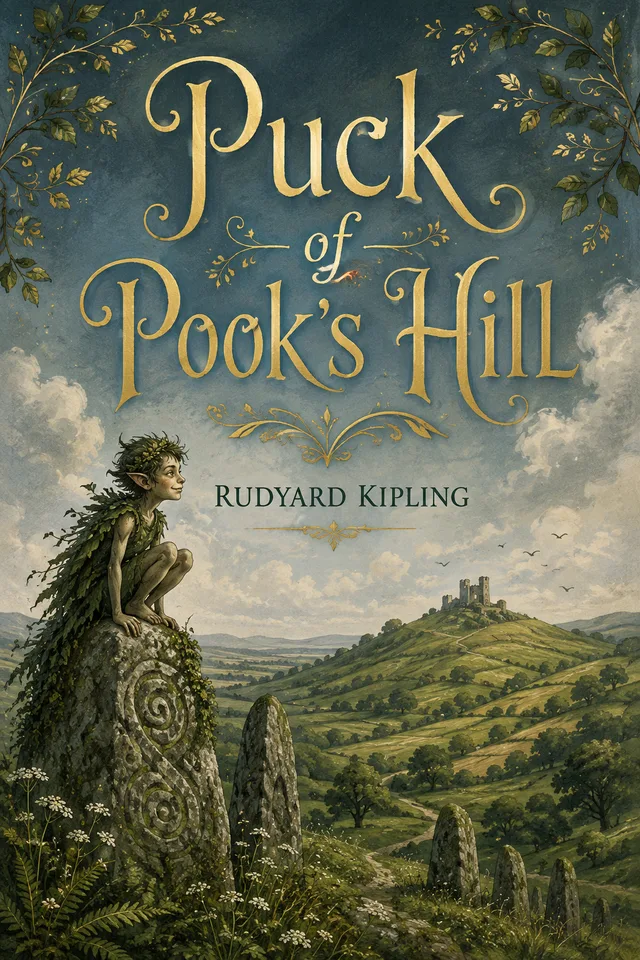
Puck of Pook’s Hill
English BooksWhale Edition by Rudyard Kipling
A sequence of historical tales where English history, folklore, childhood, landscape, and memory meet.
- Preview
- A sample from the prepared text
- Formats
- Online reader, EPUB, PDF
- Access
- Library claim
Book introduction
Puck of Pook’s Hill
Puck of Pook’s Hill brings two children into contact with figures from England’s past through the mischievous Puck. Kipling links Roman Britain, Saxons, Normans, manor life, folklore, poetry, and national memory in a popular classic for young and adult readers.
BooksWhale edition
How this edition was prepared
This edition is based on a public domain text and has been prepared for digital reading by BooksWhale.
Public domain basis
Why this edition can be shared
Rudyard Kipling died in 1936, and Puck of Pook’s Hill was first published in 1906. These dates support the public-domain basis for the original English text used in this edition.
Read preview
A sample from the prepared text
Preview selected from the prepared reader text.
Preview chapterPart 1Read preview
Puck of Pook’s Hill
Rudyard Kipling
PUCK OF POOK'S HILL
by
RUDYARD KIPLING
She is not any common Earth, Water or Wood or Air, But Merlin's Isle of Gramarye, Where you and I will fare.
The children were at the Theatre, acting to Three Cows as much as they could remember of Midsummer Night's Dream. Their father had made them a small play out of the big Shakespeare one, and they had rehearsed it with him and with their mother till they could say it by heart. They began when Nick Bottom the weaver comes out of the bushes with a donkey's head on his shoulders, and finds Titania, Queen of the Fairies, asleep. Then they skipped to the part where Bottom asks three little fairies to scratch his head and bring him honey, and they ended where he falls asleep in Titania's arms. Dan was Puck and Nick Bottom, as well as all three Fairies. He wore a pointy-cloth cap for Puck, and a paper donkey's head out of a Christmas cracker--but it tore if you were not careful--for Bottom. Una was Titania, with a wreath of columbines and a foxglove wand.
The Theatre lay in a meadow called the Long Slip. A little mill-stream, carrying water to a mill two or three fields away, bent round one corner of it, and in the middle of the bend lay a large old Fairy Ring of darkened grass, which was the stage. The millstream banks, overgrown with willow, hazel, and guelder-rose, made convenient places to wait in till your turn came; and a grown-up who had seen it said that Shakespeare himself could not have imagined a more suitable setting for his play. They were not, of course, allowed to act on Midsummer Night itself, but they went down after tea on Midsummer Eve, when the shadows were growing, and they took their supper--hard-boiled eggs, Bath Oliver biscuits, and salt in an envelope--with them. Three Cows had been milked and were grazing steadily with a tearing noise that one could hear all down the meadow; and the noise of the Mill at work sounded like bare feet running on hard ground. A cuckoo sat on a gate-post singing his broken June tune, 'cuckoo-cuck', while a busy kingfisher crossed from the mill-stream, to the brook which ran on the other side of the meadow. Everything else was a sort of thick, sleepy stillness smelling of meadow-sweet and dry grass.
Their play went beautifully. Dan remembered all his parts--Puck, Bottom, and the three Fairies--and Una never forgot a word of Titania--not even the difficult piece where she tells the Fairies how to feed Bottom with 'apricocks, green figs, and dewberries', and all the lines end in 'ies'. They were both so pleased that they acted it three times over from beginning to end before they sat down in the unthistly centre of the Ring to eat eggs and Bath Olivers. This was when they heard a whistle among the alders on the bank, and they jumped.
The bushes parted. In the very spot where Dan had stood as Puck they saw a small, brown, broad-shouldered, pointy-eared person with a snub nose, slanting blue eyes, and a grin that ran right across his freckled face. He shaded his forehead as though he were watching Quince, Snout, Bottom, and the others rehearsing Pyramus and Thisbe, and, in a voice as deep as Three Cows asking to be milked, he began:
'What hempen homespuns have we swaggering here, So near the cradle of the fairy Queen?'
He stopped, hollowed one hand round his ear, and, with a wicked twinkle in his eye, went on:
'What, a play toward? I'll be an auditor; An actor, too, perhaps, if I see cause.'
The children looked and gasped. The small thing--he was no taller than Dan's shoulder--stepped quietly into the Ring.
Preview chapterPart 2Preview
'Tell us about it,' said Dan. 'I think I like hearing of Old Things.'
They rearranged themselves comfortably, each chewing a grass stem. Puck propped himself on one strong arm and went on:
'Let's think! I met Weland first on a November afternoon in a sleet storm, on Pevensey Level.'
'Pevensey? Over the hill, you mean?' Dan pointed south.
'Yes; but it was all marsh in those days, right up to Horsebridge and Hydeneye. I was on Beacon Hill--they called it Brunanburgh then--when I saw the pale flame that burning thatch makes, and I went down to look. Some pirates--I think they must have been Peor's men--were burning a village on the Levels, and Weland's image--a big, black wooden thing with amber beads round his neck--lay in the bows of a black thirty-two-oar galley that they had just beached. Bitter cold it was! There were icicles hanging from her deck and the oars were glazed over with ice, and there was ice on Weland's lips. When he saw me he began a long chant in his own tongue, telling me how he was going to rule England, and how I should smell the smoke of his altars from Lincolnshire to the Isle of Wight. I didn't care! I'd seen too many Gods charging into Old England to be upset about it. I let him sing himself out while his men were burning the village, and then I said (I don't know what put it into my head), "Smith of the Gods," I said, "the time comes when I shall meet you plying your trade for hire by the wayside."'
'What did Weland say?' said Una. 'Was he angry?'
'He called me names and rolled his eyes, and I went away to wake up the people inland. But the pirates conquered the country, and for centuries Weland was a most important God. He had temples everywhere--from Lincolnshire to the Isle of Wight, as he said--and his sacrifices were simply scandalous. To do him justice, he preferred horses to men; but men or horses, I knew that presently he'd have to come down in the world--like the other Old Things. I gave him lots of time--I gave him about a thousand years--and at the end of 'em I went into one of his temples near Andover to see how he prospered. There was his altar, and there was his image, and there were his priests, and there were the congregation, and everybody seemed quite happy, except Weland and the priests. In the old days the congregation were unhappy until the priests had chosen their sacrifices; and so would you have been. When the service began a priest rushed out, dragged a man up to the altar, pretended to hit him on the head with a little gilt axe, and the man fell down and pretended to die. Then everybody shouted: "A sacrifice to Weland! A sacrifice to Weland!"'
'And the man wasn't really dead?' said Una.
'Not a bit. All as much pretence as a dolls' tea-party. Then they brought out a splendid white horse, and the priest cut some hair from its mane and tail and burned it on the altar, shouting, "A sacrifice!" That counted the same as if a man and a horse had been killed. I saw poor Weland's face through the smoke, and I couldn't help laughing. He looked so disgusted and so hungry, and all he had to satisfy himself was a horrid smell of burning hair. Just a dolls' tea-party!
'I judged it better not to say anything then ('twouldn't have been fair), and the next time I came to Andover, a few hundred years later, Weland and his temple were gone, and there was a Christian bishop in a church there. None of the People of the Hills could tell me anything about him, and I supposed that he had left England.' Puck turned, lay on his other elbow, and thought for a long time.
Preview chapterPart 3Preview
Ellum she hateth mankind, and waiteth Till every gust be laid, To drop a limb on the head of him That anyway trusts her shade: But whether a lad be sober or sad, Or mellow with ale from the horn, He will take no wrong when he lieth along 'Neath Oak and Ash and Thorn!
Oh, do not tell the Priest our plight, Or he would call it a sin; But--we have been out in the woods all night, A-conjuring Summer in! And we bring you news by word of mouth-- Good news for cattle and corn-- Now is the Sun come up from the South, With Oak and Ash and Thorn!
Sing Oak and Ash and Thorn, good Sirs (All of a Midsummer morn)! England shall bide till Judgement Tide, By Oak and Ash and Thorn!
YOUNG MEN AT THE MANOR
They were fishing, a few days later, in the bed of the brook that for centuries had cut deep into the soft valley soil. The trees closing overhead made long tunnels through which the sunshine worked in blobs and patches. Down in the tunnels were bars of sand and gravel, old roots and trunks covered with moss or painted red by the irony water; foxgloves growing lean and pale towards the light; clumps of fern and thirsty shy flowers who could not live away from moisture and shade. In the pools you could see the wave thrown up by the trouts as they charged hither and yon, and the pools were joined to each other--except in flood-time, when all was one brown rush--by sheets of thin broken water that poured themselves chuckling round the darkness of the next bend.
This was one of the children's most secret hunting-grounds, and their particular friend, old Hobden the hedger, had shown them how to use it. Except for the click of a rod hitting a low willow, or a switch and tussle among the young ash leaves as a line hung up for the minute, nobody in the hot pasture could have guessed what game was going on among the trouts below the banks.
'We've got half a dozen,' said Dan, after a warm, wet hour. 'I vote we go up to Stone Bay and try Long Pool.'
Una nodded--most of her talk was by nods--and they crept from the gloom of the tunnels towards the tiny weir that turns the brook into the mill-stream. Here the banks are low and bare, and the glare of the afternoon sun on the Long Pool below the weir makes your eyes ache.
When they were in the open they nearly fell down with astonishment. A huge grey horse, whose tail-hairs crinkled the glassy water, was drinking in the pool, and the ripples about his muzzle flashed like melted gold. On his back sat an old, white-haired man dressed in a loose glimmery gown of chain-mail. He was bare-headed, and a nut-shaped iron helmet hung at his saddle-bow. His reins were of red leather five or six inches deep, scalloped at the edges, and his high padded saddle with its red girths was held fore and aft by a red leather breastband and crupper.
'Look!' said Una, as though Dan were not staring his very eyes out. 'It's like the picture in your room--"Sir Isumbras at the Ford".'
The rider turned towards them, and his thin, long face was just as sweet and gentle as that of the knight who carries the children in that picture.
'They should be here now, Sir Richard,' said Puck's deep voice among the willow-herb.
'They are here,' the knight said, and he smiled at Dan with the string of trouts in his hand. 'There seems no great change in boys since mine fished this water.'
'If your horse has drunk, we shall be more at ease in the Ring,' said Puck; and he nodded to the children as though he had never magicked away their memories a week before.
Table of contents
Inside this edition
- 01Part 1
- 02Part 2
- 03Part 3
- 04Part 4
- 05Part 5
- 06Part 6
- 07Part 7
- 08Part 8
- 09Part 9
- 10Part 10
- 11Part 11
- 12Part 12
- 13Part 13
- 14Part 14
- 15Part 15
- 16Part 16
- 17Part 17
- 18Part 18
- 19Part 19
- 20Part 20
Language availability
Other languages
Additional language editions are not published yet. This section will link to other BooksWhale editions when they become available.
Request another language